

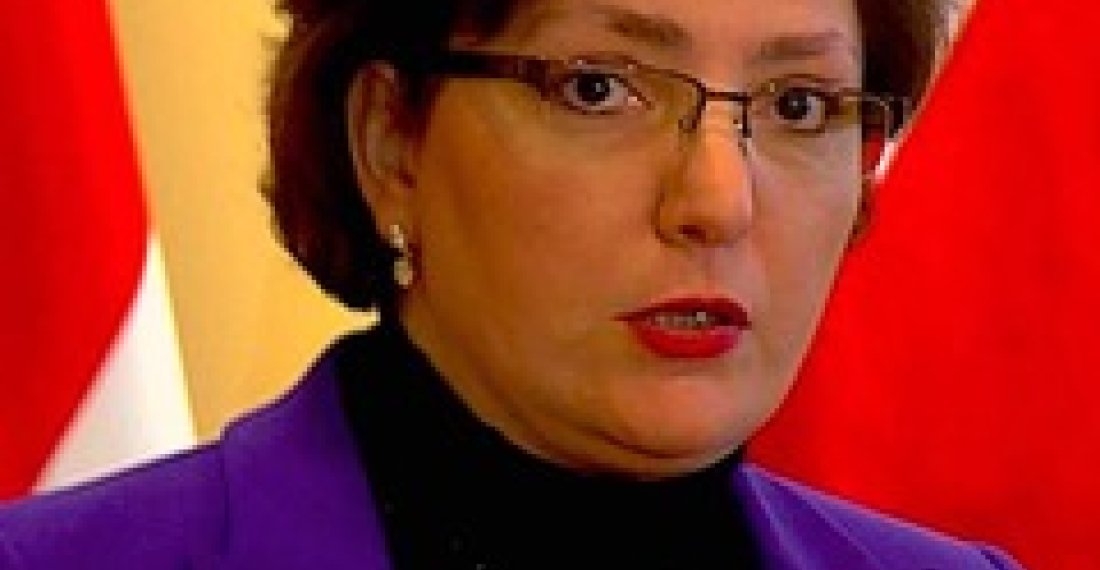
Georgia has spent the past few years moving in a direction few expected a decade ago. Following disputed parliamentary elections in October 2024 and the government’s decision to suspend the country’s EU accession process, opposition leaders have been jailed, with civil society groups now operating in an increasingly narrow space, and a country that once looked like the South Caucasus’s closest candidate for European integration is now drifting farther away from that path.
Only a few people have been in such a position to see Georgia’s reality transform as Tinatin Khidasheli. A human rights lawyer by training, she served on the Tbilisi city council and in parliament before becoming Georgia’s first female Defence Minister in 2015. Since leaving the government, she has chaired Civic IDEA, a Georgian think tank whose research has focused on Chinese influence in the country and the wider region. In this conversation, she reflects on her path from human rights law into politics, the moment she concluded the Georgian Dream coalition was heading in the wrong direction, what it means to keep working in Georgia today, and what she believes it will take to bring the country back to its European trajectory.
Read the full interview below:
Welcome, Tinatin. To start, you trained as a lawyer, then worked in human rights and electoral monitoring before entering politics. You eventually joined the Republican Party and later became Georgia's first-ever female Defence Minister. Could you take us back: what pulled you from human rights law into party politics, and how did that early grounding in civil society shape the kind of politician you have become?
Well, I spent most of my time at university studying law. I earned bachelor's and master's degrees in Constitutional Law and International Human Rights Law. I then worked for 15 years as a human rights lawyer, representing people who had been tortured and abused by the police. We handled many cases involving freedom of religion, inequality, freedom of speech, and freedom of information. So I was working on very fundamental human rights issues.
In the 2000s, a major movement began in Georgia, led by human rights groups, anti-corruption groups, and political parties. The idea was much the same, whether the effort was led by a political party or an NGO: we were fighting corruption, police brutality, abuse, and massive human rights violations. The movement led to the Rose Revolution, in which we all played a significant role. I was part of the Young Lawyers Association and one of the litigators who provided the legal basis for the Revolution.
Then comes a moment when you feel a huge sense of responsibility: you’ve played a major role and contributed a lot, but things aren’t going right. Despite the Rose Revolution and everything we hoped and fought for, we eventually realized that we were losing the ideas behind it. And, yeah, I could have stayed in NGOs in that comfortable position, criticizing everything and everybody and offering an expert opinion on everything. But I could also have taken responsibility.
I chose the second option and joined a political party that was part of the Rose Revolution Coalition. But the coalition split immediately after President Saakashvili introduced constitutional amendments that basically made him a king and gave him all the power. That was the beginning of a new chapter in my political life. First, I was elected to the city council, then to parliament, and then became a minister.
So, going back to the end of your political stint, the Republican Party was previously a part of the Georgian Dream coalition; however in 2016, the coalition dissolved and you left the government. Later in 2025 you were telling a press briefing that future historians would mark 22 May of that year (2025) as the day dictatorship began in Georgia. That's quite the transition, from governing alongside Georgian Dream to becoming one of its sharpest critics. Hence my question is: what was the moment that made this transition occur, and was it a single instance that changed your mind, or a gradual turn of events?
Well, the change was gradual, of course. But if we take the major disagreements as our starting point, the coalition began to truly change over the same issue that had caused problems with the previous government: the judiciary.
One day, a picture was published showing a meeting between then-chairman of the Georgian Dream Party, Mr. Ivanishvili, and a judge from an appellate court. Under normal circumstances, someone might ask, “Well, what difference does it make if you just met one judge?” But the truth is, this man is at the heart of everything that is wrong with the Georgian judiciary. He symbolizes the clan system, nepotism, injustice, and the close-knit circle shaped by political influence. He is a symbol of all of that. And so that picture changed everything—not necessarily in practical terms, but symbolically, especially given that the meeting had taken place without the coalition partners’ knowledge. A couple of days later, his candidacy was brought before parliament for approval as a life-term judge, which we were obviously and absolutely against. In a sense, this was the beginning of the end. It became very clear that, despite all the rhetoric and promises, the Georgian Dream party was moving in a direction based on the belief that whoever controls the judiciary controls the country. The judiciary was being used as an instrument of political control, with one basic goal: to threaten, frighten, and terrorize people, enabling manipulation of every kind of freedom imaginable.
So that was the starting point, the first major moment when things really went wrong. Other events followed, some more important than others, but together they brought us to the point of dissolution. We had a duty to complete. But it became clear to everyone that was it, and in 2016, we were no longer running together.
Today, you operate in Georgia where opposition leaders have been jailed, with civil society groups describing the space for government dissent as narrowing quickly. What does doing your work actually look like day-to-day in that environment, and has the personal risk changed how you operate, or how you're willing to act publicly?
For me, not much has changed. I mean, I’ve made peace with it to some extent. I believe you should only worry about what you can control. Some things happen outside your control and your decisions, and you have no influence over them or ability to change them. If fear dictates your actions, you end up censoring yourself, which can become a problem if you’re an activist or a democracy fighter. Of course, as long as there are things I can control, I try to take every precaution. But when it comes to predicting what the government will do or how it will act, well, it will do whatever it wants.
So if they want to punish you, they have all the institutional tools to do it. The system is now built around that. So either you let the system make you obsessed with it, self-censor, and basically do nothing, or you do what you feel is important. You follow your principles and ideas, and take all the necessary precautions you can. The rest will be what it will be; it’s beyond your control. But that's just my personal understanding. If we look at the country as a whole, then, as expected, all sorts of developments have taken place over the last three years. Lots of NGOs decided to shut down: they closed their offices and stopped doing what they had been doing, at least for a while. Some NGOs are still active, but within a very limited space, focusing on a limited range of issues rather than the diversity of issues they worked on before. Others continue to do exactly the same work as before.
It's easier for certain think tanks, like the one I chair, because, first, they're small in terms of the number of people they employ. Second, the work is intellectual, right? The government cannot regulate my intellectual work. I can simply stay home and do what I do. All I need is the internet to share my analysis or expertise with the rest of the population. That's it. As long as the internet is free, I and my organization can continue operating. But ordinary activist organizations face many more challenges because their activities require outreach and communication with people. They also have to spend money on gas, accommodation when traveling around the country, and renting facilities. That's very complicated. As long as I have a salary from a job separate from my Georgian civic activism that supports me and my family, I can keep doing exactly what I've been doing. I can continue researching Chinese influence operations and conducting open-source research on connections between Georgia and Iran, whatever. I mean, there are a couple of criminal cases against me, and the security forces interrogated me. So what? That's fine. It's okay. That's part of life. Once you make peace with that, it doesn't really bother you. And, I mean, all my life it proves true every time.
I've always believed that I'm strong and smart enough to stay at least one step ahead of others. I'm confident in what I do, and I love my country. I've worked for it throughout my adult life, even since my teenage years. Nobody—nobody—is going to change that. It's too late. If you've been doing something for 35 years, it's too late. Nobody is going to influence my ideas or my lifestyle.
Now, going to your think tank, Civic IDEA, has carved out a fairly distinctive niche; most Georgian civil society attention goes toward Russia, but your think tank focuses particularly on Chinese influence and investment in Georgia. What made you want to focus on that particular blind spot, and what is the reality of how Chinese influence operates as contrasted with Russian influence in the region?
Well, exactly. That blind spot was why, in 2017, after I left the Ministry of Defense, I sat down with my team to consider our next move and how we could best serve our country’s interests. We decided to continue the work we had done at the Ministry of Defense—minus dealing with the military, of course—but on a scale suited to our capacity and opportunities outside government. We would view every project we undertook through the lens of national security. After carefully reviewing what was being done in the country, we found many organizations focused on Russia, Turkey, and other parts of the world, but literally nobody was working on China. When we decided to focus on the PRC and published our first reports, people were genuinely surprised and asked why it mattered.
Our thinking was simple: the PRC and its actions in Georgia and the region were by far the most important things to watch and monitor in the years ahead. They already mattered, but China was poised to become the biggest game-changer. If we weren’t prepared, it would hit us hard. And yeah, I'm happy that after eight years, awareness has grown considerably. More people are interested, especially in the media. Now there's huge interest.
When we first talked about corrosive capital or economic coercion, people would ask, “What are you talking about? What does it even mean?” Now, nobody asks those questions anymore. So I'm really, really happy we made that decision in 2017. It all started here in Prague, where I am now. In 2017, I was a fellow at CEVRO Institute and met lots of people while conducting interviews for my research. At one point, I discovered that the same Chinese company was operating in the Czech Republic and Georgia, involved in major real estate issues. I started researching, and that’s how it all began. I found that CEFC, the company’s name, was using the same blueprint in Georgia as in the Czech Republic. It quickly became clear that behind all the propaganda, we were dealing with a standard case of corruption and abuse of power. Over the past eight years, we’ve done a lot of useful work, and it will become even more useful as the political climate changes.
Currently, one may describe Georgia's story right now as standing in contrast to what's happening elsewhere in the South Caucasus: Armenia and Azerbaijan are relatively edging toward peace, while Georgia moves further from the EU accession path it once seemed increasingly close to. How do you make sense of that divergence, and what do you think it will actually take to put Georgia back on a different trajectory?
The only way for Georgia to get back on track is through a change of government. This government has exhausted every resource, possibility, and opportunity to regain people’s trust. Even if tomorrow, they reversed course and made all the grand statements about how much they want to join the Union, the divisions are now so deep that it would not work. Our only chance is a new government: free and fair elections, a peaceful transfer of power, and then a new administration. I don’t think that would be especially difficult, because what we have seen in recent years proves that people's attitudes haven't changed, regardless of what the government does or how it behaves. Every poll continues to show that a huge majority of Georgians support membership in the European Union and NATO, and the reforms required by that agenda.
We have become a country where the government has managed to dominate the entire political agenda to an extent far beyond what governments normally do. That is where you get into authoritarianism, right? When representatives no longer represent voters but instead represent just one man. In our case, that man is the oligarch Ivanishvili. Whatever his desires, and whatever political or philosophical positions he holds, that is what people's so-called representatives reflect, not the views of voters and the people. So, a huge gap exists between voters and their representatives. Georgia is probably one of the classic examples today of a country where all kinds of wrongs are done in the name of the people, while the people themselves are completely absent from the discourse.
So, to answer your question directly, I don't think it will be difficult, at least on our side, because we know what needs to be done. We’ve done it before, at least in terms of reforms and legislation. The 2012-16 parliament worked extensively on the reform agenda for integration with the European Union. That is why we secured the Association Agreement, the DCFTA, and visa-free travel; everything happened quickly, over a short period, because we were strongly committed to reform. Now we need to do it all over again and reverse the damage. But there is one essential condition: we need a change of government.
To close, is there something about Georgia, or about your own work, that you think outside observers consistently misunderstand or overlook, something you'd want our readers to walk away seeing differently?
I think what’s important, as I briefly mentioned earlier, is that the government acts “in the name of the people.” We became a republic where the idea of “we the people” no longer exists. Unfortunately, we are no longer a democratic republic, and that's what we need to return to: a “we the people” republic. Without direct democracy, accountability, and oversight, we risk ending up in an authoritarian dictatorship.
Georgians often say, “Oh, it's Georgia—you know, a Belarusian dictatorship won’t happen here.” I always challenge that: Why? What, objectively speaking, makes you believe that? If we don't start asking questions and holding these people accountable for their actions, that's where we’ll end up. This power belongs to us, the people; we need to claim it and eventually take it back. Otherwise, nothing positive will happen. People need to believe in their power. That’s the problem, and I don't think Georgia is alone in facing it. Much larger countries and democracies are dealing with the same problem today.
Source: Santiago Ferbel-Azcarate interviewed Tinatin Khidasheli for the Thursday Interview feature, on commonspace.eu
Enjoyed this interview? Thursday Interview has featured a wide range of voices from across Europe, the Caucasus and Central Asia, and beyond. You can read them here:
1 October - Dr. Farid Shafiyev read the interview here
24 September - Benyamin Poghosyan read the interview here
11 June - Satu Koivu read the interview here
4 June - Amanda Paul read the interview here
28 May - Régis Genté read the interview here
21 May - Stephen Gethins MSP read the interview here
14 May - Nigel Ellway read the interview here
7 May - Mehman Aliyev read the interview here
30 April - Dr. Andrzej Klimczyk read the interview here
23 April - Dimitar Borumov read the interview here
19 March - Brian Mefford read the interview here
12 March - Dr. Jamie Shea read the interview here
5 March - Fidan Namazova read the interview here
27 February - Dr. Anar Valiyev read the interview here
19 February - Ambassador Akan Rakhmetullin read the interview here
12 February - Johnny Melikyan read the interview here
5 February - Dr. Sarah Njeri read the interview here
29 January - Mykhailyna Skoryk-Shkarivska read the interview here
22 January - Dr. Stepan Grigoryan read the interview here
15 January - Murad Muradov read the interview here