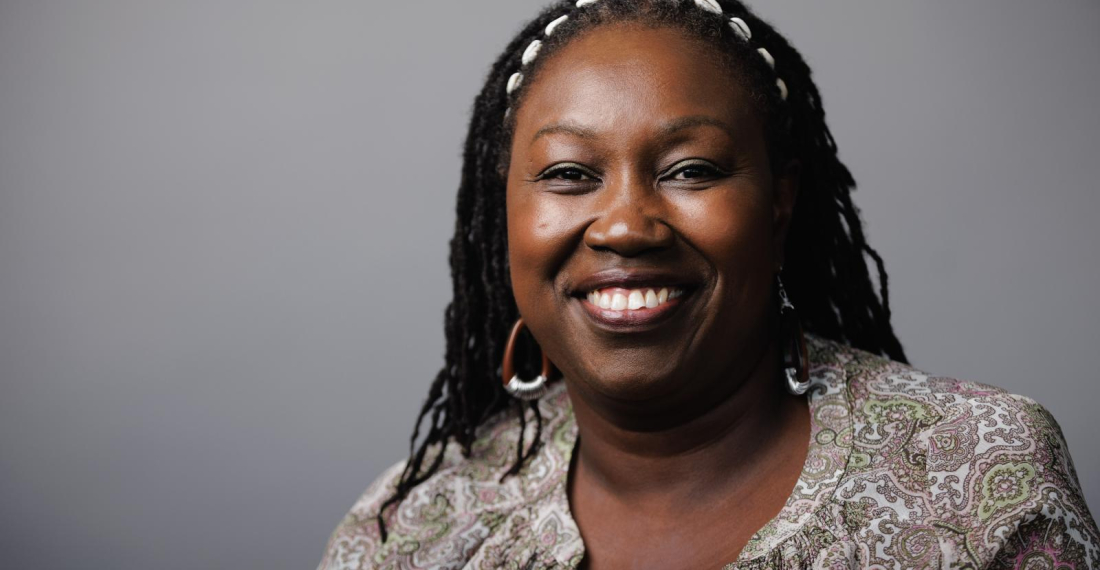
Dr. Njeri is a peace and conflict scholar and mine action activist whose work sits at the intersection of humanitarian practice, critical theory, and policy reform. In closing off a successful first month of commonspace.eu’s Thursday Interview series, she reflects on how lived experience in humanitarian action has shaped her scholarship, how hierarchies within knowledge production shape peace-building practice, and what mine action, the work of clearing landmines and other Explosive Remnants of War (ERW), reveals about power and politics on the ground.
Dr. Njeri was instrumental in the success of LINKS Europe’s Bonn Contact Group on Climate, Peace and Security, where she co-authored a report on the nexus between climate change and land contamination and degradation resulting from the remnants of armed conflict. Read “Land degradation: The ‘double exposure’ of ERW contamination and climate change” by Dr. Sarah Njeri and Dr. Christina Greene.
“Across contexts like Somaliland, Iraq, Ukraine, and the South Caucasus, the core barriers to translating evidence into mine action policy are less about ‘missing data’ and more about politics, incentives, and entrenched governance structures”.
Read the full conversation below:
Dr. Njeri, your professional journey spans humanitarian work across conflict-affected regions, advocacy work, and academic leadership at institutions such as SOAS and King’s College London. How did your early career in humanitarian practice influence the questions you ask today as a scholar, and the ways you challenge dominant approaches within academia?
Early work in programmes and advocacy made me suspicious of neat theories and generic “models”, so most of my scholarship starts from the messy realities of how interventions land in specific places and lives. It also pushed me to treat communities and practitioners in Somaliland, Kenya, or Angola not as “data sources” but as producers of situated knowledge who should unsettle how humanitarianism and peace-building are taught and researched.
From programmes to research questions
On the ground, I saw how mine action, peace-building, and development projects bump up against politics, history, and everyday survival strategies in ways that policy documents rarely acknowledge. That experience is why my research questions are often: “How is this policy actually implemented here, by whom, with what trade-offs?” rather than “Does liberal peace-building work?”. My work on humanitarian mine action in Somaliland, for example, asked what happens when standardised clearance logics meet non-recognised states, clan politics, and limited resources, instead of assuming failure or success in the abstract. In that sense, practice taught me to look at implementation modalities, not just headline paradigms, and to resist sweeping judgments about intervention “failure” that erase local nuance.
Challenging dominant framings in academia
Coming from practice into universities like King’s and SOAS, I was struck by how certain topics (e.g. technological aspects of clearance, military perspectives) are centred, while others (lived experience of contamination, environmental impacts, peripheral contexts like Somaliland) are marginal. My scholarship pushes back by insisting that mine action, environmental peace-building, and humanitarian disarmament belong in critical development and peace studies, not only in engineering or security studies silos. That means asking whose problems we prioritise, whose expertise is cited, and how funding and institutional incentives shape what counts as “rigorous” knowledge in this field.
Centring marginalised and Global South voices
Years of working as local and national staff, and being from communities that are researched or intervened in, made it impossible for me to accept that Northern institutions should remain the unquestioned centre of theory-making. This is why I have embedded advocacy for early-career and Global South scholars into my research agenda, including British Academy-funded initiatives on making marginalised researchers more visible in peace and conflict studies. In the classroom and in collaborations, I try to design projects, syllabi, and writing workshops that shift citation habits, authorship practices, and research agendas towards those who have long been treated as “case studies” rather than colleagues.
Working at the policy–practice–research intersection
Finally, having moved between NGOs, research institutes like ODI’s Humanitarian Policy Group, and universities means I am always asking how scholarship travels back into practice and policy. I am interested in research that not only critiques liberal peace-building or humanitarian disarmament, but also helps practitioners rethink programme design, whether around environmental harms of explosive remnants of war or the politics of “local ownership”. That orientation leads me to collaborations with advocacy organisations and networks, such as trusteeship roles in humanitarian disarmament and environmental peace-building, where research questions are co-shaped by those working to transform policy regimes from within.
Now, I’d like to focus specifically on your work in mine action. Across regional contexts such as Africa, Ukraine, and the South Caucasus, landmines and other Explosive Remnants of War continue to have long-term impacts on civilian safety, livelihoods, the environment, and post-conflict recovery. What have you found to be the biggest barriers to translating evidence into practice and policy decision-making in mine action, and where do you see opportunities for research to more meaningfully influence mine action governance and policy?
Across contexts like Somaliland, Iraq, Ukraine, and the South Caucasus, the core barriers to translating evidence into mine action policy are less about “missing data” and more about politics, incentives, and entrenched governance structures. At the same time, targeted research opportunities exist, particularly when co-produced with national authorities and operators, to reshape how mine action is governed, financed, and evaluated, including its environmental and livelihood dimensions.
Key Barriers to Evidence Uptake
Template-driven programming and path dependence
Once a certain way of doing prioritisation, survey, or clearance is institutionalised through treaties, national standards, and donor logframes, it is very hard for new evidence (for example, on livelihood impacts or environmental harms) to dislodge those routines. Even when studies show that certain technical approaches accelerate soil erosion or affect land use, programmes often default to what is recognised by existing standards and funding mechanisms.
Fragmented governance and short funding cycles
National mine action authorities, international NGOs, commercial operators, and donors each answer to different accountability structures, which can pull against longer-term, evidence-led planning. Short grants, political pressure to “show square metres cleared”, and staff turnover leave little room to integrate more complex findings on issues like environmental risk or differentiated livelihood recovery.
Narrow metrics of success
The sector still tends to equate success with numbers of devices cleared, land released, or accidents reduced, rather than asking what forms of “everyday peace”, social repair, or ecological recovery clearance is enabling or foreclosing. This means evidence on how clearance interacts with displacement patterns, gendered access to land, or ecosystem restoration struggles to gain traction in policy debates and action plans.
Centre–periphery dynamics in knowledge production
Research from, or led by, institutions in affected countries often has less visibility in global policy fora, even when it speaks most directly to local political economies, informal land arrangements, or customary authority structures that shape mine action outcomes. This reproduces a hierarchy where “evidence” is what circulates through Northern think tanks, consultancies, or review mechanisms, rather than what national operators and communities know from practice.
Self-referential research
A further challenge is that much mine action research is self-referential. Produced from within the sector for its own actors, it tends to justify prevailing approaches rather than subjecting them to critical scrutiny of underlying assumptions, power relations, political economies, or unintended effects. This inward focus limits evidence’s disruptive potential on dominant models of practice and governance.
Rubber-stamping by national authorities
National mine action authorities are often portrayed as central decision-makers, which holds true in contexts with robust capacity and commitment. Yet in fragile settings dominated by external funding, they frequently serve mainly to rubber-stamp donor and international operator priorities, undermining true strategic ownership. Until donors provide direct, sustainable funding to local and national demining organisations, including overheads and capacity support, this international dominance and shallow national agency will endure.
Where Research Can Influence More
Studying implementation and “peaceability” rather than only impact.
My work on Somaliland argues that mine action’s contribution to peace depends on how it is woven into existing reconciliation processes, local power relations, and community priorities. Similar deeply contextual studies in Ukraine or the South Caucasus could illuminate when and how mine action supports or undermines local forms of order, authority, and coexistence.
Bringing environmental evidence into governance debates
There is now a growing body of work documenting how clearance and explosive ordnance contamination affect soils, water, vegetation, and broader ecosystems. Research that links these biophysical findings to concrete policy tools, such as environmental clauses in extension requests under the Mine Ban Treaty or national standards on survey and mechanical clearance, can help shift environmental issues from “nice to have” to core compliance and risk-management questions.
Co-producing evidence with communities and local actors
True co-production extends beyond national authorities to directly involve affected communities, customary leaders, and grassroots organisations in shaping research questions, methods, and dissemination from the outset. In mine action, this means moving past extractive surveys or token consultations to sustained partnerships where locals co-design impact studies—e.g., on how contamination alters mobility, farming practices, or cultural sites—and jointly interpret findings for advocacy or programme adaptation. Principles like shared power, valuing lived experience, long-term relationship-building, and adequate resourcing (drawn from broader co-production literature) ensure communities are not just informants but co-authors whose priorities on safety, land restoration, or economic recovery directly inform policy tools like community action plans or livelihood-integrated clearance. This approach disrupts centre-periphery dynamics by legitimising situated knowledge in global fora and builds local ownership that outlasts short-term projects.
Targeting treaty and donor decision points
Mine action governance is punctuated by moments when states submit Article 5 extension requests, national strategies, or progress reports, and when donors revise aid and security strategies. Research explicitly timed and framed to inform these processes stands a better chance of shaping policy than generic “lessons learned” reports.
Elevating Global South and local scholarship
Finally, I see an important role for work that not only generates new evidence, but also changes who gets to speak in global mine action and humanitarian disarmament fora. That includes supporting researchers and practitioners from affected regions to publish, to participate in treaty meetings, and to drive comparative projects across contexts like Africa, Ukraine and the South Caucasus, so that governance reforms reflect a wider range of experiences and priorities.
As a lecturer and mentor, how do you encourage your students to actively dismantle Global North hierarchies within their own research?
As a lecturer and mentor at SOAS, I encourage students to actively dismantle Global North hierarchies in their research by embedding decolonial praxis across every stage, from question formulation to dissemination, grounded in principles like critical reflexivity, reciprocity, and elevating situated knowledges. I also challenge them to centre forgotten crises, marginal contexts, and overlooked topics, like mine action research, rather than recycling well-trodden cases that reinforce dominant narratives.
I encourage strategies that start with positionality audits, whether for essays or end-of-programme dissertations. Right from the proposal stage, students must map their own privileges, assumptions, and "outsider" lenses through reflexive journals or group critiques, asking: "Whose voice am I amplifying or silencing here?" This disrupts the default assumption of Northern researchers as neutral observers.
I challenge students to prioritise co-designing research with affected communities in future projects and, where possible, now. I highlight how proposals that include plans for genuine co-production—e.g., participatory workshops where Global South partners or communities shape research questions, rather than serving as "data sources"—can transform extractive paradigms.
I make students aware of the politics of knowledge production, so I challenge them to diversify citations and epistemologies. Students audit bibliographies to ensure that, as much as possible, these incorporate works from Global South scholars, grey literature from local NGOs, or indigenous methodologies. This helps challenge Eurocentric dominance in literature reviews. Part of my approach to teaching also prioritises accessible dissemination, rather than just chasing high-IF journals alone.
I connect those that I mentor including interested students to my networks such as the recently launched a Global South Peace and Security Studies Network, an outcome of a British Academy-funded international writing workshop grant. I also support them to join networks ECR initiatives through for example the DSA conferences and direct them to opportunities like writing groups with early-career African scholars, fostering mutual learning over extractive mentorship.
Looking ahead, how do you see mine action changing over the next decade, and what do you think needs to change for it to better serve affected communities?
Over the next decade, I hope to see mine action evolving from a primarily technical, clearance-focused endeavour toward a more integrated, holistic practice that explicitly addresses environmental remediation, livelihood restoration, and peace-building—driven by escalating contamination from recent conflicts in Ukraine, Gaza, and elsewhere, alongside climate pressures amplifying ecological risks. Technologies like drones, AI-driven detection, and remote sensing will accelerate surveys and reduce human risk, but success hinges on localisation, with donors shifting funding to national and community-led operators to break international monopolies.
I hope for technological acceleration meeting ecological focus, where innovative non-technical survey methods dominate prioritisation, freeing resources for long-term land rehabilitation—e.g., soil restoration post-clearance or biodiversity recovery in contaminated zones. Climate adaptation will become standard, with standards mandating assessments of how contamination worsens floods or droughts, as seen in many regions like the South Caucasus.
I look forward to the day localisation and national ownership gain real traction, as pressures from Grand Bargain commitments and localisation agendas push donors toward direct funding of southern or local NGOs and community deminers, reducing reliance on expatriate-led INGOs—though political will might remain the bottleneck, as observed in the humanitarian sector more broadly. National authorities in capable contexts can model hybrid governance, blending global standards with local priorities like pastoralist routes or customary land rights.
Essential Changes to Serve Communities Better
Direct, flexible donor funding to locals. The status quo of short-term, overhead-averse grants to international actors must end; donors need to channel 25-50% of budgets through national plans, with multi-year horizons and capacity support for community monitors and deminers.
Broader, integrated outcome metrics and environmental standards
Beyond "square metres released," benchmarks should incorporate social cohesion (e.g., mine action's role in reconciliation), gender-differentiated access, and environmental health indicators, influenced by growing civil society advocacy and treaty reporting requirements. Simultaneously, environmental concerns must be embedded in all programmes in the same way as gender is—made mandatory from design through monitoring, with dedicated indicators, training, and budget lines.
Prioritising urban warfare and protracted contamination. With urban warfare rising, protocols for high-rise clearance and critical infrastructure will mature, while forgotten contexts like Angola, Syria, South Sudan, the Caucasus, or Somaliland finally secure sustained financing as global attention shifts from acute crises. This requires accountability for protracted contexts through a dedicated funding facility for "legacy" contamination in places off the headlines, with metrics valuing slow recovery over rapid visibility.
Critical research and community co-production as norms
Fund independent, southern-led studies that interrogate power dynamics, not just technical efficacy, to challenge path-dependent models and elevate peripheral evidence into treaty debates. Simultaneously, treat locals not as victims or informants, but as partners in design, verification, and handover—using participatory mapping for priorities like grazing lands or sacred sites, ensuring clearance aligns with everyday needs over donor metrics.
These changes demand political courage from donors and operators to cede control, but they offer mine action a chance to become a true enabler of sustainable peace and resilience for affected communities.
Follow Dr. Njeri on LinkedIn, X, and Google Scholar
Read “Land degradation: The ‘double exposure’ of ERW contamination and climate change” by Dr. Sarah Njeri and Dr. Christina Greene