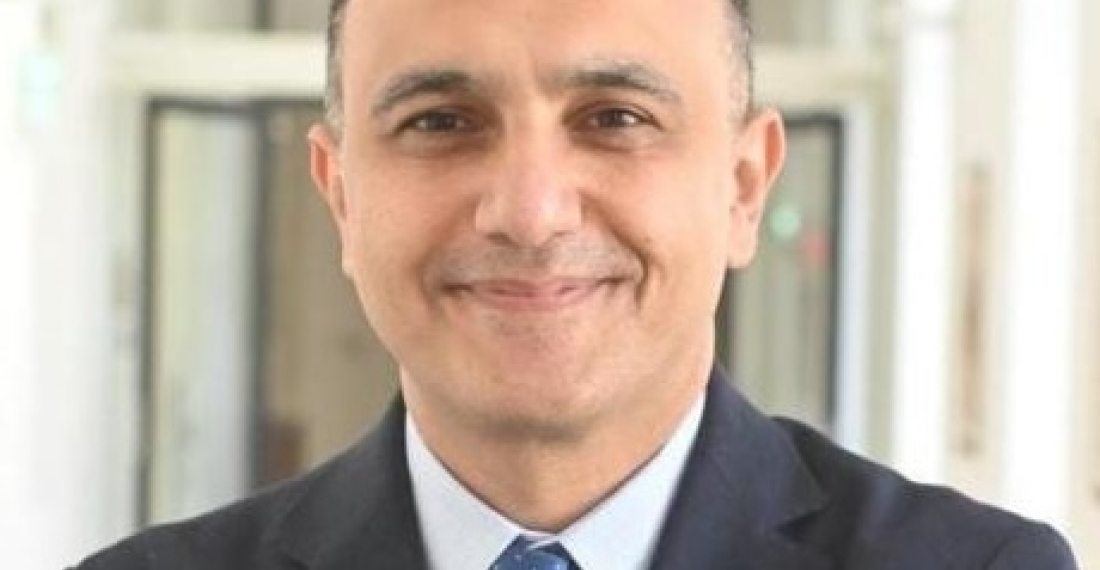
Dr. Anar Valiyev is an Associate Professor of Urban and Public Affairs at ADA University in Baku, Azerbaijan, with more than 18 years of experience in higher education. His research focuses on public policy, urban development, governance, and post-Soviet regional affairs. He holds a PhD in Urban and Public Affairs from the University of Louisville and has published widely on urbanisation, policy reform, and regional connectivity in the South Caucasus and beyond.
This week, commonspace.eu spoke with Dr. Valiyev in Brussels ahead of a roundtable jointly organised by LINKS Europe Foundation and the European Policy Centre. He is taking part in a panel discussion focusing on the Armenia–Azerbaijan peace process, its implications for both countries and the wider region, the involvement of the European Union and the United States, and the challenges that lie ahead.
In this interview, he reflects on how his research has evolved over nearly two decades in academia, examines the transformative potential of regional connectivity and trade, discusses the strategic role of energy in Azerbaijan’s foreign policy, and highlights the importance of people-to-people ties through education as a form of long-term soft power.
“At some point, oil will end. Gas will end. But education will never end.”
Read the full interview below:
Thank you for joining us, Dr. Valiyev. I’d like to start on a personal note. How did you find your way into academia, and when you compare the questions you were asking at the beginning of your career with the ones you’re asking today, what do you think has changed most in how you see Azerbaijan and the wider region?
I got into academia after graduating from the history department of Baku State University, where I completed my bachelor’s and master’s degrees. I then had the chance to go to the United States to pursue a second master’s degree in public administration, and later applied for a PhD programme. The PhD in public policy and urban studies particularly fascinated me. In 2007, I graduated from the University of Louisville in Kentucky with my PhD. Afterwards, I spent one year as a postdoctoral researcher at Masaryk University in the Czech Republic, and in 2008 I returned to Azerbaijan to join the recently established Azerbaijan Diplomatic Academy as a faculty member. Later, the Azerbaijan Diplomatic Academy became ADA University, where I have been working for the last 18 years.
I chose this career because I think it provides an opportunity to critically examine important issues. It gives you freedom—freedom of speech, freedom of discussion, and freedom of travel. Early on, people asked why I returned to Azerbaijan after living abroad for seven years. Now, people no longer ask that. Instead, they ask whether I want to go back to the United States or Europe. Before, the question was why I came back; now it is whether I want to leave again.
When I came back to Azerbaijan in 2008, the main questions I asked were: which path is Azerbaijan taking, what problems is the country facing, and how can we solve them? Today, I am more focused on what led to these problems in the first place. Before, I was thinking primarily about how to fix things. Now, I think there are enough people trying to propose solutions; the bigger challenge is understanding what the problem actually is. My research perspective has therefore shifted toward identifying root causes rather than offering solutions. Solutions can be proposed by anyone, but without understanding the root causes, they remain superficial.
At the Harvard University Davis Center panel, you suggested that if the South Caucasus were able to capture even 5–10% of the trade flows between China and the European Union, it could be transformative for the region, even likening the potential to Singapore. How do you imagine such a transition unfolding in practice, and what do you see as the main obstacles to realising that today?
Yes, I make similar points in various settings. Of course, we will not be able to capture the entirety of trade between the EU and China, as we cannot compete with maritime trade. But even a small share of that trade, if captured by the region—Azerbaijan, Georgia, Armenia, and Central Asia—would be more than enough to turn it into a transportation, financial, and logistical hub for the wider Eurasian region.
I think the main obstacle today remains the closed borders between Azerbaijan and Armenia, and between Armenia and Türkiye. I sincerely hope these borders will open in the near future. This would not only allow infrastructure to be built, but would also send a signal to the rest of the world that the region is no longer a “black box.” For the last 25 years, the region was seen as a black box because of the conflict in Karabakh, developments in Georgia, and the proximity of Iran on one side and Russia on the other. External actors considered the region a dead end. That is no longer the case. The region is becoming a space through which goods and services can flow.
I often say it would be ideal if our region became more like Singapore rather than merely a Panama Canal. The Panama Canal is primarily a passageway, whereas Singapore has become one of the world’s major centres. We should aim to become Singapore, not just a transit corridor.
In the past, you’ve argued that Azerbaijan’s energy resources have given Baku room to manoeuvre in its relations with Russia. In the current geopolitical and energy environment, do you still see energy functioning primarily as strategic leverage?
Yes. For the last 30 years, oil and gas resources have allowed Azerbaijan to use energy as a strategic hedge or form of leverage in its relations with Russia. For example, the absence of energy resources made Armenia heavily dependent on Russia, forcing it to sell strategic assets such as electricity grids and railways. By contrast, the presence of energy resources and the revenues they generated allowed Azerbaijan to avoid selling strategic infrastructure—ports, airports, electricity grids, pipelines—to Russia or other external actors. This was a major achievement for Azerbaijan.
Today, although energy production is declining, energy still serves as leverage, particularly in relations with the European Union. Azerbaijan cannot replace Russian energy supplies to Europe, but even limited volumes help to break monopolies and provide alternatives. This remains one of Azerbaijan’s strongest strategic assets.
So you believe energy will remain a major source of strategic leverage in Azerbaijan’s foreign policy?
Absolutely—especially gas, and to some extent oil. Beyond that, however, transportation routes and geography will become even more important. Azerbaijan sits at the crossroads of routes linking India to Russia and China to Europe, and vice versa. This geographic position strengthens Azerbaijan’s strategic importance.
Finally, in your recent work on education as a soft power tool, you show how long-term people-to-people ties shape political and professional networks. Compared to large-scale infrastructure and energy projects, how do you see these softer forms of influence shaping Azerbaijan’s external relations in the long run?
At present, Azerbaijan’s foreign policy is oriented primarily toward Central Asia and the European Union, largely through economic cooperation, with relatively limited emphasis on education. At some point, Azerbaijan will recognise that building closer relations with Central Asia requires going beyond economics and politics and investing in soft power, particularly education. Sending Azerbaijani students to Central Asian universities, and welcoming students from Uzbekistan and Turkmenistan, can serve as an effective soft power tool and help bring these regions closer together.
In recent years, Azerbaijan has also established universities and programmes in partnership with European countries, such as the Azerbaijan–Italian University and Azerbaijani–French programmes. There are also discussions about partnerships with universities in the United States and the United Kingdom. This would create further opportunities for exchange programmes and joint degrees with Europe, the UK, and the US. Currently, more than 80% of Azerbaijani students who study abroad go to the EU, the UK, or the United States, while around 20% go to Asian countries. At some point, oil will end. Gas will end. But education will never end. Professional ties will continue to endure.
Follow Dr. Valiyev on LinkedIn and Google Scholar