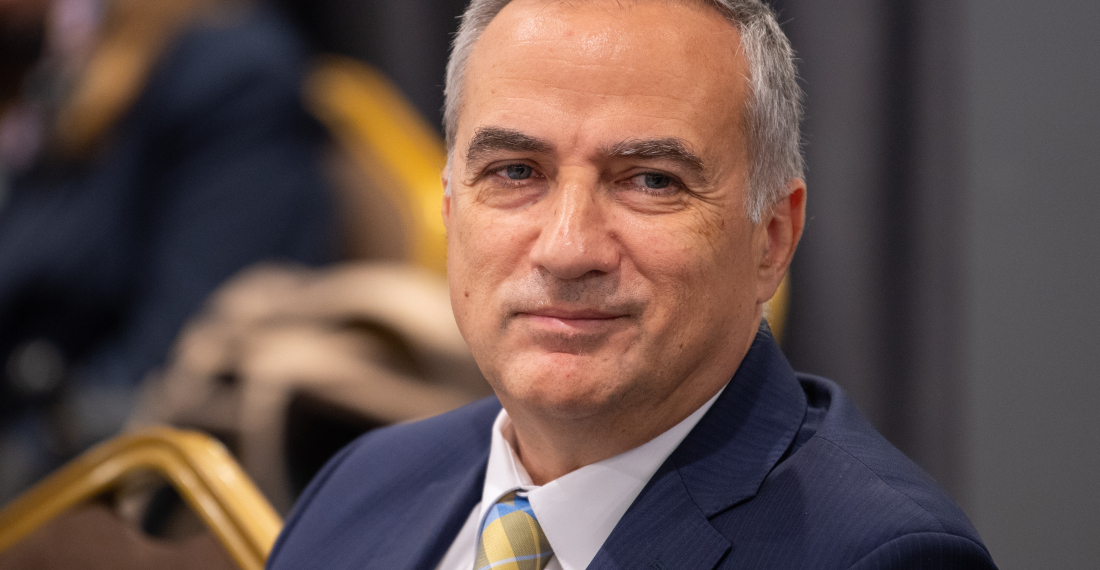
Dr Farid Shafiyev is the Chairman of the AIR Center (the Center of Analysis of International Relations and Multiculturalism), one of Azerbaijan's leading government-affiliated foreign policy think tanks. Trained as a historian and ethnographer, he began his career at Azerbaijan's Academy of Sciences before joining the Foreign Service in 1996, where he spent over two decades representing the country abroad, including as Ambassador to Canada and later the Czech Republic. He returned to Baku in 2019 to lead the Center, bringing together his academic background and his years of diplomatic experience.
In this Interview, he discusses how the AIR Center balances independent research with its ties to government, what the Center's priorities look like as Armenia and Azerbaijan move toward peace, and why he thinks Western observers often misread the region.
Read the full interview below:
Welcome, Ambassador Shafiyev. Your career began at the Academy of Sciences, in the Institute of Ethnography and Archaeology, before you moved into the Foreign Service, ambassadorships in Canada and the Czech Republic, and eventually the AIR Center. Along the way, you've also produced books, papers, and countless op-eds reaching back centuries to understand how the region got to where it is today. Has spending that much time in the long historical view changed how you personally see the region's conflicts, compared to when you were starting out, and does chairing the AIR Center at this particular moment make continuing that historical work feel urgent, or more like ongoing groundwork that just has to get done?
Thank you for this opportunity. Let me start from the end in terms of my current work in the AIR Center. Indeed, you mentioned that I began my professional career at Azerbaijan's Academy of Sciences, specifically the Institute of Ethnography and Archaeology. And my area of study was the ethnic studies, I mean, ethnic studies and the Turkic tribes. So it was more about medieval history, ancient history. And then I moved to the Foreign Service and in the Foreign Service, you deal with contemporary issues. So probably it's not a coincidence that I returned to academia after almost 23 years in Foreign Service. So now, in the AIR Center, I would say, I am between academia and foreign services. As a think tank, we're dealing with contemporary issues. So I kept my passion about history and science during my foreign service. I published some books. So this is something of a natural extension of both my academic engagement initially and the foreign service.
So regarding what we are doing right now, regarding today's perspective, the conflicts, I think indeed the fact that I studied history helps me to understand not only issues related to the South Caucasus, namely Armenia-Azerbaijani conflict or post-conflict development, but also just generally what's happening, for example, between Russia and Ukraine, around Iran. Of course international relations has its own theoretical concepts, several concepts. But I would say, in the meantime, that recent events are an extension of history. However, international relations again, is more about today's world.
Of course, the experts in international affairs study part of history, at least the recent history. And for example, it helps me when I'm dealing with the Armenia-Azerbaijan conflict to debunk the theories of ancient hatred. There was no ancient hatred in the South Caucasus. There were wars, which happened everywhere throughout human history. But we had moments of peaceful interaction between different tribes, different ethnic groups. So we are not doomed to have an eternal conflict. However, in the meantime, when you know for the last 100 years and plus, we had a conflict, we cannot just switch immediately to peace within one, two years. So you have to be patient, you have to work towards peace. And there are some international actors who try to help, but there are spoilers too.
So that's my answer. The merging of history with contemporary politics and international affairs, and this is exactly what we are doing at the AIR center. We study to a certain extent, some historical background of contemporary issues, and try to formulate the policies for the government and for the public, as well as, of course, receiving some instruction from the government, because we are a government funded think tank, so we need to also explain government policy towards certain issues.
Having spent more than two decades articulating Azerbaijan's stance abroad as a career diplomat, you, in a sense, shifted in 2019 toward crafting the strategic framework underlying those diplomatic efforts. This role carries a distinct, less prominent, yet foundational weight. What prompted your transition from ambassadorial posts to heading an academic institute, and has this work offered the profound strategic impact you anticipated?
So that's an interesting question. Let me start with sequential issues. In 2019, I finished my second term as an ambassador. I did five years in Canada and five years in the Czech Republic. So I was returning home and I was offered to take leadership of a newly organized think tank. And I thought that, you know, I always had this inclination toward, as I said, academia, and I thought that would be indeed relevant.
Of course, when you are in academia and as compared to diplomacy, you have much more flexibility because in diplomatic life you have to follow strict instructions from the headquarters. When you are in academia, you can contemplate about different issues, you get freedom of maneuvering. And I think across the world, however sometimes I hear that, oh you are in a government funded think tank, so you have limits to your flexibility. But I mean, if you are a Western think tank funded by, let's say, liberal corporations or whatever, you also have certain frameworks and you cannot change them. For example, liberal think tanks won't support conservative policy or vice versa.
So to a certain extent, we all have frameworks where we operate with given concepts. Here too, however, I found that during this very difficult and interesting time/period of history, I have had very interesting engagements with many other think tanks, experts, professors of international law, international relations across the world - from the United States to China and the Middle East and Europe. Each one has their own perspective.
Yes, I can say that we definitely live in a Western Anglosphere dominated world. But for me, it's interesting to hear perspectives from partners in the Middle East, from Central Asia, and I mean we have different points of view. Yet, this is something which enriches me and gives opportunity as well when we formulate certain concepts or policies in order to make some small contribution to the vision of our government regarding relevant issues.
You operate in close proximity to both the presidential administration and foreign ministry which affords the AIR Center considerable reach, yet foreign analysts often query whether an enterprise so tied to state leadership can maintain objective research capabilities, or if its primary role remains refining official policy. As Chairman, how do you manage this balance, and do you view this relationship as a fundamental challenge or an incorrect premise altogether?
Interesting question. Look, in Azerbaijan, the structure of the government according to a constitution, is a presidential republic. So foreign policy is formulated by the president and instructions go down to the Presidential Administration and the Ministry of Foreign Affairs. And when we receive the instruction, how to deal with certain issues. Whether it's the conflict, post-conflict, normalization, or our relationship with Central Asia, with the European Union, food security, et cetera. And so our task indeed is to explain Azerbaijan's position on these issues and explain in different formats - it can be the form of seminars, conferences, it can be policy papers. However we also have an important second purpose, it's in feedback. We have a top down process, but we also have from down up to the top. For example, embassies across the world, Azerbaijan embassies, they supply information to the Ministry of Foreign Affairs and then the Ministry of Foreign Affairs submits this information to the Presidential Administration. And we do the same. We gather, we assess, collect opinions of different experts and submit to the presidential administration. So we receive instruction, implement them, but we'll also gather information from different multiple sources to supply the government. And when the question is whether our research objective or not, because we are tied to the government. We say, look if you're giving false information, I don't know, sort of incorrect information, then it means that the government policy on certain issues, energy transport, conflict, war, et cetera, can also be prone to mistakes. So our task is to verify all this information and submit to the government correct information, or at least to try saying, okay, this is decision one, two, three, or expert opinion A, B, C. And we believe that opinion B is more reliable than opinion A and C.
So that's why, you know, saying that we just are trying to disseminate government views is not correct. Yes we do this as well and this is also an important task. To give our partners information about what Azerbaijan thinks, what are our security concerns, what are our economic concerns, etc. I know the position of some experts - they dismiss ideas by saying, you know, if it's the government funded think tank or institution, then the opinion is not valid or the research is not worth it because it's not accurate. Again, accuracy is important not only for outreach, but also for insight assessments. And again, even in the Western societies, you can see that each think tank makes an assessment based on its ideology - liberal, conservative, libertarian, et cetera.
Historically, much of the Center's output focused on supporting national perspectives during an ongoing period of regional friction. Now, should Armenia and Azerbaijan establish a lasting peaceful environment, it presents an institutional realignment for a body accustomed to that focus. What specific analytical priorities must the AIR Center set aside, and which new areas must it cultivate to drive regional cooperation moving forward, and how to flip the switch to a reality of peace?
Interesting. Definitely the major priority now is indeed peace and normalization. And we realize that we have two hurdles. First is just the legacy of the conflict. Legacy still continues, for example, landmines. People cannot safely return to certain areas because of this problem. Another is the memory, and that is indeed, applicable to both sides. And we see that the recent outbursts of the debates about the cultural heritage, et cetera. Definitely, the conflict happened on the territory of Azerbaijan. So Azerbaijan is the site which has to deal with the primary consequences of the conflict. I mentioned landmines, but there are some others like destruction. and our losses, biodiversity, et cetera.
So we have to make research on those problems, how we can deal with them, what's the international experience in Bosnia, in Cambodia, in some other places, how we deal with the landmines problem, how we deal with the memories, with grievances, But we study not for the sake of some historical research, but we need to formulate proper policy and recommendations. We, in the meantime, as you said, also have to deliver what's Azerbaijan's position on those issues. So our partners and neighbours - and it's not only about Armenia - but some of our partners in Europe, in the Middle East understand what is our problem and our concerns. But the most important thing that we also have to identify in these normalization process spoilers, those who don't want peace. So this is also an important area of study. The role of some religious institutions, the role of diaspora, the role of some countries. So there are many things which are indeed vital to know what obstacles we have. And again, we have to be realistic that there is no magic switch, that in one or two years we reach peace and reconciliation. It's a long process and we've seen that in many other parts of the world. We see that if the countries decide to have political determination to continue peace, it will indeed arrive at some point in the future.
In September, AIR Centre co-hosted with LINKS Europe in Baku an important event on the future of Azerbaijan-Europe relations. Everyone agrees that these relations are important for both sides. But things have not always worked out well. How will you contribute to better relations between Azerbaijan and Europe, and the EU in particular?
Yes, well, first of all, I would like to thank our partner, LINKS, and its director, Dennis Sammut, for this event. And we have a partnership and Mr. Sammut visited Azerbaijan for the last 30 years, continuously, so he knows the region. Yes, you're right, we had some ups and downs in the relationship between Azerbaijan and the European Union, but I think we're on the positive trajectory right now. This year, we've seen the visits of all high officials, Mr. Costa, Ms. Kallas and Von der Leyen to Azerbaijan. So we, I think, are moving towards greater cooperation. And our task is indeed to discuss with partners in Europe, with some European think tanks, what problems we have, how we can resolve them, or what opportunities we have, how we can have a profit, mutual benefits, for example, in energy. This is quite a well known area of cooperation between the EU and Azerbaijan, but there are some other promising areas like transport - the Middle corridor or, you know, agriculture, alternative energy, etc.
So these are the things we are focused on right now and we have quite a robust plan to work with some European partners in October. We are planning an event in Brussels, by the way, with the Belgium think tank. Then we also have in mind one engagement with an Italian think tank in Rome in November. And in the meantime, we received a number of think tanks from Europe. We had an event with the University of St. Gallen from Switzerland in September. We recently received a delegation from Friedrich Ebert Stiftung from Germany. So we expect soon to think tankers and some diplomats from Estonia. I can name further. So we are, I would say, quite happy with this active engagement with European partners.
Zooming back into the region, as you were touching on the middle corridor. I look at Georgia, I look at Armenia, I look at central Asia, I look at TRIPP. And so my question is are there any underlying dynamics that are involved in the South Caucasus that only you can see right now from where you're sitting?
Right now, we have the war in the north and in the south. So the Caspian region and Azerbaijan as an important bottleneck in that geography assumed a greater role in terms of the transport and communication between Europe and Asia and back from Asia to Europe. So we have to use this opportunity for the benefits of our countries, but not only in terms of transit fees, but in terms of creating jobs, creating the interaction between countries on this route. Also, I think, for example, if we look at the Trump Route for International Peace and Prosperity. It's not just a transport project, it's an important element of normalization between the states. So when countries are connected, we are better off in terms of political interaction. Definitely sometimes economic interaction or economic interdependence does not prevent conflicts and tension. For example, the United States and China with half trillion trade, they now have political problems. But yet I have to underline that when there are economic links, people think twice whether it's worth fighting rather than to trade because there are benefits of, you know, economic interaction. So I believe the Middle corridor is not only important for transport, but also as a general geopolitical project. And we have great interaction with the European Union and European partners on this idea.
Interesting. So to close, is there something about Azerbaijan or about your own work that you think outside observers consistently misunderstand or overlook? What is something you would want our readers to walk away seeing differently?
You know, I happen to study in the United States and Canada and am quite well aware of Western concepts and, you know, different liberal and conservative concepts, the neoconservatives. First, I think we have indeed some Western centric views on the world. Second, we have some Orientalist perspective on the region, which I always try to study and to fight, I would say. But in the meantime, I think what we have right now in terms of the concepts of international affairs and international relations, there's a great deal of them, from the West. So we have to not dismiss, we have to correct them, to have a better understanding.
I also mentioned that I learn from different countries, experts, I never dismiss them. For example, if they are in what would be called the third world or global South, I found a very interesting perspective from my colleagues from Latin America, from Africa, from South Asia. So this is what we need. We need diversity of opinions. Some interesting research done by small countries.
So this is what I'm trying to say. Here in our center (AIR) we sometimes face difficulty in explaining certain things which are happening in Azerbaijan or in the region. Because of just this kind of stigma we have - government funded think tanks or the think tank from this region, from this geography. I think the dialogue is very important to understand because indeed, when someone in Europe does not accept or does not interact, they have this sort of, what I would say, ideological self-confinement. This is the theory I'm working on. Then you're making the wrong conclusion. I'll just give you an example. The Russian-Ukrainian war some people dismissed as not going to happen. When it happened, Western experts said, oh, Ukraine is going to collapse in a month, but it didn't happen. Then it was a different view, oh, Russia is going to collapse in one year, it didn't happen. Why? Because indeed this ideological rigidness, conceptual rigidness, the same we have seen right now with the situation around Iran, causes a lot of misconception. The only way to overcome and come to a better conclusion is to listen to each other, especially to experts from the regions.
Source: Santiago Ferbel-Azcarate interviewed Dr Farid Shafiyev for the Thursday Interview feature, on commonspace.eu
Enjoyed this interview? Thursday Interview has featured a wide range of voices from across Europe, the Caucasus and Central Asia, and beyond. You can read them here:
24 September - Benyamin Poghosyan read the interview here
11 June - Satu Koivu read the interview here
4 June - Amanda Paul read the interview here
28 May - Régis Genté read the interview here
21 May - Stephen Gethins MSP read the interview here
14 May - Nigel Ellway read the interview here
7 May - Mehman Aliyev read the interview here
30 April - Dr. Andrzej Klimczyk read the interview here
23 April - Dimitar Borumov read the interview here
19 March - Brian Mefford read the interview here
12 March - Dr. Jamie Shea read the interview here
5 March - Fidan Namazova read the interview here
27 February - Dr. Anar Valiyev read the interview here
19 February - Ambassador Akan Rakhmetullin read the interview here
12 February - Johnny Melikyan read the interview here
5 February - Dr. Sarah Njeri read the interview here
29 January - Mykhailyna Skoryk-Shkarivska read the interview here
22 January - Dr. Stepan Grigoryan read the interview here
15 January - Murad Muradov read the interview here