Theme

Conflict and Peace

Stories related to violent conflicts, diplomatic tensions, and conflict prevention, mediation and resolution.

Editor's choice
Opinion
Opinion: The US strikes Venezuela, Consequences for Ukraine and Europe

Opinion: The US strikes Venezuela, Consequences for Ukraine and Europe

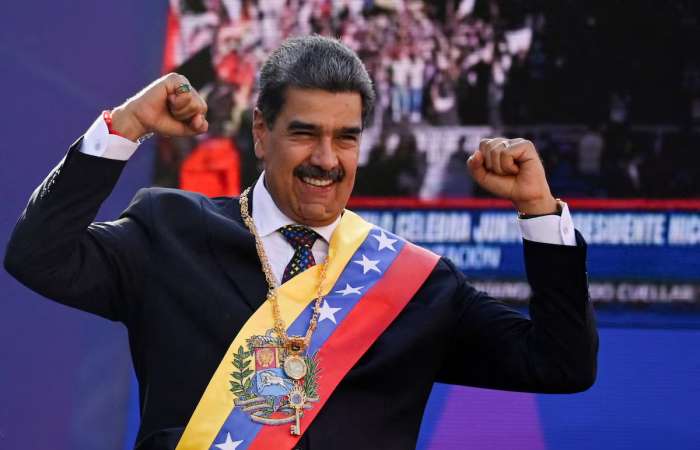
This is a Flash Analysis published on 3 January 2026 by the European Policy Centre in Brussels. Chris Kremidas-Courtney is a Senior Visiting Fellow at the European Policy Centre. As 2026 barely takes its first breath, we are already drifting back into an age where great powers manage their own neighbourhoods and look away from everyone else’s. It’s a world order that prizes control over legitimacy and stability over justice until neither one survives. The most immediate consequence of the US strike on Venezuela may be felt not in Latin America, but first in Ukraine. As foreshadowed in the Trump administration’s National Security Strategy, Washington is intent on rooting its power firmly in the Western Hemisphere while potentially leaving Russia and China greater freedom of action in their ‘backyards’. Seen through this lens, the strike on Venezuela looks more like part of a broader reversion to regional spheres of influence. The emerging message is that the United States will enforce primacy close to home but its willingness to underwrite security beyond its hemisphere is increasingly transactional and politically fragile. This is a 21st century version of the 1823 Monroe Doctrine, in which US hemispheric dominance was paired with strategic disengagement from Europe’s wars. It is also the world Putin has long argued for. It is hard to see an upside for Europe, but there may be one small silver lining. Prior to the strike, Caracas had been demonstrating how a sanctioned regime could survive and adapt by embedding itself into alternative economic and financial networks backed by China, Russia and Iran. That resilience was undermining the credibility of sanctions as a systemic tool, on which the EU relies far more heavily than the United States. By decapitating the Maduro regime, Washington has reasserted that sanctions are not an end state, but a step on an escalation ladder that can still culminate in the use of force. Yet this restoration of the credibility of sanctions comes at a great cost. It risks signalling to other revisionist or embattled regimes that force is the ultimate arbiter. All eyes are now on Moscow, since, as former US National Security Council official Fiona Hill testified in 2019, Russia had informally offered to end its support for Venezuela in exchange for US acquiescence on Ukraine.  Meanwhile, online advocates in China are calling on their regime to emulate the US and take similar steps against Taiwan. Worse still, Venezuela is now politically hollowed out. Any opposition figure who emerges now could be instantly labelled a US proxy. It is not yet clear what the thinking is in Washington about the day after, but the precedents of Iraq and Afghanistan are not encouraging. Once again, Washington has demonstrated its ability to act decisively – but also reminded us of its lack of staying power. For Ukraine, that distinction may prove fatal unless Europe can step up and support Kyiv more decisively in 2026.

Filter archive

Publication date
Editor's choice
News
Trump says US will send more weapons to Ukraine

Trump says US will send more weapons to Ukraine

On Monday evening (7 July), US President Donald Trump announced that the US will supply more weapons to Ukraine. According to Trump, recent Russian attacks on Ukrainian cities left him with little choice. “We are going to send more weapons,” Trump told reporters at the White House. “We have to. They have to be able to defend themselves. They are being hit very hard.” It is unclear what kind of weapons Trump is referring to.
Editor's choice
News
Russia fires record number of drones at Ukraine overnight

Russia fires record number of drones at Ukraine overnight

According to various Ukrainian media reports, several Ukrainian cities were hit on the night of Tuesday 8 July into Wednesday 9 July by the heaviest Russian missile and drone attack since the large-scale invasion in February 2022. The capital, Kyiv, was among the cities that came under heavy fire, according to Kyiv Independent journalists who were on the scene.
Editor's choice
News
Dozens participate in new Armenia-Azerbaijan dialogue process as societies prepare for the signing of historic peace agreement

Dozens participate in new Armenia-Azerbaijan dialogue process as societies prepare for the signing of historic peace agreement

The governments of Armenia and Azerbaijan have recently agreed the text of a historic peace agreement that ends years of animosity and warfare. The agreement is expected to be signed soon. LINKS Europe, which has a long history of engagement with the process of peace in the region, recently launched a new Armenia-Azerbaijan dialogue format in the framework of the European Union's EU4Peace initiative. In the last two weeks dozens of Armenians and Azerbaijanis, including academics, students, civil society activists, journalists and other professionals, many of them young, were involved. The work is organised in five thematic groups focusing on peace and security, connectivity, environment, governance and gender and equality and in phase 2 of the project, which has just ended, around fifty participants took part in in-person and online meetings, and more than twenty others were involved indirectly. The Chairpersons of the five thematic groups met in Vilnius, 3-6 July to launch the third phase of the program. The five thematic groups are now working on separate reports, which are expected to be finished in November and presented to the two governments and other stakeholders. The reports will outline a vision, up to 2040.
Editor's choice
Opinion
Just Peace - "The Hague Speaks for Peace: Rebalancing Security”

Just Peace - "The Hague Speaks for Peace: Rebalancing Security”

 Last week, as NATO leaders gathered in Brussels for their summit, LINKS Europe joined other civil society organisations in a public statement. The Statement was the initiative of The Hague Humanity Hub. The statement called for a balanced vision of peace and security, one that places people at its heart. At a time when the focus is increasingly drawn toward defense capabilities and military preparedness, the statement urged equal and sustained attention to and investment in the long-term work of building resilient, inclusive, and just societies. This is not an alternative to security, it is the foundation of it, the statement added.
Editor's choice
News
The Houthi rebels are shipping high-tech weapons to Somali rebels

The Houthi rebels are shipping high-tech weapons to Somali rebels

On Friday (4 July), Eurasia Review reported that Yemen’s Houthi rebels were supplying drones to Somali militant groups, raising security concerns across the Horn of Africa. Despite having different religious affiliations — Somali militant groups primarily advocate for Sunni Islamist ideology, while the Houthis back Shiism — the two groups began cooperating to expand ammunition and weaponry supply routes.
Editor's choice
Opinion
The South Caucasus is Set for Geopolitical Realignment

The South Caucasus is Set for Geopolitical Realignment

In Mackinder’s terminology, Eurasia is the heartland of geopolitics and the South Caucasus, though small in economic terms compared to the surrounding major powers, constitutes the heart of that heartland. No major power can afford to ignore or neglect it. Strategically located at the crossroads of East and West and being the only region that borders two most controversial actors of Eurasia (Russia and Iran), control over the South Caucasus equates to control over a vital part of the Eurasian continent. This is why the region’s geopolitical orientation carries immense significance, particularly amid the evolving landscape of international relations shaped by the war in Ukraine and the recent escalation of tensions between Iran and Israel in the southern neighborhood. Today, the geopolitics of the South Caucasus is in flux, and most importantly, this transition has now reached to the most important nation-state of the region: Azerbaijan.
Editor's choice
News
EU Foreign Policy Chief Kaja Kallas ends visit to Yerevan aimed at strengthening partnership with Armenia

EU Foreign Policy Chief Kaja Kallas ends visit to Yerevan aimed at strengthening partnership with Armenia

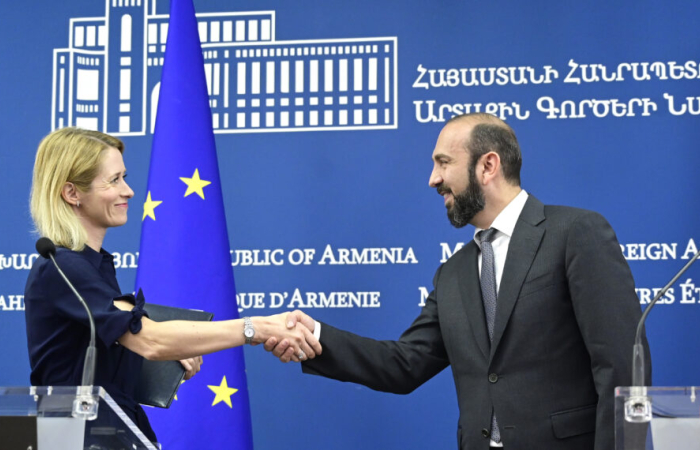
EU High Representative for Foreign Affairs and Security Policy Kaja Kallas has ended her official visit to Armenia after signing a partnership agreement with authorities in Yerevan. Following talks with Armenian Foreign Minister Ararat Mirzoyan, a joint press conference was held in which the media was briefed about an agreement outlining Armenia’s participation in the European Union’s Common Security and Defence Policy crisis management operations. According to Kallas, the document envisions Armenia’s participation in EU missions around the world.