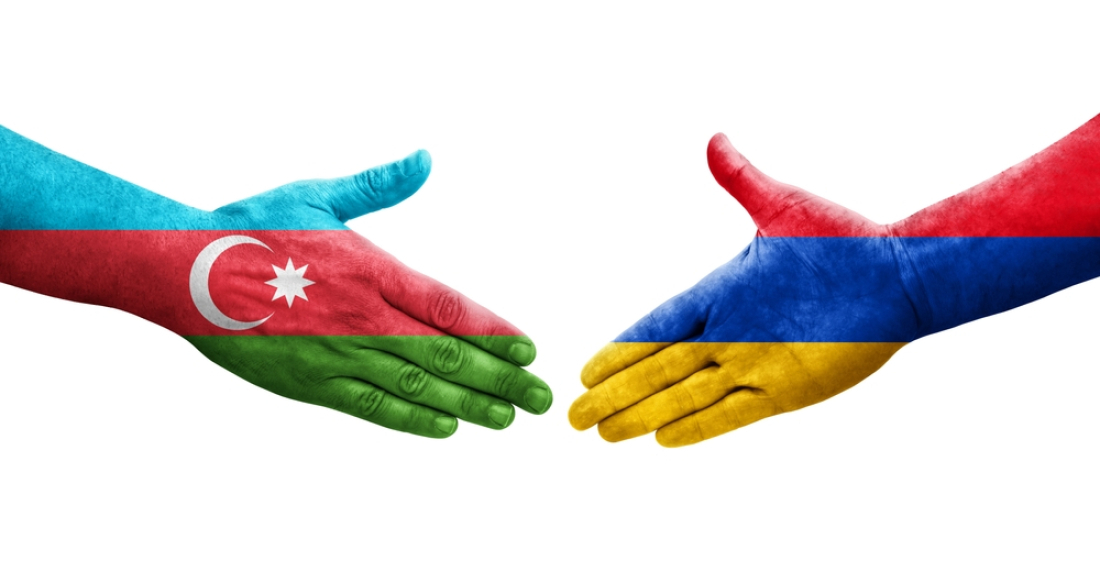
Since February 2020, it is not uncommon for the leaders of Armenia and Azerbaijan to appear on the same stage at international events – or at least at the Munich Security Conference. The same has not been true for their foreign ministers. That changed on April 12 at the Antalya Diplomacy Forum, a notable moment just weeks after the finalisation of a long-overdue treaty aimed at normalising relations between the two countries. While the road ahead remains uncertain, the meeting carried clear symbolic significance.
The elephant in the room was, of course, the Armenian constitution and specifically its preamble which references the 1990 Declaration of Independence and is interpreted by Baku, and likely Ankara too, as laying claim to territories beyond Armenia’s internationally recognised borders. The constitutional preamble is particularly controversial as it does not just mention the earlier document, but specifically stresses the “nationwide objectives enshrined” within it, arguably adding some credence to the allegations.
Armenia denies this, though the Armenian Prime Minister, Nikol Pashinyan, has gone on record warning that the declaration of independence will forever keep Armenia in conflict with Azerbaijan and Türkiye. Moreover, the constitution and declaration were also one of the reasons for the failure to normalise relations between Ankara and Yerevan. In 2010, Armenia's Constitutional Court ruled that while the ill-fated protocols to do so did not contradict the constitution, they should be interpreted and applied only in line with the referenced declaration.
That does not mean that this will be the case for any treaty between Armenia and Azerbaijan, but it does demonstrate why Baku is concerned that it could be in the future. It is anyway now the main obstacle to signing the treaty.
The reason for Yerevan’s reluctance has been domestic. Pashinyan’s desire to change the constitution is hardly new. It predates the 2020 war, and in many ways is a natural extension of his long-held vision for Armenia’s democratic transformation. In order for it to pass in a referendum, the last thing he now needs is criticism that he did so only because Baku demanded it.
But in the current geopolitical climate, it is impossible to decouple this issue from the broader Armenia-Azerbaijan peace process. While the Armenian government continues to treat constitutional reform as an internal matter, the reality is more complicated. In practice, such changes carry regional implications. They are watched closely by Baku, scrutinised by Ankara, and serve as a barometer of Yerevan’s willingness to normalise relations and move beyond the past. Acceptance by the majority of Armenians is considered central to this.
In Antalya, Armenia’s foreign minister, Ararat Mirzoyan, pointedly sidestepped a direct question from the moderator about whether the preamble would be changed, signalling either strategic ambiguity, political caution, or both. Even so, Pashinyan had already advanced the timeline for the new constitution. Initially expected by 2027, the draft must now be ready by the 2026 parliamentary elections. This move suggests urgency, some argue, perhaps in an attempt to preempt criticism from the opposition or to present it in a broader package as part of his Real Armenia concept.
This will require consensus, or at least a convincing argument that it serves the national interest, something that has not been directly forthcoming to date, though that could be changing. Since the panel in Antalya, Pashinyan has admitted that a new constitution should not reference the declaration which comes as no surprise. Nonetheless, it remains a gamble. Even if the population was to vote for a new constitution, failure to reach the minimum voter turnout for the referendum to be considered valid could call into question Yerevan’s commitment to peace through no fault of its own. Not to deliver on his 2021 election pledge to officially end the conflict could also lose Pashinyan the premiership.
That is no small feat in a deeply polarised society where the opposition weaponises any perceived concession to Azerbaijan. It is also hard to imagine that Pashinyan can avoid what is arguably inevitable. With Azerbaijan repeatedly raising the issue over the past 18 months, failure could be construed as validation of Baku’s long-standing concerns. This is also not helped by what appears to be the refusal by Armenian civil society to genuinely engage in discussion on the matter. It should be remembered that it was also against the 2007 Madrid Principles.
This is a delicate moment, and the position of some analysts in Azerbaijan is worth considering unless that opportunity has already passed. They point to the 1998 Belfast Agreement between the UK and Ireland, which necessitated constitutional changes but briefly deferred a referendum and the treaty coming into force. Such an approach could offer a way forward, allowing both sides to maintain momentum in other areas. Dialogue among policymakers is essential, but among those sometimes guiding public opinion it is also important.
Though the Antalya panel did not resolve this issue, it did at least allow both sides to present their positions, sitting together in public for the first time, albeit also alongside their Georgian counterpart. That in itself is a step forward and should not be underestimated. Panels like this must become the norm, not the exception. It can only be hoped that the opportunity for Armenian and Azerbaijani analysts to similarly engage more publicly and in person, but away from simply repeating maximalist positions or refusing to tackle the issue head on, is not missed. After all, despite all the difficulties, if officials can share a stage in an attempt to talk openly, so too should others.