


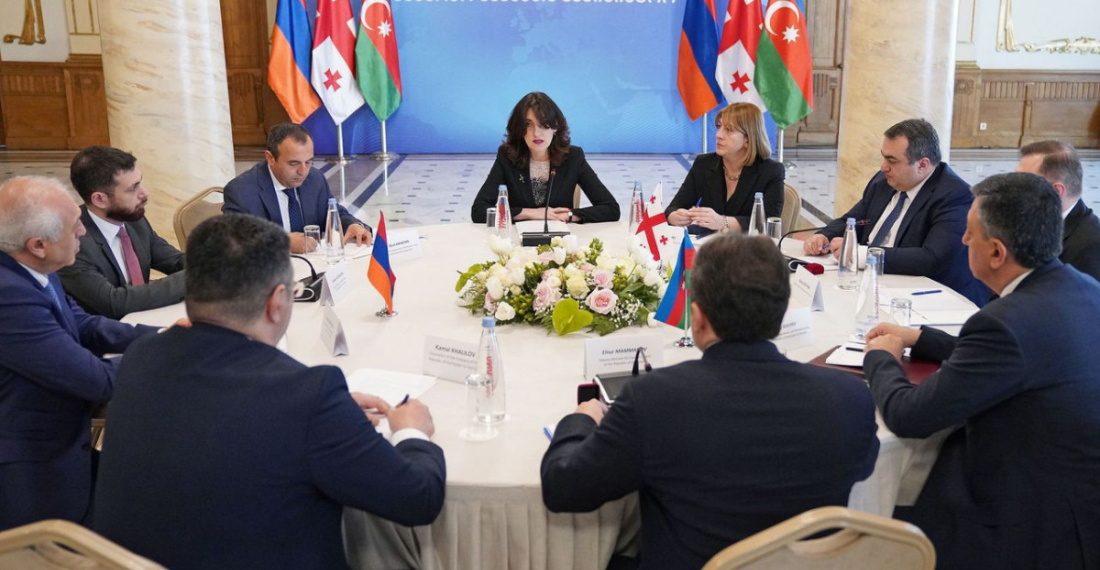
Opinion: Trilateral meeting in Tbilisi - what does it mean for the South Caucasus?

On April 17, 2025, Tbilisi played host to a historic moment, as the foreign ministers of Armenia, Azerbaijan, and Georgia convened for the first-ever formal trilateral consultations. The central aim of the parties was to establish a transparent channel for dialogue and explore concrete steps for regional cooperation. The discussions were notably constructive, the parties identified several areas for potential collaboration, and importantly, the meeting set the stage for further talks, with a promise to follow up on the progress made and to develop a more comprehensive roadmap for trilateral cooperation. It was a signal that the political realities of the region are shifting. Now it is important to understand why such cooperation was not possible until now and why it has become possible only today.

The countries of the South Caucasus were traditionally pulled in different directions by competing geopolitical forces. Azerbaijan aligned itself closely with Turkey and built deep energy cooperation with Europe, with its vast oil and gas resources. On the other hand, Armenia remained heavily dependent on Russia for military protection through its participation in the CSTO and the Eurasian Economic Union. Georgia, after its 2008 war with Russia, decisively turned toward the West and made NATO and EU integration its strategic priority. These foreign policy choices meant that Baku, Tbilisi and Yerevan were operating in entirely different strategic spheres. They lack a common agenda and, in many cases, perceive each other through the lens of broader geopolitical rivalries.

Another major obstacle was the Armenian-Azerbaijani conflict over Karabakh, which made such trilateral cooperation almost impossible. The Karabakh conflict turned Baku and Yerevan into bitter adversaries. Georgia also had to manage its relations carefully with both Armenian and Azerbaijani communities within its borders in order to avoid any move that could be seen as favouring one side over the other. In such an environment, any serious effort at trilateral cooperation was unthinkable because it was too sensitive, and the risks of even smaller engagement were too high.

Finally, there was no political will to pursue trilateral cooperation. For years, the leadership in all three countries prioritised alliances with larger external powers over building direct regional ties. Regional cooperation simply did not align with the domestic or foreign policy agendas of the time. As a result, the idea of a South Caucasus platform remained little more than a theoretical concept, discussed just among scholars in academic circles and experts at various dialogue conferences.

Earlier on, there had been some attempts to create regional frameworks, for instance, the "3+3" platform, which included Armenia, Azerbaijan, and Georgia together with Russia, Turkey, and Iran. However, it failed to gain real traction. Tbilisi refused to participate, unwilling to sit at the table with Russia after the 2008 war and the ongoing occupation of Georgian territories. Armenia also had serious reservations. In the end, it was unclear how the smaller South Caucasus countries could assert their own needs within a platform dominated by larger powers like Russia, Turkey, and Iran. A similar initiative, the “Caucasus Four” framework, which operated in the early 2000s and included Armenia, Azerbaijan, Georgia, and Russia, also struggled to establish any lasting cooperation due to the competing geopolitical interests of the member states. These failed attempts made it clear that any meaningful cooperation in the South Caucasus would have to be built by the local states themselves, free from external influence, on a platform they control and shape according to their own agency.

Now, the possibility of success for trilateral cooperation in the South Caucasus is greater than ever. The situation around the Karabakh conflict (with the recent finalisation of the peace agreement between Armenia and Azerbaijan, even if the official signing remains uncertain) has fundamentally shifted, which means that one of the major obstacles to cooperation between the three countries has been removed. Equally important is the shift in internal dynamics within Georgia. Apparently, given its evolving domestic and geopolitical considerations, Tbilisi sees the value in deeper engagement with its neighbours. And most significantly, the global geopolitical landscape has changed. The new Trump era, which could be characterised by uncertainty, has seen a reshaping of global priorities. As regional actors, the South Caucasus states have come to understand that cooperation among themselves is important to resist external pressures. By sticking together, these smaller countries can increase their collective bargaining power to protect their sovereignty.

In turn, the trilateral cooperation is also hugely beneficial for all of them. Economically, a more integrated South Caucasus can unlock significant opportunities. Cross-border trade and joint projects can boost regional development. Economic interdependence between Baku, Tbilisi and Yerevan is needed for the stability and prevention of any potential escalations. In addition, a united South Caucasus could amplify its presence globally; just like Central Asia’s five, the South Caucasus could become a cohesive bloc, which would make it easier to engage with global powers and promote its own interests.

For this trilateral cooperation to succeed, several key factors need to be aligned. First and foremost, the three countries should demonstrate sustained political will, prioritising regional stability and collaboration over short-term selfish considerations or external influences. Another important element is trust-building, which can help to address sensitive issues on the agenda. Beyond this, external support from the international community, especially from the EU, could be beneficial. Most importantly, the three countries must recognise that the success of this cooperation depends on their long-term commitment to a prosperous region.


source: Gulkhanim Mammadova is a researcher with a focus on gender studies, peacebuilding, and conflict transformation. She received her MA in Peace and Conflict Studies from the Social Sciences University of Ankara and has taken part in numerous cross-border dialogues and youth projects, such as EU4Dialogue, Corridors, and Conflict School. Photo: Georgian Foreign Minister Maka Bochorishvili addressing the trilateral meeting in Tbilisi
The views expressed in opinion pieces and commentaries do not necessarily reflect the position of commonspace.eu or its partners

Related articles

Editor's choice
News
UAE says it will withdraw from Yemen, but division emerges in Yemeni presidential council

UAE says it will withdraw from Yemen, but division emerges in Yemeni presidential council

In a move seen as an attempt to de-escalate a crises with Saudi Arabia, the United Arab Emirates, on Tuesday (30th December) announced that it was heeding a call to withdraw its troops from Southern Yemen. UAE says that its presence included counter-terrorism teams that were crucial in fighting against Islamist groups. UAE sources said that parts of Yemen not controlled by the Houthis have had Al Qaeda in the Arab Peninsula (AQAP) operatives using the territory to launch attacks on Europe, the US and Middle East. UAE teams have co-ordinated with American and British special forces and intelligence. The sources added that Emirati forces and their Yemeni allies also helped reverse Houthi gains in the south. including the liberation of Aden port. The small UAE contingent has remained in place since the UAE withdrew most of its military personnel in 2019. The leading English-language newspaper in Abu Dhabi, The National, said that the main UAE force was based at Riyan Mukalla International Airport, with access to fixed-wing aircraft and helicopters, but also operated smaller contingents in the port town Balhaf and Shabwa. "It is understood it also flew a number of drones from the airbase that were able to track terrorist movements, pass information back to its allies and assisted special forces' missions." Meanwhile a division has emerged in Yemen's presidential council after four members denounced what they called the 'unilateral decisions' by the chairman. Four of Yemen’s eight Presidential Leadership Council members on Tuesday denounced an announcement by the council’s chairman accusing him of breaching the governing agreement. Tension between Yemeni leaders has been rising for weeks, underscoring the fragility of the country's already fractured political landscape and further complicating efforts to confront the Iran-backed Houthi rebels. The latest rift took an unprecedented turn on Tuesday morning, marked by a Saudi-led coalition “limited operation” striking combat vehicles Riyadh linked to the Southern Transitional Council, which has three members in the PLC. The PLC Chairman, Rashad al Alimi, on Tuesday said that he was seeking to cancel the joint defence agreement with the UAE. “What has been issued … constitutes a clear violation of the Declaration of the Transfer of Power [agreement], which explicitly stipulates that the Presidential Leadership Council is a collective body whose decisions are taken by consensus, or by majority when consensus is not possible,” the statement by the four members said. “It does not, under any circumstances, allow for unilateral decision-making on sovereign, military, or major political matters." The statement was signed by STC chief Aidarous Al Zubaidi, Faraj Al Bahsani, Tariq Saleh and Abu Zaraa al Muharrami. (click the picture to read the full article).

Popular

Editor's choice
News
UAE says it will withdraw from Yemen, but division emerges in Yemeni presidential council

UAE says it will withdraw from Yemen, but division emerges in Yemeni presidential council

In a move seen as an attempt to de-escalate a crises with Saudi Arabia, the United Arab Emirates, on Tuesday (30th December) announced that it was heeding a call to withdraw its troops from Southern Yemen. UAE says that its presence included counter-terrorism teams that were crucial in fighting against Islamist groups. UAE sources said that parts of Yemen not controlled by the Houthis have had Al Qaeda in the Arab Peninsula (AQAP) operatives using the territory to launch attacks on Europe, the US and Middle East. UAE teams have co-ordinated with American and British special forces and intelligence. The sources added that Emirati forces and their Yemeni allies also helped reverse Houthi gains in the south. including the liberation of Aden port. The small UAE contingent has remained in place since the UAE withdrew most of its military personnel in 2019. The leading English-language newspaper in Abu Dhabi, The National, said that the main UAE force was based at Riyan Mukalla International Airport, with access to fixed-wing aircraft and helicopters, but also operated smaller contingents in the port town Balhaf and Shabwa. "It is understood it also flew a number of drones from the airbase that were able to track terrorist movements, pass information back to its allies and assisted special forces' missions." Meanwhile a division has emerged in Yemen's presidential council after four members denounced what they called the 'unilateral decisions' by the chairman. Four of Yemen’s eight Presidential Leadership Council members on Tuesday denounced an announcement by the council’s chairman accusing him of breaching the governing agreement. Tension between Yemeni leaders has been rising for weeks, underscoring the fragility of the country's already fractured political landscape and further complicating efforts to confront the Iran-backed Houthi rebels. The latest rift took an unprecedented turn on Tuesday morning, marked by a Saudi-led coalition “limited operation” striking combat vehicles Riyadh linked to the Southern Transitional Council, which has three members in the PLC. The PLC Chairman, Rashad al Alimi, on Tuesday said that he was seeking to cancel the joint defence agreement with the UAE. “What has been issued … constitutes a clear violation of the Declaration of the Transfer of Power [agreement], which explicitly stipulates that the Presidential Leadership Council is a collective body whose decisions are taken by consensus, or by majority when consensus is not possible,” the statement by the four members said. “It does not, under any circumstances, allow for unilateral decision-making on sovereign, military, or major political matters." The statement was signed by STC chief Aidarous Al Zubaidi, Faraj Al Bahsani, Tariq Saleh and Abu Zaraa al Muharrami. (click the picture to read the full article).

