


Putin speaks about "controlled chaos" on the borders of Russia.

In an article published this morning and that is likely to be quoted for many years to come, Russian Prime Minister Vladimir Putin, writing in the newspaper Rossiiskaya Gazetta as part of his election campaign for the Russian presidency, referred to the growth of regional and local conflicts, the emergence of zones of instability and "an artificially fuelled, controlled chaos." "Deliberate attempts are obvious to provoke such conflicts in the immediately proximity from the borders of Russia and our allies," Putin noted. "We witness the basic principles of international law were devaluated and disrupted, particularly in international security," he pointed out.

"In these conditions Russia cannot rely only on diplomatic and economic methods to lift disagreements and settle conflicts," the premier remarked. "Our country is facing the task for the development of military potential as part of the deterrence strategy and at the level of defence sufficiency. The Armed Forces, security services and other power-wielding agencies should be ready for a quick and efficient response to new challenges," he said.

"This is a compulsory condition for Russia to feel safely, and the arguments of the country will be taken by its partners in various international formats," the premier indicated. Putin also announced that Russia’s armed forces will receive over 400 modern intercontinental ballistic missiles, more than 100 military spacecraft and over 2,300 new tanks within the next ten years.

Putin noted that "jointly with our allies we also should build up the capabilities of the Collective Security Treaty Organization (CSTO), including the Collective Rapid Response Forces." "The CSTO is ready to fulfil its mission as a guarantor of stability in the Eurasian space," the prime minister noted. Thus, Putin concluded, "The issues to ensure the dynamic development of the Armed Forces, nuclear and space industry, the defence and industrial sector, military education, fundamental military science and applied research programs should remain the top priority of Russian state policy for years to come."

Commonspace.eu political editor said in a comment that "Putin's article may be dismissed as election rhetoric and part of the Kremlin's strategy not to leave space for the increasingly active and loud opposition to exploit increasing nationalist sentiment in Russia. Putin needs to be seen as the most partriotic candidate in this election. However the article in Rossiiskaya Gazetta reflect a paranoia with encirclement that is a constant feature of Russian official thinking. The article will not do anything to reassure Russia's neighbours of Russia's good intentions and will play into the hands of those who constantly depict Russia as an 'enemy'. Putin's article which is likely to be quoted by foreign policy analysts for a long time, may be dangerously self-fulfilling."

source: commonspace.eu with Itar-Tass

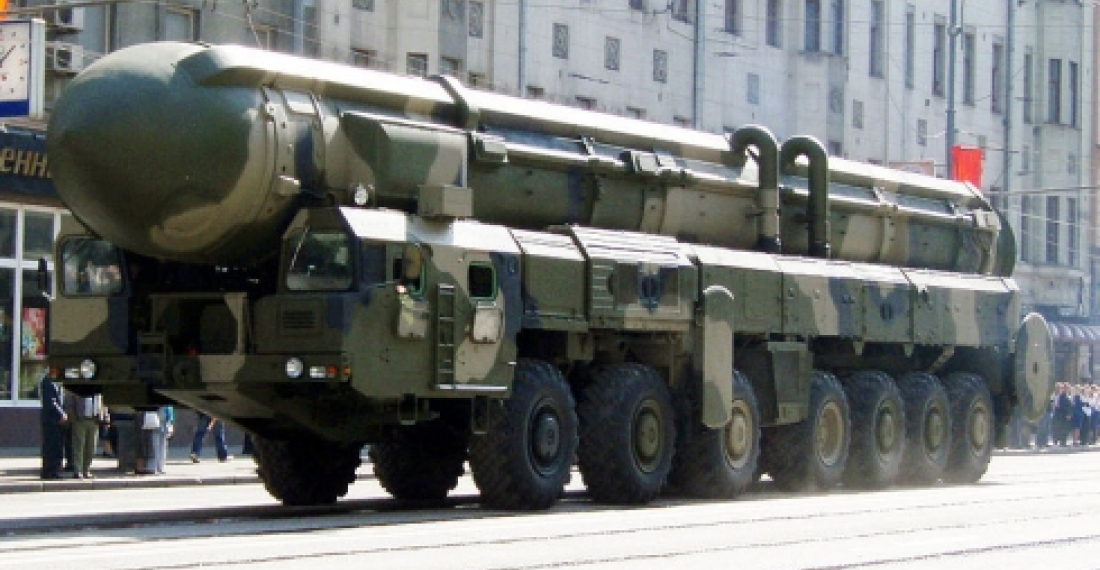
photo: A Russian SS 25  is a mobile intercontinental ballistic missile designed in the Soviet Union  and in service with Russia 's Strategic Rocket Forces on parade in Moscow in 2008. (archive picture)

Related articles

Editor's choice
News
Zelensky of Arabia

Zelensky of Arabia

Ukrainian president, Volodomyr Zelensky, has just ended a tour to some of the Arab monarchies of the Gulf, during which he visited Saudi Arabia, the United Arab Emirates and Qatar. For the past four years the Gulf countries have been lukewarm in their support for Ukraine, as it fought off an unprovoked Russian invasion. In these four years a steadfast Ukraine has developed the skills, and the equipment, to resist the continuous attack by Russian drones, most of which provided by Iran. Now the Arab Gulf states unexpectedly find themselves fighting off a similar threat, as Iran fires drones and missiles at them as it widens the conflict started by the US and Israel four weeks ago. Ukraine's experience and equipment are now desperately needed by the Arab Gulf countries. During the trip Zelensky managed to convince his Arab hosts to turn the page. He offered them Ukraine's equipment and expertise in their present predicament. His offer was gladly accepted. Two hundred Ukrainian advisors are already in the region. The Gulf countries will buy Ukrainian equipment and expertise. This is not just a transactional step. It is an important shift that will have long term implications. Ukraine is set to become a long term  strategic partner of Ukraine, as the sides agree on joint long term co-operation in anti-drone technology. The visit of Zelensky to the Arab Gulf monarchies further isolates Russia, and especially the Russian approach to Ukraine. It also cements a relationship that is important for both Ukraine and the GCC.

Popular

Editor's choice
Interview
Thursday Interview: Murad Muradov

Thursday Interview: Murad Muradov

Today, commonspace.eu starts a new regular weekly series. THURSDAY INTERVIEW, conducted by Lauri Nikulainen, will host  persons who are thinkers, opinion shapers, and implementors in their countries and spheres. We start the series with an interview with Murad Muradov, a leading person in Azerbaijan's think tank community. He is also the first co-chair of the Action Committee for a new Armenian-Azerbaijani Dialogue. Last September he made history by being the first Azerbaijani civil society activist to visit Armenia after the 44 day war, and the start of the peace process. Speaking about this visit Murad Muradov said: "My experience was largely positive. My negative expectations luckily didn’t play out. The discussions were respectful, the panel format bringing together experts from Armenia, Azerbaijan, and Turkey was particularly valuable during the NATO Rose-Roth Seminar in Yerevan, and media coverage, while varied in tone, remained largely constructive. Some media outlets though attempted to represent me as more of a government mouthpiece than an independent expert, which was totally misleading.  Overall, I see these initiatives as important steps in rebuilding trust and normalising professional engagement. The fact that soon a larger Azerbaijani civil society visits to Armenia followed, reinforces the sense that this process is moving in the right direction." (click the image to read the interview in full)

