Today, commonspace.eu starts a new regular weekly series. THURSDAY INTERVIEW, conducted by Lauri Nikulainen, will host persons who are thinkers, opinion shapers, and implementors in their countries and spheres.
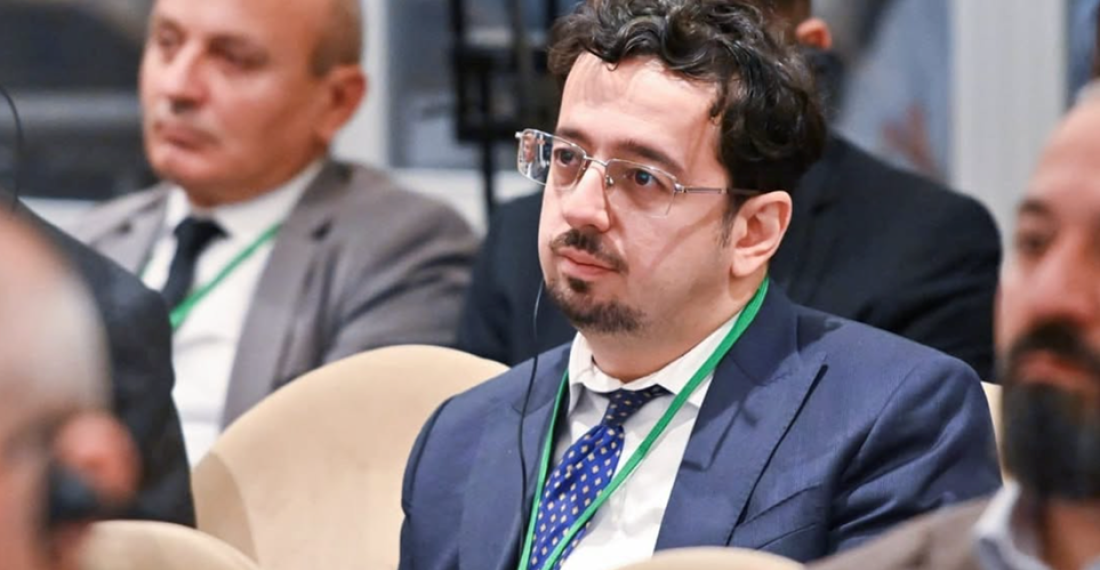
We start the series with an interview with Murad Muradov, a leading person in Azerbaijan's think tank community. He is also the first co-chair of the Action Committee for a new Armenian-Azerbaijani Dialogue. Last September, he made history by being the first Azerbaijani civil society activist to visit Armenia after the 44-day war, and the start of the peace process.
Speaking about this visit Murad Muradov said:
"My experience was largely positive. My negative expectations luckily didn’t play out. The discussions were respectful, the panel format bringing together experts from Armenia, Azerbaijan, and Turkey was particularly valuable during the NATO Rose-Roth Seminar in Yerevan, and media coverage, while varied in tone, remained largely constructive. Some media outlets though, attempted to represent me as more of a government mouthpiece than an independent expert, which was totally misleading.
Overall, I see these initiatives as important steps in rebuilding trust and normalising professional engagement. The fact that soon a larger Azerbaijani civil society visits to Armenia followed, that group including my colleague Rusif, reinforces the sense that this process is moving in the right direction.
Here is the interview in full:
Could you tell us about your background and what led you into policy research and analysis, as well as your role as the co-founder of the Topchubashov Center?
I’m from Baku, Azerbaijan, where I studied International Relations and Diplomacy for both my Bachelor’s and Master’s degrees. I later earned a second Master’s degree in Comparative Politics and Political Economy from the London School of Economics [LSE] which gave me a broader background.
The idea of working in a think tank environment, ideally establishing one on my own, came to me while I was in London. As one of the global capitals for think tanks, the city offers constant exposure to events, expert meetings, and policy discussions. I was fortunate to take part in more in-depth conversations, thanks to LSE also, and I’ve been a part of a few fellowships in Britain, including the John Smith Trust Fellowship. All of this contributed to a broad outlook on world affairs and to an understanding that this sphere of public life needed further development in Azerbaijan.
When I returned to Baku, I became increasingly aware of a significant lack of mutual dialogue: on the one hand, discussions about Azerbaijan within Western expert communities, and on the other, informed debates in Azerbaijan about Europe and the West. There was a clear need to develop this field.
In 2018, my colleague Rusif Huseynov and I co-founded the Topchubashov Center. We will soon be celebrating eight years of the Center’s work. It was the first independent foreign policy think tank in Azerbaijan, and shortly afterwards, a ‘boom’ started, with more organisations of a similar nature existing now.
Global developments have reinforced the importance of policy analysis. From the ’44-Day War’ with Armenia in 2020, to the prolonged and difficult negotiation process that followed, and the outbreak of the war in Ukraine, alongside a growing number of global conflicts that shook up geopolitics- all these events have increased interest in policy analysis and developing a more genuine understanding of what is going on in the world.
Even when we first established the Center, our motivation was to anticipate how global technological and political changes might affect Azerbaijan and the wider region, how we should adapt, and how we could improve not only security, but also public awareness of the growing complexity of global affairs. Many of the issues we have been discussing since 2018, and even earlier, are now turning into reality.
While the world has undoubtedly become a less secure and less safe place, we take some reassurance in knowing that we have consistently worked to raise awareness of these challenges. Overall, I believe we have largely achieved the goals we set out to pursue.
Observers from outside the region may find Azerbaijani and South Caucasian politics difficult to understand, given its layered history and complex security environment. What role do you believe independent institutions such as the Topchubashov Center can play in shaping public debate?
More specifically, how does the Center’s commitment to engagement with the global policy community inform its mission to support long-term strategic foresight for Azerbaijan?
There are several interesting questions here. I would like to start by going back to my student years and the time I spent in London. What worried me then was the absence of a strong think tank community in Azerbaijan, which made meaningful communication and bridge-building much more difficult.
What distinguishes think tank analysts is their ability to speak openly and honestly, and the ability to express informed opinions without those views being treated as politically risky. To be properly represented in international policy environments, Azerbaijan needed professionals capable of operating in this space.
Azerbaijan’s historical experience also uniquely positions it for this kind of role. For centuries, the country has stood at the crossroads of Europe and Asia, between Russia, the Middle East, and the Turkic world. Azerbaijan has undergone several major transformations: from a part of the Muslim Orient, to a province of the Russian Empire; from an economically significant hub attracting global professionals, to the first democratic republic in the Muslim world in 1918; followed by a short but important liberal, capitalist experiment, and then seventy years of Soviet development.
The Soviet period, while complex and often negative, also gave Azerbaijan a deep understanding of Russia and the broader post-Soviet space. As part of the USSR, Azerbaijanis shared a political and social framework with Georgians, Armenians, Ukrainians, the Baltic states, and the countries of Central Asia, with whom we have long-standing historical ties. Each period added new layers of complexity.
By the time Azerbaijan restored its independence in 1991, it had become a fundamentally different society from what it had been in the early nineteenth century. Different people, different mentalities, and different know-how. This has created unique opportunities to understand and navigate diverse political and intellectual spaces, be it Western Europe, Russia, the Middle East, Turkey, and the wider Turkic world.
This complexity is directly reflected in Azerbaijan’s foreign policy, which I would describe as multi-vectoral. While this concept was directly caused by national interests, it is fundamentally shaped by our cultural and historical background that enables Azerbaijan to connect easily to various cultures and centres of power. This is one reason why Baku has increasingly become a regional hub for policy dialogue, hosting numerous international forums and conferences.
The Topchubashov Center seeks to be part of this community. Our work has focused primarily on research related to Europe and the wider Western world, as well as engagement with Western institutions, including the European Union. Over time, this has allowed us to build strong relationships with European research centres and organisations and to participate in various formats, from conferences to long-term research projects.
I am also particularly proud that we were among the first organisations in Azerbaijan to actively engage in dialogue with Armenian experts after 2020. I believe we have made a meaningful and tangible contribution to this process.
On that note of dialogue in a wider peace process, your work recently included the dialogue initiative with LINKS Europe, in which Thematic Groups worked on long-term visions for peace and cooperation across areas such as security, connectivity, governance, and the environment, with the reports having been recently published. From your perspective, what is the real value of these kinds of dialogue processes?
I believe this project came at a good time. I was first invited by Dennis [Dr Dennis Sammut - Director of LINKS Europe] to participate as a co-chair in April 2025, shortly after Azerbaijan and Armenia announced that they had reached an agreement on the text of a peace treaty. That news came against the background of persistent speculations about the prospects for a renewed escalation, and created space for more forward-looking engagement. In that sense, the timing of the dialogue initiative with LINKS Europe was ideal.
I had previously participated in several confidential expert dialogue formats, which focused mainly on exchange rather than producing joint outputs. This initiative was different, as it required the production of published reports agreed by both sides. That naturally introduced new challenges. Drafting texts that are publicly available, jointly endorsed, and sensitive to differing narratives requires negotiation and mutual understanding.
There are still issues on which experts, and societies, hold different views, which is understandable after decades of conflict. A key challenge was deciding how to handle contested narratives: whether to include both views, omit contentious points, or clearly distinguish between shared assessments and divergent positions. In our case [Thematic Group on Peace and Security] we opted for transparency, clearly indicating where agreement existed and where it did not, while also outlining possible ways forward in treating disagreements where they exist.
My visit to Yerevan [NATO Parliamentary Assembly’s Yerevan Rose-Roth seminar in October 2025] as part of this greater dialogue process was also significant. It was the first expert visit of its kind since the 2020 war, which was actually quite surprising. Let’s look at it this way, Armenia and Azerbaijan had a long ceasefire, which was never perfectly complied with, but nevertheless, there were somewhat regular visits by experts and journalists from both sides in various formats. Many of them weren’t so smooth, but they were taking place.
The last exchange of this sort took place in Autumn 2019, when relations between the countries had again heated up to a boiling point. Visits thereafter didn’t take place until September 2025, and as a frontrunner, I had some strong concerns. Physical safety wasn’t the biggest issue, because security protocols were in place from the moment you arrive at the airport to the moment you depart.
There were uncertainties about public and local media reactions. When I was asked to participate in a press conference, I was of course a bit worried. These revolved mostly around navigating difficult issues without distorting the truth, and also catching the sensitivities adequately. It felt like a little bit of a risk.
In the end, my experience was largely positive. My negative expectations luckily didn’t play out. The discussions were respectful, the panel format bringing together experts from Armenia, Azerbaijan, and Turkey was particularly valuable, and media coverage, while varied in tone, remained largely constructive. Some media outlets, though attempted to represent me as more of a government mouthpiece than an independent expert, which was totally misleading.
Overall, I see these initiatives as important steps in rebuilding trust and normalising professional engagement. The fact that soon a larger Azerbaijani civil society visits to Armenia followed, that group including my colleague Rusif, reinforces the sense that this process is moving in the right direction.
To close our interview, I’d like to hear your thoughts on the Washington peace agreement and the so-called Trump Route for International Peace and Prosperity (TRIPP). Last Thursday, President Trump withdrew the United States from multiple international organisations, including the UN Framework Convention on Climate Change, along with 65 others, citing that they were contrary to US interests. Based on this, what are your views on the United States’ evolving role in the South Caucasus? Do you see the US as a reliable guarantor in the corridor?
This is an important question, and one we have discussed extensively within the expert community. In my view, the key to assessing this initiative is to maintain realistic expectations.
I agree that the current US administration has quite a different approach compared to how things used to be. The withdrawal from a number of international organisations and the reevaluation of commitments led many analysts to interpret this as an isolationist trend; I see this more as a shift in how the United States seeks to exercise influence.
Previously, from the collapse of the USSR to the early 2020s, we witnessed a country that was trying to maximise its benefits from the global order and to establish systemic patterns of influence. Azerbaijan was also on the receiving end of this, where we experienced Democratic administrations replacing Republican ones and saw the importance of Azerbaijan for Washington decreasing as a result. This posed certain problems, because foreign policy is, by definition, based on continuity. In contrast to many European countries, the ad hoc nature of this new approach has not come as much of a shock to us.
Currently, international law lies in flux. The international order, which was somehow sanctioned by the current version of international law but not always complied with, is over. Everyone is independently reacting to these new opportunities, risks, and the reshaping of the world, and the US is not an exception.
The current US administration appears to favour a more deal-based, transactional approach to international engagement. Informal agreements, visible political gestures, and reputation-driven commitments matter more in this model than traditional guarantees.
In this logic, the high-profile nature of the Washington peace deal, its public symbolism, and strong media coverage create a reputational commitment. Having invested political capital in the process, it could be costly for the United States to disengage abruptly without damaging its credibility elsewhere. In that sense, the event has generated a degree of long-term US interest in the South Caucasus.
Beyond peace-building, there are clear strategic considerations related to long-term access to Central Asia. Almost immediately after this agreement, Azerbaijan started to implement the first transit and then exports of goods to Armenia. This created the perception that perhaps all roads through the region can eventually be unlocked, and that it is not only about TRIPP. There are some Soviet-era railroads that could eventually be reopened in the future if the process goes well, and all of this makes Central Asia more accessible to the West.
Azerbaijan is sandwiched between Russia and Iran, and I think it was during the escalation between Iran and Israel in June that a flight map showed a congestion of planes over Azerbaijan, which illustrated how strategically important this part of the world has become. This creates a win-win situation for several parties. For us, it is a chance to make the most of a time of peace, generate much stronger economic opportunities, and elevate Azerbaijan as a ‘gateway’ to the wider region. Economic opportunity is the best guarantee against future conflicts, as it creates mutual interests and dependencies. For Americans, it is a chance to demonstrate that they can be a positive actor in the region and to support future efforts related to resources and the containment of Russia, China, and Iran. Having access to the region is vital. Even though we live in unstable times and the very nature of commitments and guarantees is changing internationally, the US, at least in the medium term, will be interested in making the most of this opportunity.
Follow Murad Muradov:
On Facebook here and LinkedIn here
Follow Topchubashov Center:
On their website here
On Facebook here. On You Tube here On Instagram here