


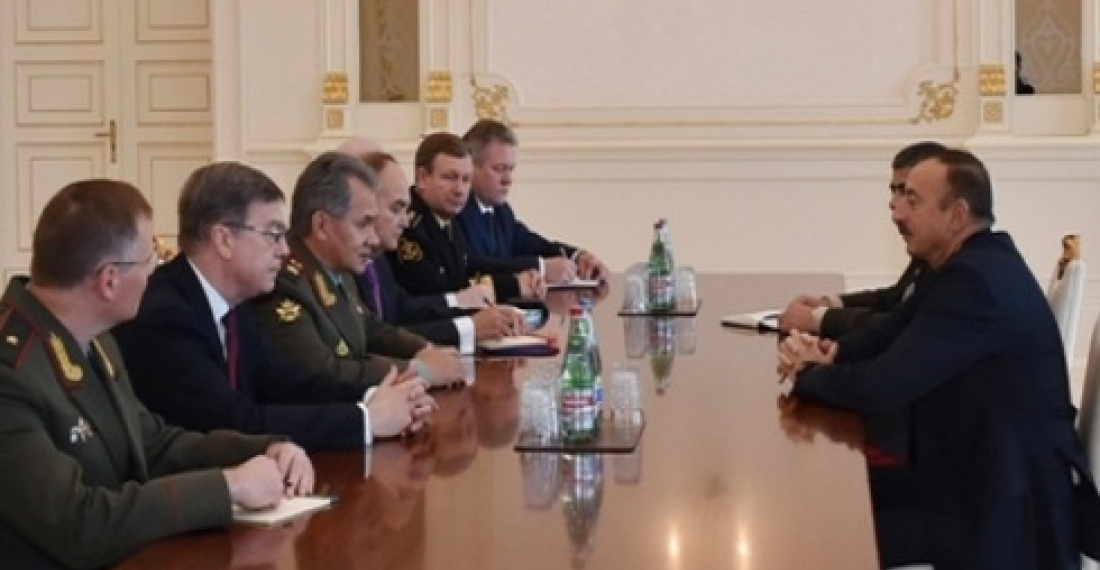
Shoigu in Baku. Welcoming the Russian Defence Minister to Azerbaijan, president Ilham Aliev said that relations between his country and Russia "were successfully and dynamically developing".

The Defence Minister of Russia, Sergei Shoigu is in Baku where this morning he was received by the President, Ilham Aliev.

The Azerbaijani leader told the visiting Russian Defence Minister that "bilateral relations between Azerbaijan and Russia were successfully and dynamically developing", according to the website of the presidential administration. Aliev recalled his recent meetings with President Vladimir Putin in Astrakhan and Minsk, and added that such high-level meetings were constantly on-going.

Ilham Aliyev stressed the importance of cooperation in the military and military-technical fields as a cornerstone of the bilateral relations, and hoped that Shoigu's visit to Azerbaijan would create good opportunities to discuss cooperation in these fields, and expressed confidence that the visit would be a success.

Expressing his gratitude for the warm words about the development of bilateral relations between the two countries, the Russian Minister underlined the importance of the high-level meetings in Astrakhan and Minsk. Sergei Shoigu stressed the significance of decisions on cooperation in the Caspian Sea.  

Coinciding with the visit of the Russian Defence Ministers two ships of the Caspian Flotilla of the Russian Navy were expected to enter Baku Harbour on Thursday. Russia is the largest arms supplier to Azerbaijan.

source: commonspace.eu 

photo:  President Ilham Aliev of Azerbaijan welcomes to Baku the defence Minister of the Russian Federation, Sergei Shoigu (picture courtesy of the press service of the president of Azerbaijan).
 

Related articles

Editor's choice
News
Tensions continue between Pakistan and Afghanistan

Tensions continue between Pakistan and Afghanistan

Tensions have again increased between Pakistan and Afghanistan. At least 28 civilians were killed after Pakistan launched air strikes and sent ground troops into Afghan provinces along its border on Sunday, the United Nations Afghan mission (UNAMA), has said. A further 49 were injured and women and children were among the victims, according to UNAMA. Afghanistan's Taliban government said civilian homes were hit and described the attack as a "cowardly act" and an "atrocity". Meanwhile, Pakistan said it had targeted militant hideouts in Afghanistan's Paktia, Paktika and Kunar provinces. The neighbouring countries agreed to a ceasefire last October following weeks of deadly clashes and an agreement that has since fallen apart. Casualties were concentrated in Mandokhail, a village in the Paktia province, according to Taliban officials. Afghanistan's Taliban government put the civilian death toll at 36 and said more than 160 had been injured. Pakistan's information minister Attaullah Tarar said 29 militants had been killed in an operation responding to "recent terrorist attacks against innocent people". The BBC has not independently confirmed figures from either side. The attacks come a day after three members of the Sindh Rangers, a Pakistani paramilitary force, were killed at their headquarters in Karachi, according to Pakistan's military. Three militants also died in the suicide attack, and Pakistani officials said they had arrested a fourth, who was an Afghan. Jamaat-ul-Ahrar, a splinter faction of the TTP, claimed responsibility for Saturday's attack. Both the TTP, also known as the Pakistan Taliban, and Jamaat-ul-Ahrar are banned in Pakistan, and by the UN, because of their involvement in past attacks. Pakistan has long accused Afghanistan of harbouring terror groups that carry out cross-border attacks, a claim the Taliban government rejects.

Popular

Editor's choice
Interview
Thursday Interview: Murad Muradov

Thursday Interview: Murad Muradov

Today, commonspace.eu starts a new regular weekly series. THURSDAY INTERVIEW, conducted by Lauri Nikulainen, will host  persons who are thinkers, opinion shapers, and implementors in their countries and spheres. We start the series with an interview with Murad Muradov, a leading person in Azerbaijan's think tank community. He is also the first co-chair of the Action Committee for a new Armenian-Azerbaijani Dialogue. Last September he made history by being the first Azerbaijani civil society activist to visit Armenia after the 44 day war, and the start of the peace process. Speaking about this visit Murad Muradov said: "My experience was largely positive. My negative expectations luckily didn’t play out. The discussions were respectful, the panel format bringing together experts from Armenia, Azerbaijan, and Turkey was particularly valuable during the NATO Rose-Roth Seminar in Yerevan, and media coverage, while varied in tone, remained largely constructive. Some media outlets though attempted to represent me as more of a government mouthpiece than an independent expert, which was totally misleading.  Overall, I see these initiatives as important steps in rebuilding trust and normalising professional engagement. The fact that soon a larger Azerbaijani civil society visits to Armenia followed, reinforces the sense that this process is moving in the right direction." (click the image to read the interview in full)

