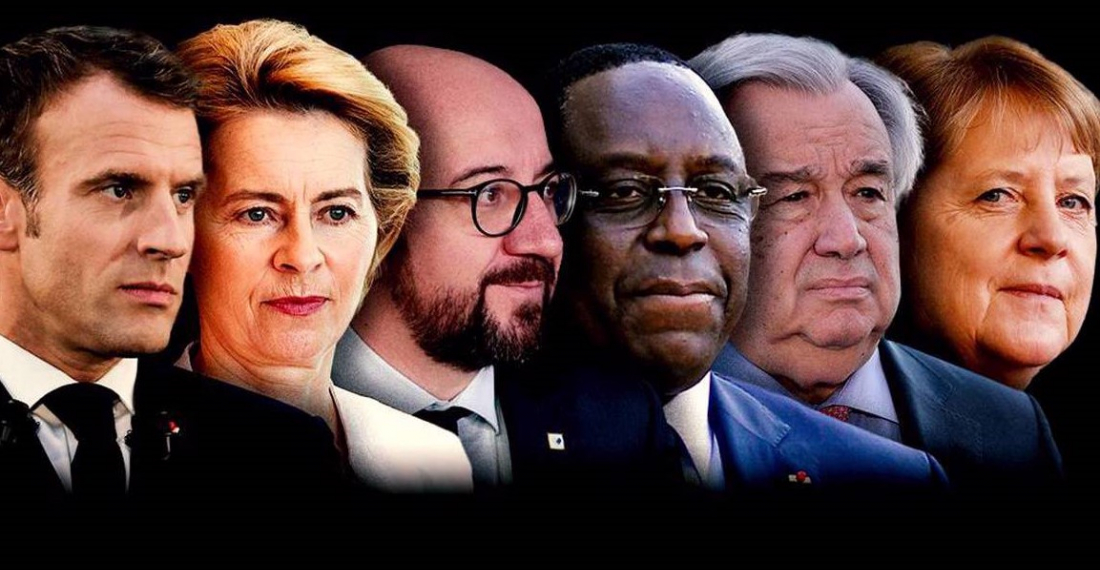
Six world leaders have have published a joint appeal in which they called for a global conversation on multilateralism. The leaders said in the article published in several languages in media outlets across the world that there was an "opportunity to rebuild consensus for an international order based on multilateralism and the rule of law through efficient cooperation, solidarity and coordination."
The signatories of the appeal are French President Emmanuel Macron, German Chancellor Angela Merkel, UN Secretary-General Antonio Guterres, Senegalese President Macky Sall, European Commission President Ursula von der Leyen and European Council President Charles Michel.
We publish here their appeal in full:
In September 2000, 189 countries signed the “Millennium Declaration,” shaping the principles of international cooperation for a new era of progress toward common goals. Emerging from the Cold War, we were confident about our capacity to build a multilateral order capable of tackling the big challenges of the time: hunger and extreme poverty, environmental degradation, diseases, economic shocks, and the prevention of conflicts. In September 2015, all countries again committed to an ambitious agenda to tackle global challenges together: the UN 2030 Agenda for Sustainable Development.
Our world has experienced diverging trends, leading to increased prosperity globally, while inequalities remain or increase. Democracies have expanded at the same time that nationalism and protectionism have seen a resurgence. Over the past decades, two major crises have disrupted our societies and weakened our common policy frameworks, casting doubt on our capacity to overcome shocks, address their root causes, and secure a better future for generations to come. They have also reminded us of how interdependent we are.
The most serious crises call for the most ambitious decisions to shape the future. We believe that this one can be an opportunity to rebuild consensus for an international order based on multilateralism and the rule of law through efficient cooperation, solidarity, and coordination. In this spirit, we are determined to work together, with and within the United Nations, regional organizations, international fora such as the G7 and G20, and ad hoc coalitions to tackle the global challenges we face now and in the future.
Health is the first emergency. The COVID-19 crisis is the greatest test of global solidarity in generations. It has reminded us of an obvious fact: in the face of a pandemic, our health safety chain is only as strong as the weakest health system. COVID-19 anywhere is a threat to people and economies everywhere.
The pandemic calls for a strong coordinated international response that rapidly expands access to tests, treatments, and vaccines, recognizing extensive immunization as a global public good that must be available and affordable for all. In this regard, we fully support the unique global platform Access to Covid-19 tools (ACT) Accelerator launched by the World Health Organization and G20 partners in April.
To deliver on its mission, the ACT-Accelerator urgently needs wider political and financial support. We also promote the free flow of data between partners and the voluntary licensing of intellectual property. In the longer term, we also need an independent and comprehensive evaluation of our response to draw all the lessons of this pandemic and better prepare for the next one. The WHO has a central role to play in this process.
The emergency is also environmental. Ahead of the UN Climate Change Conference (COP26) in Glasgow in November, we must enhance our efforts to tackle climate change and make our economies more sustainable. By early 2021, countries accounting for more than 65% of global greenhouse-gas emissions are likely to have made ambitious commitments to carbon neutrality. All national governments, businesses, cities, and financial institutions should now join the global coalition for reducing CO2 emissions to net zero according to the Paris climate agreement – and start implementing concrete plans and policies.
The pandemic has caused the world’s worst economic crisis since World War II. Recovery of a strong and stable world economy is a fundamental priority. Indeed, the current crisis is threatening to undo the progress we have made over two decades in fighting poverty and gender inequality. Inequalities are threatening our democracies by undermining social cohesion.
No doubt, globalization and international cooperation have helped billions of people escape poverty; but nearly half the world’s population still struggles to meet basic needs. And within many countries, the gap between rich and poor has become unsustainable, women still do not enjoy equal opportunity, and many people need to be reassured about the benefits of globalization.
As we help our economies overcome the worst recession since 1945, it remains our core priority to ensure rules-based free trade as an important engine of inclusive, sustainable growth. We must, therefore, strengthen the World Trade Organization and fully use the potential of international trade for our economic recovery. At the same time, protection of the environment and health as well as social standards must be placed at the heart of our economic models while ensuring the necessary conditions for innovation.
We need to ensure that the global recovery reaches everybody. That means stepping up our support to developing countries, particularly in Africa, by building on and going beyond existing partnerships such as the G20’s Compact with Africa and its joint effort with the Paris Club within the Debt Service Suspension Initiative. It is crucial to further support those countries in reducing their debt burden and ensure sustainable financing for their economies, using the full scope of international financial instruments such as the International Monetary Fund’s reserve asset, the special drawing rights (SDRs).
The rise of new technologies has been a great asset for progress and inclusion, contributing to the openness and resilience of societies, economies, and states, while proving lifesaving during the pandemic. Yet, almost half the world’s population – and more than half the world’s women and girls – remain offline and unable to access their benefits.
Moreover, the considerable power of new technologies can be misused to limit the rights and freedoms of citizens, to spread hatred, or to commit serious crimes. We need to build on existing initiatives and involve the relevant stakeholders toward effectively regulating the Internet in order to create a safe, free, and open digital environment, where the flow of data in a trusted environment is guaranteed. Benefits must accrue especially to the most disadvantaged including by addressing the tax challenges of the digitalization of the economy and combating harmful tax competition.
Finally, the health crisis interrupted the education of millions of children and students. We must keep the promise to provide education for all and to equip the next generation with understanding for basic skills and science, as well as an understanding of different cultures, tolerance and acceptance of pluralism, and respect for freedom of conscience. Children and youth are our future, and their education is key.
To meet these challenges, multilateralism is not just another diplomatic technique. It shapes a world order and is a very specific way of organizing international relations based on cooperation, the rule of law, collective action, and shared principles. Rather than pitting civilizations and values against one another, we must build a more inclusive multilateralism, respecting our differences as much as our common values enshrined in the Universal Declaration of Human Rights.
The world after COVID-19 will not be the same again. Let us make use of different fora and opportunities such as the Paris Peace Forum to work toward tackling these challenges with a clear vision. We invite political, economic, religious, and thought leaders to contribute to this global conversation.