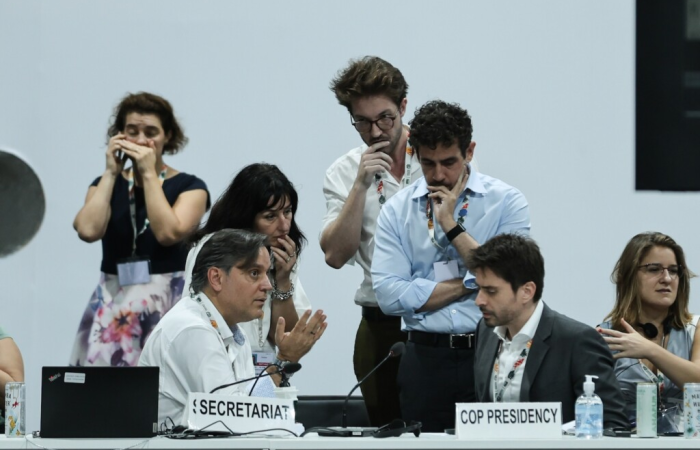
Negotiators at COP31 in Antalya faced renewed divisions on Thursday, November 19, after a revised draft agreement removed all references to phasing out fossil fuels, while disagreements over climate finance and the implementation of a just transition mechanism continued to complicate efforts to reach a consensus ahead of the summit's conclusion on Friday.
The latest draft, published by the Australian co-presidency, removed two, and thus all, references to transitioning away from coal, oil and gas, as well as a proposed call to accelerate their phase-out. Instead, it included a target to increase electricity's share of global final energy consumption to 35% by 2035, up from approximately 20% today. Although the target was linked to expanding renewable energy capacity and improving energy efficiency, it did not explicitly require the additional electricity to come from clean sources. The text also called for deeper and sustained emissions reductions, stronger action on methane and the further deployment of carbon removal technologies. It warned that global warming is projected to exceed the 1.5°C threshold established by the Paris Agreement.
Climate finance, since the beginning of the summit, is a major point of contention. While the new draft calls for further discussions on tripling adaptation finance for developing countries to at least $120 billion, against estimated annual adaptation costs of $305 billion by 2035, developing countries are still not satisfied: according to them, the proposal still lacks concrete commitments and clarity on implementation. Panama specifically threatened to block any final agreement that did not address limiting oil production and eliminating methane emissions.
Disagreements also persisted over the proposed Just Transition Mechanism (JTM). In discussions on Wednesday (November 18), the G77 and China insisted that the mechanism must be an independent institutional arrangement capable of delivering financial and technical support, rather than simply extending the existing Just Transition Work Programme (JTWP). Developing countries advocated a two-tier governance structure for the JTM, comprising a Party-driven steering body to oversee its work and an implementation-support component responsible for facilitating technical assistance, capacity-building and access to financial resources. The EU, on the other hand, rejected the establishment of a new constituted body and a dedicated financial framework, describing both as red lines. Instead, it proposed integrating the existing work programme into the JTM under a single contact group and a five-year work plan. The UK, Canada, Japan and New Zealand broadly supported this approach, citing concerns about institutional duplication and additional costs. With no agreement reached, further ministerial consultations were considered necessary.
Alongside the negotiations, the EU announced that it had joined the Global SF6 Pledge, launched by Germany to reduce emissions of sulphur hexafluoride (SF6), a greenhouse gas with approximately 25,000 times the global warming potential of CO2. The initiative now has 35 participating countries, representing roughly one-third of the global economy. Signatories commit to improving emissions monitoring, minimising leaks and promoting alternatives to SF6 in electricity grid equipment. EU Climate Commissioner Wopke Hoekstra stressed that alternatives already exist and called on other countries to join the initiative. The commitment builds on existing EU legislation requiring SF6 to be phased out in new switchgear by 2032 in principle.
With the conference scheduled to end on Friday, November 20, negotiators face a final round of discussions to resolve outstanding disagreements and secure a unanimous agreement.
Source: Anna Szedlacsek prepared this 11th update on COP 31 for commonspace.eu with Deutsche Welle (Bonn), Directorate-General for Climate Action (Brussels), and Third World Network (Penang).