

Karabakh dilemma for peace activists.

This article was prepared for commonspace.eu by a special correspondent.

These are deeply emotional times in Armenia and Azerbaijan, and not least among the Armenians in Karabakh itself and among the Azerbaijanis displaced by the conflicts of the last three decades. The number of casualties from the fighting of the last days is high, and there is widespread concern about what is to come. On both sides people are enthused to rally to the flag, and not to do so is often considered an act of treason.

Armenian and Azerbaijani peace activists face a big dilemma as the fighting in the Nagorno-Karabakh conflict zone rages on, and patriotic feeling overwhelms most of the population. The choice whether to challenge or to embrace the patriotic rhetoric is a difficult one. Many have taken to facebook to express their positions, and the picture is as confusing, as it is on the battle field.


Avaz Hasanov

Veteran Azerbaijani activist Avaz Hasanov is a well-known and respected face of the moderate voice in Azerbaijan on issues related to the conflict. His work with grass root communities of refugees and IDPs is highly respected. On the third day of the fighting he wrote:

Today I was asked to write about what was going-on on the front line, and on the reaction of Azerbaijanis. I decided to describe the latest developments without keeping any peacekeeping positions.

Beginning April 1, the Armenian armed forces have been fired with heavy weapons at the civilian population of Azerbaijan living in the border areas, as well as all along the contact line of Azerbaijani troops. As a result of the ongoing three-day clashes there were victims among the civilian population. Until now, hundreds of homes, schools and kindergartens were damaged as a result of the bombing. The number of victims among the civilian population is still to be determined. It is hard to say the exact figures as of now, as everything is confused and I do not know which information is plausible. Yesterday, the Interior Ministry and Prosecutor's Office opened a criminal investigation and published a preliminary list of the dead and wounded.

After the outbreak of hostilities, many in Azerbaijan hope that 2016 will become the year of the resolution of the frozen conflict. Or at least that there will be significant progress towards the resolution of the conflict.

First of all, Azerbaijan is keen to move from frozen conflict phase to another level, and also to show the superiority of its army in the war zone, so this will force Armenians to give up the idea of maintaining the status quo.

Secondly: Russia's position is weakened in the region because of the sanctions and low oil prices and it is experiencing diplomatic isolation. Therefore, it would be a mistake for Azerbaijan not take advantage of this and to solve the frozen conflict.

Azerbaijani society calmly accepts all the action of the authorities on the front line. Even in the face of misinformation about the fighting people believe what news comes out from the front line.

I would not say that Azerbaijan is preparing for full-scale war. However, it is important for Azerbaijan to check the pulse of the CSTO member states to find out whether Nagorno Karabakh is in the area of responsibility and interest of the CSTO member states or not, apart of Armenia and let's say Russia. Now, when there are open clashes for the first time in 20 years it is very important for Azerbaijan to demonstrate that its army is able to repel the attack and able to perform complex tasks. During this time, people's stance to events and patriotic broadcasts were aiming to maintain the spirit of patriotism among the Azerbaijanis.

For Azerbaijan, it was important to test the response of the international community. It got the reaction from all the important players in the region and from the heads of state in two days. The fastest response came from Russia naturally.  As well as  the statement of President Putin, Russian Foreign Ministry, Sergey Lavrov's visit to Baku is scheduled. Medvedev is also expected to visit Armenia. When different heads of state and international organizations issue statements calling for parties to cease hostilities, based on the fact that the conflict should be resolved peacefully, and that there is no a military solution to the conflict, it irritates the Azerbaijani public. People think, why, when Azerbaijani side demands to liberate the occupied territories and to start serious peace talks instead of delaying the conflict, mediators equally criticise the parties of the conflict? According to the people, Azerbaijan considers itself  victim of the conflict, one that has lost lands and that's why the attitude to Azerbaijan and occupant should not be the same.

Here now conflictologist can no longer contain himself :)

I think the strategic interests of Azerbaijan indicate that the resolution of the Karabakh conflict, with the mediation of Russia, Turkey and Iran and other interested European countries could have a big impact on the development of the region's future. After the resolution of the conflict all the economic plans and projects could be implemented with the participation of neighbouring countries. The cautious policy of Azerbaijan in relation to Russia and America, as well as towards the European continent shows that the country is able to support peaceful coexistence with its neighbours in the future.

With the hope of a speedy peace and a ceasefire.


Karen Ohanjanian

A different tone was set on the same day by the fiery and charismatic Armenian activist from Nagorno-Karabakh, Karen Ohanjanian, another veteran of the peace movement and a familiar face in many peace initiatives and meetings in Europe over the last twenty years.

Ohanjanian on his facebook page criticised those Armenian activists who he said  were "deprived of the feelings of patriotism, bordering on the betrayal of their people in the most difficult period of its modern history, and who by their actions question the truth of the latest developments". He singled out Artak Kirakosyan, Artaxias Sergoyan and Edgar Khachatrian for particularly harsh criticism. Ohanjanian also posted a statement issued by the organisation which he founded and has led since the early 1990s, - the Nagorno-Karabakh Committee of "Helsinki Initiative-92".

The statement says,

Today is the third day of unannounced war of Azerbaijan against independent Nagorno Karabakh Republic. The scales of destructions and physical violence which the freedom-loving Nagorno Karabakh Republic has been subjected on the part of barbarous Republic of Azerbaijan are comparable to the peak of hostilities of the first Karabakh war.

During the three days of the war the world community, represented by international intergovernmental and non-governmental organizations not only did not take steps aimed at condemning the aggressor, and on the contrary does everything possible to equate the aggressive actions of Azerbaijan and defense measures of Nagorno Karabakh and Armenia aimed at defense of their motherland.

Taking into account such conduct of international organizations, Nagorno Karabakh Committee of "Helsinki Initiative-92" has decided to refuse from cooperation with international organizations in the framework of projects on Nagorno Karabakh settlement and urges all non-governmental organizations of Armenia and Nagorno Karabakh to do the same. At the same time Nagorno Karabakh Committee of "Helsinki Initiative-92" pays attention to the fact of absence of condemnation by Azerbaijani NGOs of aggressive actions of its state against Nagorno Karabakh and considers cooperation with Azerbaijani NGOs as harmful and dangerous for independent Nagorno Karabakh Republic, posing a threat to security and image of Nagorno Karabakh Republic and stops relation with the civil sector of Azerbaijan.

Nagorno Karabakh Committee of "Helsinki Initiative-92" urges the authorities of Nagorno Karabakh and Armenia to forbid non-governmental organizations of Nagorno Karabakh and Armenia to cooperate with the non-governmental sector of Azerbaijan.


Edgar Khachatrian

In Armenia, Edgar Khachatarian, the founder of the organisation Peace Dialogue, has for many years challenged the official narrative on many issues related to military affairs in the country. Khachatarian made a very strong appeal on his facebook page on Sunday, on the second day of the conflict.

Dear friends and colleagues,

This is the second day that the newswires are filled with information about the bloodshed and clashes at the Line of Contact in Nagorno-Karabakh. In just a few hours, these events have taken the lives of dozens of soldiers and civilians on both sides of the line. As a human being I regret the fact that I must sit by passively watching this due to the ongoing military operations killing people, regardless of their nationality and religious affiliation. However, it is even more painful to realize that political paranoia has led to a total depreciation of peace building as a universal value. For a second day, the people that I considered and consider as colleagues continuously spread the pseudo-patriotic, militaristic ideas, supposedly designed to unite society to confront a common enemy. It is a perverse sense of satisfaction to gloat over the fact that the alleged enemy had more losses than we are is unacceptable to me.

I do not quite understand this concept of a common enemy, as, in fact, the philosophy of this concept is that the mere fact of my nationality makes me an enemy of the entire Azerbaijani society. The same perception presents my Azerbaijani friends as enemies for my country mates. Such a perverted perception just plays into the hands of the ever devouring war machine.

Deeply aware of the unpopularity of my ideas in societies fueled by the militaristic and pseudo-patriotic propaganda, I still urge my friends and colleagues in Armenia, Azerbaijan, Nagorno-Karabakh, their friends and colleagues from all countries and continents of the globe, working for peace building and protection of human rights to stand up together against violence and the use of military force. To everyone's regret, we have all witnessed such actions and understand the tragic consequences of the use of violence and the futile attempts to resolve conflicts by military means. I hope for your understanding and support.


These are difficult times for Avaz, Karen and Edgar. No doubt they will be demonised or celebrated by people inside their countries and others on the outside. They are all products of this conflict in Karabakh that has raged on for thirty years. It is better not to judge them but to listen to them and try to understand where they are coming from.

This article was prepared by a special correspondent for commonspace.eu


Latest

Editor's choice
Monday Commentary
Monday Commentary: PEACE IN OUR TIME?

Monday Commentary: PEACE IN OUR TIME?

Making peace between Armenia and Azerbaijan was never going to be simple, nor easy, nor quick. It is taking time, writes Dennis Sammut in this Monday Commentary. “There is a sense of realism coming from the leaders of the two countries – President Ilham Aliyev of Azerbaijan and prime minister Nikol Pashinyan of Armenia, that frankly, is necessary and welcome”, he writes. At a time when conflicts are raging all over the world – from Ukraine to the Gulf, from Africa to South Asia, the prospect that Armenia and Azerbaijan had finally, after decades of conflict that left thousands of dead and many more displaced, decided on embarking on a journey of peace was welcomed. Peace between Armenia and Azerbaijan can be top-down up to a point. Both leaders have spent political capital preparing for a peace deal. But both are aware that their people are not ready for peace yet. In fact, in Armenia, most of the elite are negative toward a peace deal with Azerbaijan. Pashinyan needs time to persuade his countryfolk. That is why 2031 is realistic. Ilham Aliyev runs a tighter shop, but he is also not immune to public opinion. Every time someone hits a landmine in Karabakh, which unfortunately happens often, peace comes into question. Which is why Aliyev chooses to sound hardline, more often than not. In pursuing the peace agenda, both Aliyev and Pashinyan need to proceed cautiously. But they are right in making peace the central issue in their agenda. It is the main issue, and the one that will define them in history. So forward, cautiously but resolutely! In pursuing the peace agenda, Aliyev and Pashinyan need to be supported clearly and unambiguously. There are too many people in Baku and Yerevan who are sitting on the sides, waiting. The international community is not doing enough. It is time to be counted. Otherwise, the spoilers will win, and the region will go back to its bad habits. (Click the image to read the full commentary).
Editor's choice
News
COP31 Update 14: Summit Ends Without Agreement Amid Disputes Over Fossil Fuels

COP31 Update 14: Summit Ends Without Agreement Amid Disputes Over Fossil Fuels

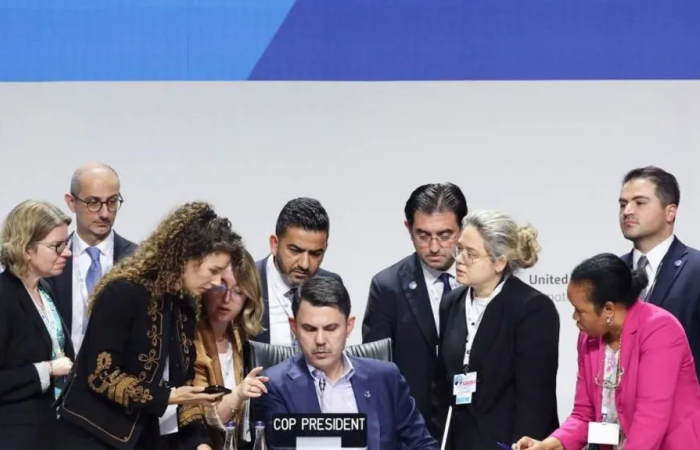
The COP31 climate summit in Antalya, Türkiye, ended on Sunday, November 22, without a final climate agreement after two weeks of negotiations and two additional days of overtime talks. Disagreements over the inclusion of fossil fuels in the final text proved to be the main obstacle, with the European Union and several countries rejecting the proposed agreement for failing to address the transition away from coal, oil and gas. A new draft agreement was published early Sunday by the Turkish and Australian presidencies following days of negotiations. An earlier version had proposed accelerating the transition away from fossil fuels, but a subsequent draft published on Thursday (November 19) removed all references to them. On Friday (November 20), a group of countries, including France and Panama, sent a letter to the COP presidency demanding a clear commitment to transitioning away from fossil fuels. The European Union refused to support the final text. Irish Climate and Energy Minister Darragh O’Brien, representing the EU’s rotating presidency, said the bloc could not accept an agreement that did not even mention fossil fuels, which remain the principal driver of climate change. Panama, the Marshall Islands and several other delegations also opposed the proposal, arguing that it weakened previous commitments and failed to reflect the urgency of limiting global warming to 1.5°C. Other countries, including Saudi Arabia, defended maintaining a range of climate solutions, such as carbon capture and storage, while Ghana, speaking on behalf of the African Group, acknowledged shortcomings in the text but chose not to block consensus. Following these developments, UN Secretary-General António Guterres expressed “deep disappointment” at the failure to reach an agreement, warning that greenhouse gas emissions remain dangerously high and that the world is on course to exceed the 1.5°C threshold. He called on governments to accelerate the energy transition, strengthen emissions reductions and increase climate finance, particularly for vulnerable countries. COP31 President and Turkish Environment Minister Murat Kurum acknowledged the failure to reach consensus, stating that the decisions could not be adopted in the absence of an agreement. The summit consequently became the longest UN climate conference on record, extending two days beyond its scheduled closing, without resolving the central political disagreements over fossil fuels.

Popular

Editor's choice
Monday Commentary
Monday Commentary: European-Azerbaijan relations need an intensive and multifaceted dialogue that is frank and honest

Monday Commentary: European-Azerbaijan relations need an intensive and multifaceted dialogue that is frank and honest

Last week I visited Baku, Azerbaijan. My visit was relatively short, but very intensive, and had many meetings with stakeholders and colleagues. When I arrived in Baku first time in 1996,  Azerbaijan was a different country: weak, poor, and shaken by defeat in war. For thirty year the Karabakh issue dominated the agenda: the political agenda but also the popular mindset. Now, thirty years later, Azerbaijan has returned to Karabakh, and peace with Armenia is on the horizon. It is a new era for Armenia-Azerbaijan relations, for the South Caucasus, but also for Europe.  But we cannot be complacent: the Peace agreement has been initialed but not signed; borders remain closed; TRIPP is ambitious but remains an idea; and there are spoilers who want to turn the clock back. We must not allow them, and in this Europe and Azerbaijan must work together. Europe’ vanguard organization is the European Union – it is a free union of 27 member states; it is a strong global economic force, and increasingly a diplomatic and military force too. But it remains “work in progress” and can often appear dysfunctional. It often lacks collective and institutional memory. In its dealings with Azerbaijan the EU has made many mistakes – not least opening the delegation here late – in 2008. It sometimes appears condescending. Some utterances from the European Parliament and from some quarters in some member states are not understandable even for me. They irritate the Azerbaijanis, but serve no other purpose But Azerbaijan has also not handled relations with the EU well. It has failed to respond when the hand of friendship reached out; and it confused irritating actions, sometimes by well-meaning people; sometimes by outright spoilers, with strategic action. In short, EU-Azerbaijan relations have suffered from a lack of proper dialogue. This dialogue must be frank, honest and multi-faceted involving different segments of society on both sides.   Is Azerbaijan Europe? When Azerbaijan applied to join the Council of Europe in the 1990s, there were some who opposed, saying this was not Europe. I was one of the people who argued that Armenia and Azerbaijan may be on the periphery of the continent geographically, but were European in essence. Certainly their elites. During the discussion on 4 September in Baku, my friend Farhad Mammedov, mentioned that Azerbaijan is not interested in joining the EU, and was now close to the Central Asian countries in the 5 plus 1 format. Neither things mean that Azerbaijan is not Europe. There are several European countries that are not in the EU, and do not want to be, for example Norway and Switzerland. Iceland has recently voted to stay out of the EU. The UK was a member and left. Europe is bigger than the EU, and the holding of the European Political Community summit in Baku in 2027 proves that. Despite all the rhetoric, I never heard the president of Azerbaijan  saying that Azerbaijan is not Europe, nor have I heard any European president say it either. Not wanting to join the EU and forging close relations with neighbouring regions does not make Azerbaijan any less European. It is only logical that when Europeans talk to Azerbaijan they talk like family. The conversation is often frank. It must also be honest, and Europeans need always to remember this too. A frank, honest and multi-faceted dialogue A frank, honest and multifaceted dialogue will contribute to relations between Azerbaijan and the rest of Europe: it will avoid misperception, which unfortunately is very common on both sides; it will provide a forum where problems can be discussed and resolved, and it will increase mutual trust, so that together common problems can be addressed. (click image to read the full Monday Commentary)
Editor's choice
Monday Commentary
Monday Commentary: “The barren rocks of Aden” and “These lands of Yemen are so ruthless”

Monday Commentary: “The barren rocks of Aden” and “These lands of Yemen are so ruthless”

There are two early 20th-century tunes that mark foreign attempts to occupy and “pacify” Yemen. The Scottish tune “The barren rocks of Aden” marks the mobilisation of Highland soldiers, enlisted to be deployed to the Yemeni port of Aden, that in 1837 became the last colony to be incorporated into the British Empire. The tune talks of the harshness of the terrain, but is celebratory, It was even played as a farewell tune to Sir William Luce at the parade in Sharjah celebrating his end as “British Viceroy” in the Middle East in 1966. The second tune is an Anatolian lament. As Ilker Sezer reminded us this weekend, in his weekly feature on “Turkiye Today”, it “mourns the tragic fate of Ottoman soldiers dispatched to the harsh, remote deserts of Yemen during the fall of the empire, young men who marched away from their villages and never returned home. Most of their names, and numbers, were never recorded. Yet, their fate left a mark on the Turkish psyche.” Subsequent invaders have discovered that Yemen is a grave that cannot be overcome by the strength of modern technology, and that whilst Yemeni society is splintered and divided, building a reliable alliance with Yemeni factions is difficult. These are the harsh lessons facing Saudi Arabia, as the Kingdom faces its biggest challenge in its modern history. The leadership of the Kingdom now has to respond decisively. At stake is their very credibility. This is likely to be a long and messy conflict. Saudi military objectives need to be focused: to box in the Houthis rather than destroy them. This is likely to include: (a) regaining territory lost on the Red Sea coast; (b) control over Bab el Mandeb Strait; (c) some kind of cordon sanitaire on the Saudi-Yemeni border; and if things go well (d) the capture of Sanaa. All this would not eliminate the Houthi problem, but it will contain it. In the end the Saudis will have to continue managing Yemen with a mixture of carrot and stick. For the moment, the stick is likely, but the carrot cannot be forgotten either. (click the image to read the Monday Commentary in full)