Editor's choice
This is a members’ functionality. Please
Sign upOpinion
Trending
Opinion: Sustaining Momentum in Armenia-Türkiye Normalization After Armenia’s Parliamentary Elections
17 August 2026
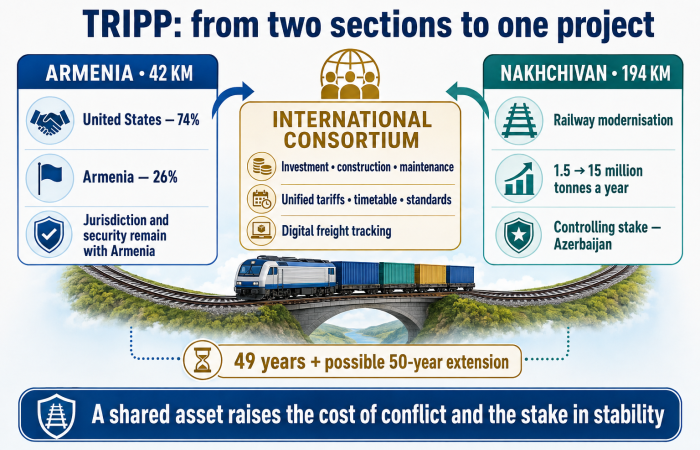
"The signing of the framework agreement between Armenia and the United States on the Trump Route for Peace and Prosperity (TRIPP) on June 4, 2026, and the ruling Civil Contract party’s victory in Armenia’s June 7 parliamentary elections have opened a window of opportunity to advance Armenia-Türkiye normalization. Türkiye, in coordination with the United States, is well positioned to seize this moment and help move the region from frozen conflict toward normalization", write Dr Benyamin Poghosyan, in this article for the Turkish publication, "Global Panorama".
He adds, "TRIPP emerged from the August 2025 Washington meeting, where Armenia and Azerbaijan also initialed a peace agreement, giving fresh momentum to regional normalization. Since then, TRIPP has been moving toward implementation. The framework agreement signed on June 4 established the basis for developing and operating the route. This was followed in early July by a visit from engineers from the U.S. consulting firm AECOM, who surveyed the proposed site for rail and other infrastructure development. On July 16, the Armenian government approved a draft law to ratify the framework agreement and submitted it to the Constitutional Court. These steps were encouraging for both the Armenia-Azerbaijan and Armenia-Türkiye normalization processes, as all sides view TRIPP as part of the region’s broader transition from conflict and isolation toward connectivity and cooperation.
Yet normalization has not proceeded as some may have expected, and the momentum generated in Washington is fading. The main hurdle to signing the peace agreement is Azerbaijan’s insistence that Armenia amend its constitution. The dispute centers on the preamble’s reference to Armenia’s 1990 Declaration of Independence, which cites a 1989 decision supporting the reunification of Soviet Armenia and Nagorno-Karabakh.
Armenia’s prime minister had stated that amending the constitution had been part of the ruling party’s election platform and promised to publish a draft of the new constitution by the end of 2026. But despite its victory, the Civil Contract party did not secure the two-thirds majority in parliament needed to approve a new constitution. Even if the ruling party can persuade some opposition MPs to support it, final approval would still require a nationwide referendum, whose outcome is far from guaranteed given significant public opposition.
That, in turn, has complicated Armenia-Türkiye normalization, as Ankara considers a peace agreement between Armenia and Azerbaijan a prerequisite for progress. Relations between Yerevan and Ankara have improved since 2022. In July 2022, the two sides agreed to open their border to third-country nationals and diplomatic passport holders as a first step toward full normalization. Since then, their special representatives have met several times, discussed rehabilitating the Gyumri-Kars railway, and agreed to permit direct trade. But the talks have produced no major breakthrough, and four years later, the border remains closed. This has created a vicious circle: without constitutional change, there is no Armenia-Azerbaijan peace agreement; without that agreement, Armenia-Türkiye normalization cannot advance; and without progress on either track, the momentum generated by the August 2025 Washington summit risks being lost. Meanwhile, the U.S. midterm elections in November may shift the Trump administration’s attention toward domestic politics, leaving roughly four months to break the deadlock and restore momentum." click the image to read the article in full)