


Azerbaijani Foreign Minister says Karabakh talks are in a state of stagnation

Azerbaijan's Foreign Minister Elmar Mammadyarov told journalists that he shares Russian counterpart Sergei Lavrov's views on the lack of progress in the negotiations on resolving the Nagorno-Karabakkh confllct. Mammadyarov saıd that "Currently we are in a stage of stagnation."


"Ministers meet, but there is no logical conclusion of these negotiations," Mammadyarov added. "There are many issues that must be discussed between the belligerents including the return of internally displaced persons, the status determination and other issues. We are ready to work on a broad peace agreement," Trend News Agency quotes Mammadyarov as sayıng.


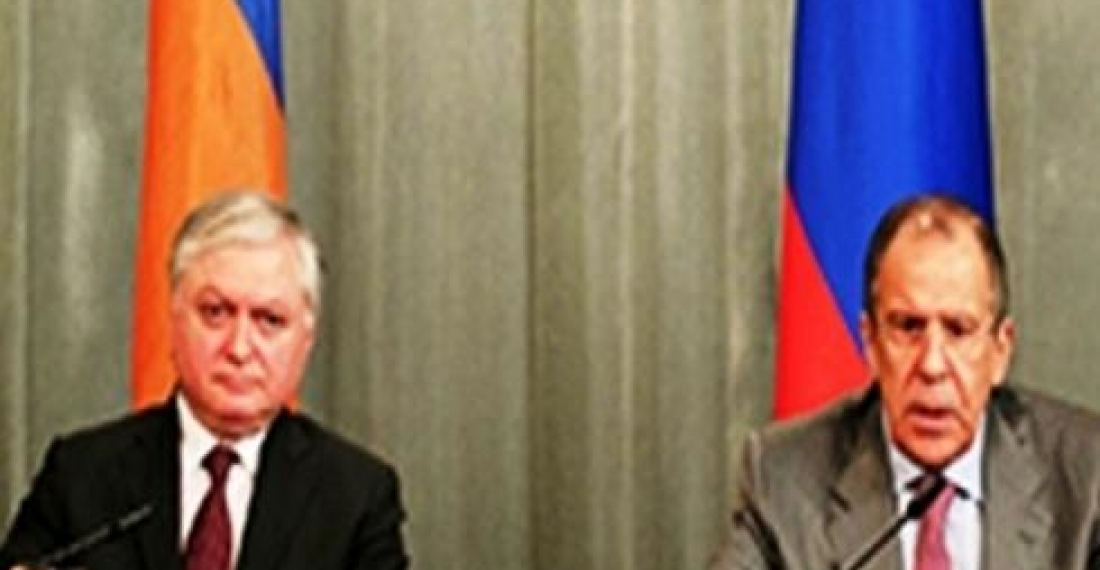
Earlier it was reported that Russian Foreign Minister Sergei Lavrov had told journalists after meeting with his Armenian counterpart, Edward Nalbandian ın Moscow, that there was no progress "yet" in the negotiations. Moscow sees no movement in the Karabakh peace process, However, it would be wrong to say that the talks have reached a deadlock, Lavrov added. "A new meeting of foreign ministers is prepared. The meeting will take place in Krakow this May," Russian Minister said, not ruling out the meeting of presidents, RIA Novosti reported. In his turn, Armenian Foreign Minister Nalbandian said that the process is not moving ahead because of non-constructive position of one of the sides which is rejecting mediators' proposals.

source:commonspace.eu with agencies

Photo: Foreign Ministers Lavrov and Nalbandian after their meeting in Moscow on 25 April. (Picture courtesy of the Russian Foreign Ministry)

 

Related articles

Editor's choice
News
ANAMA hosts 4th International Mine Action Conference in Baku

ANAMA hosts 4th International Mine Action Conference in Baku

The 4th International Mine Action Conference is taking place in Baku, Azerbaijan, on 2 - 3 September 2026. The event is hosted by ANAMA, the Azerbaijani Mine action agency and the United Nations. The conference, which attracts hundreds of particpants from all over the world, opened with a message from president Ilham Aliyev, delivered to the coonference by senior presidential administration official, Hikmet Hajiyev. The theme of the conference is HUMANITARIAN DEMINING FOR URBAN RECOVERY; SETTING STANDARDS OF EXCELLENCE FOR SAFE SETTLEMENTS. President Aliyev in his message said, "Unfortunately, mines and unexploded ordnance continue to threaten human life and security in many countries around the world. Long after conflicts have ended, explosive ordnance continues to cause loss of life, injury to civilians, damage to infrastructure and delay reconstruction projects. In this regard, humanitarian demining is an essential commitment to safe settlements. Urban reconstruction in post-conflict areas requires the restoration of buildings, roads and public infrastructure, as well as the establishment of security and confidence. No city, village or town can be fully rebuilt, no school or hospital can function safely, no family can return to their homes with dignity, and no economic activity can develop sustainably until the land is cleared of mines and explosive remnants of war. Humanitarian demining is therefore at the heart of urban reconstruction and the creation of safe settlements. (click image to read more).

Popular

Editor's choice
Interview
Thursday Interview: Murad Muradov

Thursday Interview: Murad Muradov

Today, commonspace.eu starts a new regular weekly series. THURSDAY INTERVIEW, conducted by Lauri Nikulainen, will host  persons who are thinkers, opinion shapers, and implementors in their countries and spheres. We start the series with an interview with Murad Muradov, a leading person in Azerbaijan's think tank community. He is also the first co-chair of the Action Committee for a new Armenian-Azerbaijani Dialogue. Last September he made history by being the first Azerbaijani civil society activist to visit Armenia after the 44 day war, and the start of the peace process. Speaking about this visit Murad Muradov said: "My experience was largely positive. My negative expectations luckily didn’t play out. The discussions were respectful, the panel format bringing together experts from Armenia, Azerbaijan, and Turkey was particularly valuable during the NATO Rose-Roth Seminar in Yerevan, and media coverage, while varied in tone, remained largely constructive. Some media outlets though attempted to represent me as more of a government mouthpiece than an independent expert, which was totally misleading.  Overall, I see these initiatives as important steps in rebuilding trust and normalising professional engagement. The fact that soon a larger Azerbaijani civil society visits to Armenia followed, reinforces the sense that this process is moving in the right direction." (click the image to read the interview in full)

