by Joseph Alexander Smith, reporting from Tbilisi for commonspace.eu
Georgia's Foreign Minister has publically addressed claims of a "threat to national interests" after state-owned Russian oil company Rosneft acquired 49% of the energy company that owns a strategic oil terminal on Georgia's Black Sea coast.
Opposition figures and economic analysts had protested the deal between Petrocas Energy International and Russian company Rosneft, which is currently subject to western sanctions due to Russian actions in Ukraine.
Petrocas is owned by Russian-Georgian businessman Davit Iakobashvili and operates one of Georgia's largest retail chains with the Gulf brand, as well as the oil terminal at Poti port under its subsidiary Channel Energy. Russian media have claimed the terminal will pass into the ownership of Rosneft as part of the deal, while Iakobashvili remains majority shareholder of the joint venture as a whole.
Objections to the deal centered around claims that Rosneft is violating Georgia's Law on Occupied Terrorities, which forbids foreign companies from operating in the break-away regions of Abkhazia and South Ossetia without authorization from the Georgian government. Rosneft signed a five-year deal with Abkhaz authorities in 2009 to prospect for oil along the region's Black Sea coast.
The website of opposition newspaper Tabula has carried a petition stating that the Rosneft-Petrocas deal violates the Georgian Law on Occupied Territories, urging the government to apply the relevant penalties.
However, Georgia's Foreign Minister Tamar Beruchashvili told reporters that since Rosneft does not conduct direct financial and other operations in the occupied territories, the deal doesn't fall foul of Georgian legislation. "As far as I know, currently, the law on the occupied territories is not being violated" she said on Wednesday 7 January, adding that "the issue is being studied by the country's Foreign Ministry and Ministry of the Economy."
Rosneft had been showing an intense interest in the oil terminal at Poti since at least March 2014. Back then, the company's deputy CEO Mikhail Leontyev told Georgian reporters that Rosneft's interest in Poti was connected with securing the company's gasoline supply to Armenia. At the time, Rosneft's interest was openly welcomed by Georgian Finance Minister Nodar Khaduri who commented: "I see nothing wrong with this."
While Leontyev originally stated that there was "no urgent need" to buy up the oil terminal, the recent deal with Petrocas came just days ahead of Armenia's accession on 2 January to the Russian-led Eurasian Economic Union. The Union allows for the free trade of commodities between Armenia and the other three member states - Russia, Belarus and Kazakhstan - whilst raising tariffs for goods from outside the bloc.
Rosneft's acquisition of a key facility in Georgia may go some way towards allaying Armenian concerns about the transport of energy. In recent months some in Armenia have articulated concerns about the viability of Armenian membership, given that the country shares no land border with another EEU member state. There is no direct rail-link between Armenia and the Russian Federation and the road link via Georgia through the Caucasus Mountains is often closed in winter due to heavy snow.
Armenia's dependence on Western-leaning Georgia for overland trade routes to Russia has caused minor political upset in Georgia in the past, exacerbating tensions between the government - which is keen not to unduly aggravate Moscow while in pursuit of deeper euro-atlantic integration - and the opposition, which has labelled the authorities "pro-Russian" and "collaborationist".
In November last year, Armenia's deputy transport minister caused consternation in Tbilisi when he announced that plans for a railway line linking Armenia, Georgia and Russia via breakaway Abkhazia - a scheme that failed to gain traction when first floated several years ago - were progressing and that an announcement could be "expected soon".
Successive Georgian governments have sought to maintain good relations with Yerevan, and the issue of the Poti Port is therefore a sensitive one for Tbilisi in more than one way. However, as the Eurasian Economic Union gets off to a faltering start, Armenia's trade, energy and transport links with Russia may have the potential further down the line to cause ripples in Georgia's deeply divided political environment.
source: Joseph Alexander Smith reports regularly from Tbilsii for commonspace.eu
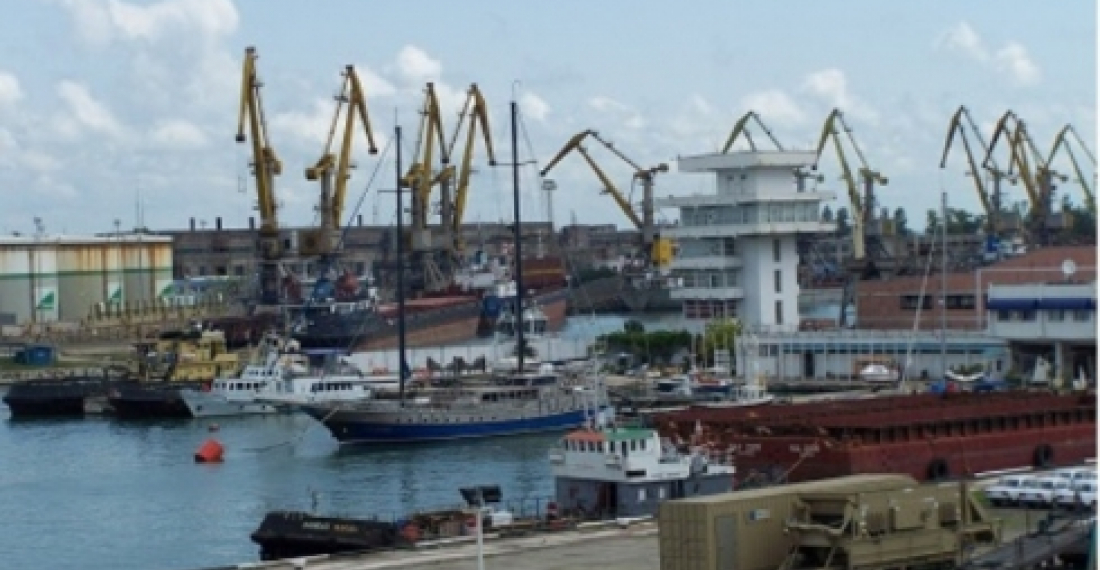
photo: Poti Port, a general view (archive picture).