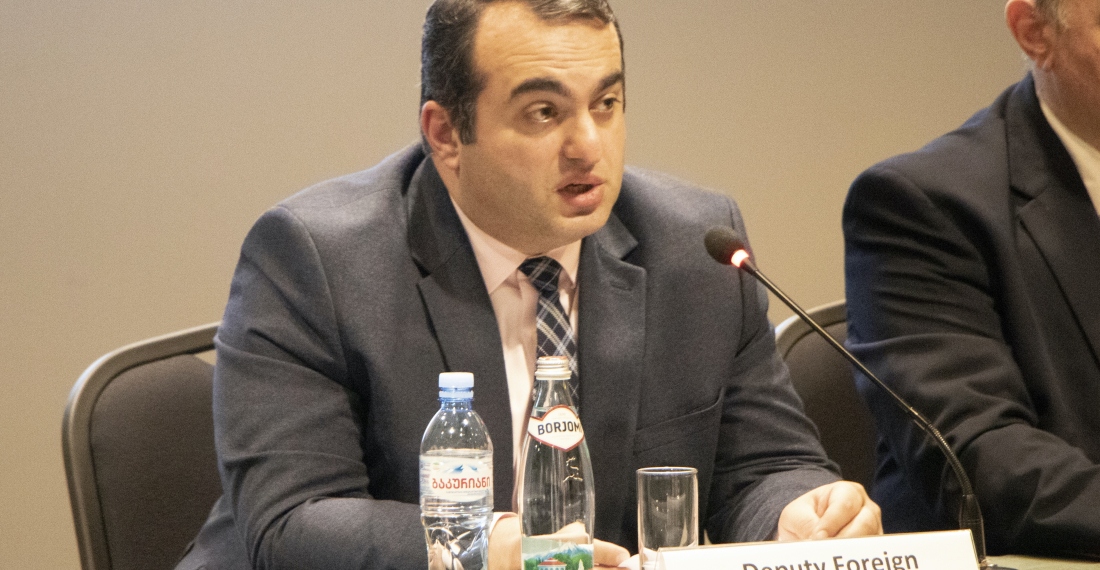
"Years ago the South Caucasus was not a political concept. It could be a geographical concept, anything, but not a political region. Maybe we are still not there yet. But definitely today there are opportunities to have the South Caucasus as a real region, and especially a region where processes are based on cooperation and mutual respect. This, at least, is how Georgia sees the South Caucasus and how we aim for this region to be. As independent countries for the last thirty years, we have been looking for this momentum, and Georgia sees it as an opportunity to build truly mutually beneficial cooperation inside our region".
This was stated by Georgian Deputy Foreign Minister, Lasha Darsalia, speaking in Yerevan, at the opening of the 3rd South Caucasus Dialogue Forum, on Friday, 6 November 2026.
Here is his keynote speech in full
Dear colleagues, dear participants. First of all, I want to use this opportunity to express my appreciation to LINKS Europe and [the Analytical Centre] for organising this very important event. It's my pleasure and honour to be present here today. I want to thank Dr Dennis Sammut for organising this event and for the great work he has been doing over the years in the South Caucasus. I want to welcome Madame Magdalena Grono, the European Union Special Representative. She too has been dealing with issues in the South Caucasus for a long period now, and from Georgia's point of view we appreciate very much the work done by Magdalena, not only on conflict issues but generally on cooperation in the South Caucasus. I want to welcome Mr Grigoryan — we appreciate our long friendship and the work you are doing on these issues — and all the colleagues and participants of today's event.
When we talk about the South Caucasus, I want to say that years ago the South Caucasus was not a political concept. It could be a geographical concept, anything, but not a political region. Maybe we are still not there yet. But definitely today there are opportunities to have the South Caucasus as a real region, and especially a region where processes are based on cooperation and mutual respect. This, at least, is how Georgia sees the South Caucasus and how we aim for this region to be. As independent countries for the last thirty years, we have been looking for this momentum, and Georgia sees it as an opportunity to build truly mutually beneficial cooperation inside our region.
There are a lot of prerequisites and conditions for this in the region today. From Georgia's perspective, we enjoy very good relations with our neighbours — except one. We have strategic partnerships with Azerbaijan and Armenia, and a strategic partnership with Turkey, and these are not just words: these are real processes and real partnership formats, with very strong bilateral relations with our neighbours. Based on this, we are looking for very strong regional cooperation, and Georgia has always aimed for this.
One thing I want to highlight is that what Georgia is offering is not mediation. What Georgia is offering is equal trilateral cooperation based on the equal participation of all countries. While it is not always easy to build a positive agenda bilaterally, we see more space in trilateral or even larger regional formats to build a positive agenda for our countries.
In this regard, Georgia welcomes all the processes in the region aimed at establishing a final peace, and the projects which aim to provide a strong basis for the peace process — meaning economic cooperation or cooperation in other areas. We have always expressed our strong support for regional cooperation projects, including the TRIPP project, where another step was made in this direction these days. Georgia also welcomes the positive engagement of non-regional actors, first of all the United States and the European Union.
If before we had regional conflicts and confrontation, which created the conditions for the unhealthy interference of external powers like the Russian Federation in regional issues and allowed them to manipulate the whole region, today we have a window of opportunity — let's call it that — to build a positive agenda inside the South Caucasus. Its basis will be, first of all, strong cooperation between the regional countries — by which I mean the three South Caucasian countries — relations with Turkey, as well as the support of important non-regional actors, the United States and the European Union. We look to the near future with great hope, and we hope that further developments in our region will be only in this direction.
Around sixty participants, including Ambassadors, officials, experts and civil society activists from Armenia, Azerbaijan and Georgia, and from the international community, participated in the 3rd South Caucasus Dialogue Forum, held in hybrid form in Yerevan, and on line, on Friday, 6 November 2026. The European Union Special Representative for the South Caucasus, Ambassador Magdalena Grono, also addressed the forum.
Dr Benyamin Poghosyan, Dr Vasif Huseynov, Dr Tornike Sharashenidze, Dr Anar Valiyev and Mr Narek Minasian made substantial interventions in the panel presentations, addressing some of the topics currently facing the region, and answered questions.
The meeting was opened by Dr Stepan Grigoryan, Chairman of the Analytical Centre on Globalization and Regional Cooperation (Yerevan), and Dr Dennis Sammut, Director of LINKS Europe Foundation, the co-organisers of the 3rd Forum, made opening remarks in the event chaired by Alexandra Dumitrescu.
The 3rd Forum built on the success of the 1st Forum held in Kachreti in August 2023, and in Tbilisi, in October 2025, and some of those attending these two events were also present in the 3rd Forum.
Realism, hope, action and vision characterised the discussion and the mood of participants in the 3rd South Caucasus Regional Dialogue Forum. The forum will continue in Tbilisi in early 2027.
source: commonspace.eu with LINKS Europe (The Hague)