Opinion: Ahead of the Eastern Partnership Summit in Vilnius later this week Dennis Sammut argues that the EU must be both consistent and flexible in its approach to its Eastern neighbours.
The Eastern Partnership Summit - a meeting of leaders of the 28 member states of the European Union, and those of its six Eastern neighbours will take place in Vilnius on 28 and 29 November. It is the centrepiece of the current Lithuanian Presidency of the European Union and has been under preparation for some time.
After years of discussions and negotiations, most of it very technical, but some of it very political, the European Union announced in July that it was envisaged that in Vilnius it will sign an Association Agreement with Ukraine, and initial similar agreements - with the aim of signing them soon after - with Armenia, Georgia and Moldova. Attempts to move in the same direction with Azerbaijan were rebuffed because Baku wanted "something better", and spoke about a "strategic partnership". Belarus was considered too far behind with reforms and thus not eligible.
July now seems very far away. First, Armenia, with whom EU officials had worked patiently and diligently over several years to prepare for the Association phase, made a dramatic pullout. There was not even a pretence that what had happened was not the result of Russia leaning in a very rough way on its traditional neighbour in the Caucasus in order to make it change course. The only thing for President Serzh Sargsyan to do was to "keep calm and carry on", and hope nobody notices. But ofcourse everybody did. Armenia lost a lot of international credibility, and alarm bells all of a sudden started ringing in Brussels. And sure enough it soon became clear that Ukraine, a much bigger and more complex country than Armenia, with whom the EU was prepared to enter into an even more comprehensive arrangement, started having second thoughts too. And sure enough last week, days before the signing ceremony, Ukraine announced that it will not after all sign.
With the benefit of hindsight, even though dust has not settled on any of these issues, it is still possible to detect two ways in which things could have, and probably needed to, be done differently.
First there is the perennial structural problem of the European Union of how to connect the technical with the political. The Brussels bureaucracy is very good with the first and very clumsy with the second, a reflection of member states willingness to delegate powers in some fields but not in others. With regards to the Eastern neighbours good progress was made over the last five years in developing co-operation and pushing reforms in many areas, but when it came to locking that into a political framework the EU blinked. This allowed President Putin, who has never hidden the fact that he thinks that countries that used to form part of the Soviet Union belong together, to take the initiative. For Brussels the Association Agreements with its Eastern neighbours are first and foremost economic tools aimed at increasing prosperity for both sides; for Moscow relations with the neighbours is first and foremost a political and security matter. Economics comes way behind. The Eastern neighbours seem to agree. All, without exception, are making their decisions based on political and security considerations first.
The second element that could have been done different is the approach with a single model - an Association arrangement underpinning a deep and comprehensive free trade area (DCFTA). It is true that within the details of the Association Agreements and DCFTA arrangements each country could negotiate specific conditions, and they all did. However the obsession with neat models persists. Faced with a demand from Azerbaijan for something different the EU hesitated - not least because something different had first to be negotiated and agreed with the 28 member states.
These two considerations would probably not have mattered very much had a third element not also been missing. The EU is offering Association to its Eastern neighbours without the prospect of full membership within a reasonable time frame. Its fine for Baltic States politicians to lecture their colleagues in the East about the need for perseverence. They, from day one, had the prospect of full EU membership in their vision, unlike countries like Georgia and Moldova who seek membership but have so far been politely rebuffed.
Vilnius therefore is not going to be a neat affair. But even with the setbacks of the last weeks it will be a defining moment for Europe's relations with its Eastern neighbours. No doubt some document or other will be signed with most if not all of the six countries, but they will be very different things reflecting the political willingness of each country. In its relations with the Eastern neighbours Brussels must be able to adopt flexibility as a virtue, whilst remaining consistent with its principled positions especially on reforms. With all its problems and weaknesses the European Union remains an attractive point of reference for the people and the elites in the Eastern neighbourhood. All the Eastern neighbours will in Vilnius take some steps in that direction. The EU must be ready to respond generously and in time to those who are ready to make big steps. To those that aren't it must remain courteous and polite. The time will come when the people in these countries too will send a clear message to their governments of where they want to go, and at that stage no amount of heavy leaning by Mr Putin will be able to stop the process.
source: Dennis Sammut contributed this op-ed to commonspace.eu.
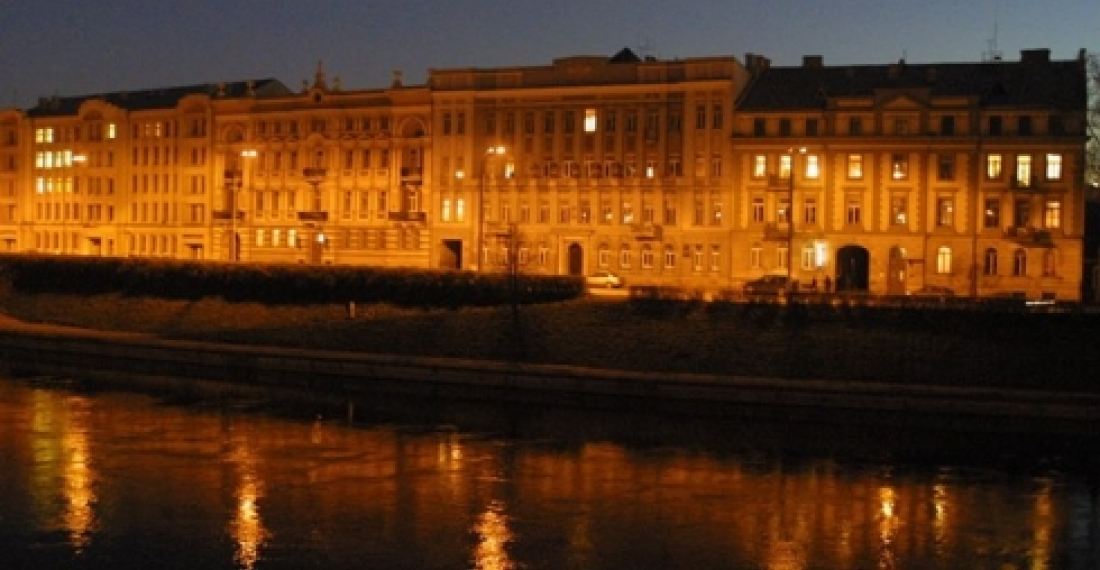
photo: Vilnius by night (archive picture).