|
Russia continues to pile pressure on Armenia. It realises it is loosing the grip that it has had on the country ever since its independence in 1991. Now, Russia is also using its influence on Iran, a country that borders Armenia, to add pressure on the government of Nikol Pashinyan.
According to some Armenian media outlets Iran has demanded that security for the TRIPP project in Armenia be ensured exclusively by the Armenian Armed Forces or the armed forces of a third country already present on Armenian territory. The only such third country at the moment is Russia.
Iranian authorities fear that American forces can be deployed to protect the TRIPP route and this could result in the encirclement of Iran. Yet the deployment of US troops has never been under consideration.
The Armenian authorities have assured that the implementation of the TRIPP project will not create any challenges or threats for Iran.
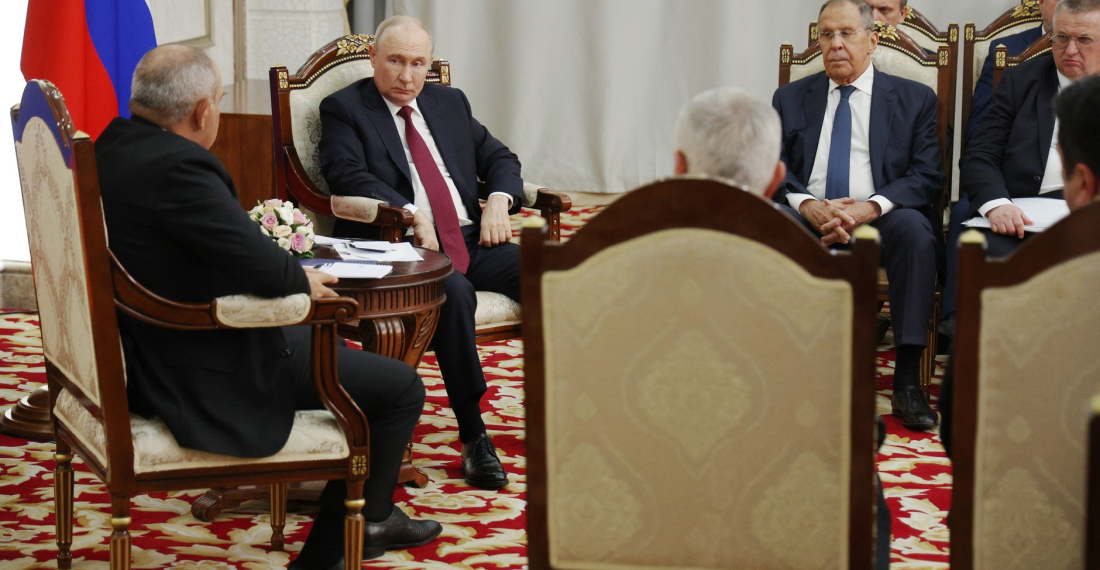
This latest development follows a tense meeting between Russian president Vladimir Putin and Armenia prime minister, Nikol Pashinyan in Bishkek. The Russian president was transmiting "hot and cold" in Bishkek. With Pashinyan, the atmosphere was certainly cold.
Turkish journalist, Ilker Sezer, Managing Editor of Turkiye Today, wrote on Saturday (5 September)
Russian President Vladimir Putin was not always highly diplomatic, or Siberian-cold, in Bishkek this week. Sitting across from Armenian Prime Minister Nikol Pashinyan, the Russian president delivered a tense ultimatum masked as administrative advice. They had an unusual back-and-forth conversation, and it wasn't a PR video showing Putin as a strongman involving other countries’ internal affairs.
He stated that Yerevan needs to make up its mind about its European Union membership aspirations "sooner" rather than later, adding that Moscow desperately needs "clarity" on how to proceed with the relationship. It was a reminder of the zero-sum game the Kremlin insists on playing in its immediate neighborhood.
Yet, the same day, Putin stood next to Turkish President Recep Tayyip Erdogan, and the geopolitical temperature inexplicably dropped to a tepid room setting. There is no need to highlight that Türkiye is a NATO member—a defense alliance Western media claim Russia could attack by the late 2020s (and damn, we entered the late 2020s on Sept. 1, 2026)—or that its EU candidacy status endures, albeit purely on paper.
The resulting press statement from the two leaders was a staggering display of diplomatic theater. The world is practically burning, and yet, listening to the official readouts, one might assume these two men had gathered in the Central Asian steppes solely to review the booming volume of Russian tourists visiting Antalya and to track milestones at the Akkuyu nuclear power plant. Press readouts are always dry, anyway.
They presented a heavily curated vision of Antalya's sunny beaches and energy cooperation. But this Pollyannaish attempt to steer the narrative strictly toward shared mutual interests convinces no one. Behind closed doors, the actual agenda may have been undeniably heavy with structural, existential issues that neither leader felt comfortable airing in front of the cameras.
Back in Moscow, Russian politicians close to Putin, continue with daily tirades against Armenia, and its attempts to escape Moscow's grip.
The European Commission's evasive stance on the timing of establishing a visa-free regime with Armenia is not unexpected: Brussels traditionally demands maximum concessions from candidates, but limits itself to assurances of "brilliant prospects," Konstantin Kosachev, Deputy Chairman of the Federation Council of the Russian Federation, told the TASS news agency.
"There is certainly nothing unexpected in this position. The European Union's practice is well known: to demand maximum loyalty and concessions from its candidates for membership, in return for which it rewards them with non-binding assurances of "brilliant prospects." So, in this situation, the only unexpected thing is the unfounded confidence of the current Armenian leadership in such assurances.
And if that is not confidence, then it is an unprincipled calculation that it will be possible to play on the contradictions of other power centers competing for Armenia, besides the European Union. It will not work,” Kosachev added.
This politicial pressure comes on top of a series of economic measures that Moscow has ordered that try to stifle the Armenian economy. But Pashinyan and his government remain defiant. The governent plan for 2026-31 speaks about a balanced foreign policy. Russia's primary role in Armenia is over.
source: This analysis was prepared by the editorial team of commonspace.eu
|