


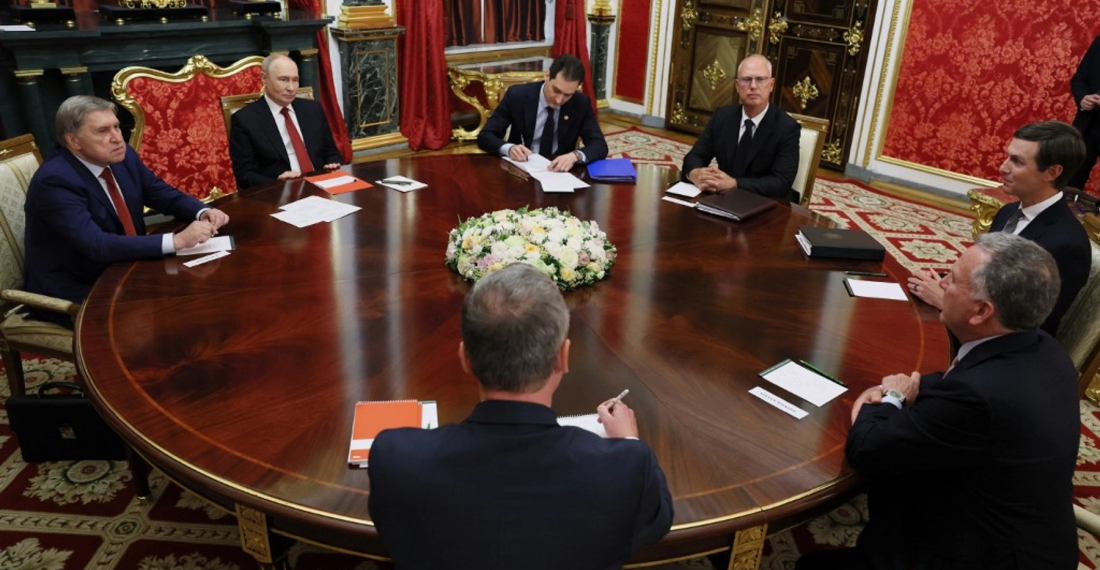
U.S. negotiators visit Moscow and Kyiv these days as Washington seeks to revive diplomatic efforts to end Russia’s war in Ukraine.
The Kremlin, said on its website,
Vladimir Putin received in the Kremlin Special Envoy of the President of the United States of America Steve Witkoff and entrepreneur, founder of Affinity Partners Jared Kushner.
On the Russian side, the meeting was attended by Presidential Aide Yury Ushakov and Special Presidential Representative for Investment and Economic Cooperation with Foreign Countries, CEO of the Russian Direct Investment Fund (RDIF) Kirill Dimitriev.
Welcoming the US delegation, President of Russia Vladimir Putin said:
Colleagues, I heartily welcome you to Moscow.
The situation we are to sort out today is, of course, a difficult one.
But before we begin, I would like to ask you to convey my best wishes and words of gratitude to the President of the United States, Mr Trump.
While he realizes that he is facing a difficult situation, he nevertheless does not stop his efforts to resolve it and to contribute to the settlement of the Russian‑Ukrainian conflict. Today, we will discuss all its components and all its aspects, and for our part, we are also ready to inform you about our view of the situation.
As you informed us, I know that you are planning to go to Kiev after visiting Moscow. In any case, of course, no matter what happens next, contacts of this kind are certainly always beneficial. And here, of course, the quality of mediation and trust in those who are engaged in it are very important. I’d like to tell you that we find it comfortable to work with you, and, of course, we have a very high level of trust during this work.
We are glad to see you. Welcome.
Replying, Steve Witkoff said:
So, first of all, President Putin, thank you so much for having us.
We were sitting outside just now, me, Jared and Kirill, and then Yury joined us, and we were all talking about when we retire, we'll have all these incredible stories and incredible memories, and yours will be right at the top of it all.
President Trump sends you his best wishes. The Gilman family is incredibly indebted to you and thanks you very, very much for Bob Gilman being allowed to come home.
Vladimir Putin: They should be thanking President Trump; it was he who made the appeal.
Steve Witkoff: They have thanked President Trump, but they’ve thanked you also, sir.
I want to thank you for endorsing the no shoot policy in Kiev and in Moscow for these three days that allowed us to be able to come here in a safe manner.
Vladimir Putin: We received this request through official channels – both through the intelligence services and through the Ministry of Foreign Affairs – to stop the strikes on Kiev. I issued the respective order, and since midnight on September 5, these strikes on Kiev have not been carried out.
I would like to note that the Ukrainian side has also significantly reduced – by an order of magnitude – the strikes on the territory of the Russian Federation, including Moscow.
The Ukrainian authorities have published their call for a broader three‑day truce, but we have never agreed on this with them. Yet we will do everything in our power to ensure the safety of the negotiation process and the mediators, represented by you and, perhaps, by those accompanying you.
Steve Witkoff: Thank you.
In Kyiv, Ukrainian President Volodymyr Zelenskyy said Thursday (September 3). In his nightly address, Zelenskyy said preliminary dates had been established for the visits and stressed the importance of continued American involvement. “It is important that America continues to be active,” he said.
The announcement came as Russian President Vladimir Putin indicated that he believed an agreement could still be reached. Speaking at the Eastern Economic Forum in Vladivostok on Thursday (September 3), Putin said there was a “chance” for peace and argued that the conflict ultimately had to be resolved by Russia and Ukraine. He also acknowledged the involvement of countries including the United States and China in efforts to support a settlement.
Ukraine’s Foreign Minister Andrii Sybiha said the developments could create a “new dynamic” in diplomatic efforts, with political and diplomatic engagement becoming active again across several capitals. Previous U.S. and European attempts to broker an agreement have failed to produce a settlement, while disagreements over territory, security guarantees and Ukraine’s military alignment remain unresolved. CIA Director John Ratcliffe also reportedly visited Moscow the previous week to warn against escalation.
U.S. President Donald Trump separately said Thursday that he wanted the war and its casualties to end, telling GB News, “I just want to see that end. I think we’ll get it.” He had previously said he wanted to meet Putin for a summit once the Russian leader was prepared to pursue a peace agreement.
Despite the renewed diplomatic signals, fighting continued. Russian drones struck a Coca-Cola plant near Brovary outside Kyiv, while a Russian attack on Kyiv injured 10 people and severely damaged a residential high-rise. In Russia’s Belgorod region, Ukrainian strikes killed four people, including two medical workers, according to regional officials.
Tensions also remained high between Russia and Europe. Foreign Minister Sergey Lavrov announced that Russia would close German cultural centres in retaliation for tensions with Berlin, following Germany’s accusation that Moscow was behind an attempted drone attack at Leipzig airport in August.
Source: commonspace.eu with kremlin.ru (Moscow), CNBC (New York) and The Guardian (London).



