


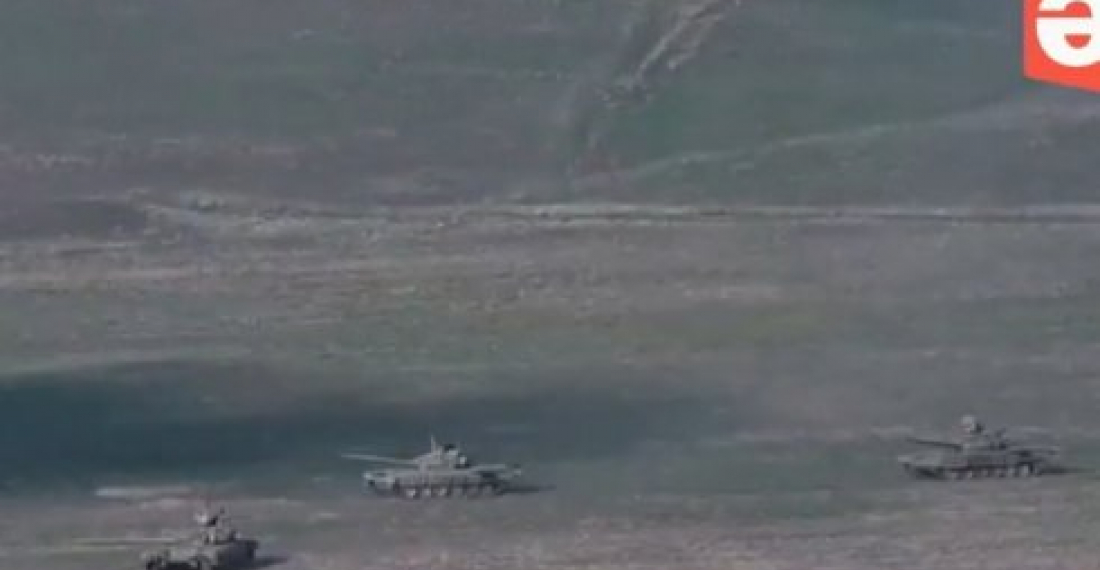
For the second day intensive fighting has been going on in the Nagorno-Karabakh conflict zones, with Azerbaijani forces trying to break through in two areas in the north and in the south of the line of contact. In the meantime diplomatic efforts to stop the fighting continue, with the UN Security Council expected to meet on Tuesday to consider the situation
2000 CEST (2200 Baku Yerevan)
Military situation on the ground
Commonspace.eu political editor has been assessing reports of the military situation on the ground after the second day of intensive fighting between Armenian and Azerbaijani forces in the Nagorno-Karabakh conflict zone. He says:
There appear to be two fronts for the moment: one in the north and one in the south east of the line of contact. In the north Azerbaijani forces have during the day kept up the pressure on Martakert/Agdere, with heavy bombardment. Fights have been going on further north for control of mountain heights and passes. This is a strategic area, since control of the heights will give control over some key roads running from this part of Nagorno-Karabakh to Armenia. This evening the Armenian Army is saying that there is a massive Azerbaijani push south of Martakert/Agdere, towards the village of Talysh.
An Armenian defence ministry source, Artsrun Hovhanissian has written on facebook
"The enemy has launched a new large-scale offensive in the Araks valley and Mataghis-Talish. The Artsakh Defense Army successfully resists all attacks and inflicts significant losses of personnel and equipment on the enemy."
In the South, Azerbaijani forces appeared to be pushing towards the town of Fizuli, and earlier in the day some Azerbaijani bloggers said that they had reached the centre of the town. But Armenian sources say this attack has been repelled.
There appear to be heavy casualties on both sides, and fighting appears to be intense.
Commonspace.eu reports about military actrivity based on secondary sources and it is not possible for us to confirm the accuracy of these reports.
1800 CEST (2000 Baku/Yerevan)
The United Nations Security Council will discuss the situation at a closed meeting on Tuesday, according to various media reports
In case you missed it here is a summary of the latest international reaction to the fighting compiled by our colleague William Murray
More international reaction to renewed conflict in Karabakh
1345 CEST (1545 Baku/Yerevan)
Foreign mercenaries
There is one issue coming up in the reporting of the current fighting between Armenia and Azerbaijan in the Nagorno-Karabakh conflict zone that is likely to create controversy for a long time to come. This the involvement of foreign mercenaries. Armenia accuses Azerbaijan of bringing in jihadist militants from Syria to fight on its side. Azerbaijan says that Armenia has brought in PKK militants and other Kurdish groups, including from Syria, to fight for its side. So far there is no tangible proof that either or both of these claims are true. But this will for sure be a very contentious point to be discussed in the future, once the dust settles down. We are definetely not there yet.
1230 CEST (1430 Baku/Yerevan)
Armenia and Azerbaijan mobilise military reservists
Over the last twenty four hours Armenia and Azerbaijan have declared martial law. Decisions were taken by the parliament of the respective countries yesterday. Armenia yesterday announced a full mobilisation of all adult male aged 18-50 years.
Azerbaijan has today announced a partial mobilisation.Reservists in the rank of soldiers, sailors, sergeants, warrant officers other non-commissioned officers under the age of 35 have been told to report for duty, as well as officers under the age of 50, or older in the case of some senior ranks.
___________
1145 CEST (1345 Baku/Yerevan)
War is never a solution!
In case you have missed it here is our editorial from this morning on commonspace.eu here
________________________
1015 CEST (1215 Baku/Yerevan)
Reports continue coming in of bombing of civilian settlement
Both sides continue to accuse each other of bombing civilian settlement.
Armenia says that the town of Martakert was being bombarded with artillary fire. Armenia also accused Azerbaijan of bombarding Stepanakert with heavy artillary and aerial bombardment during the night and early this morning
Azerbaijan on its part has accused Armenia of bombarding the town of Tartar. It said the main strategic bridge and police department of Tartar region were hit. The Azerbaijani side also said that in Tartar the building No. 10 consisting of 54 apartments on E. Safarov Street and the apartment building No. 16 in Shikh Arkh settlement of the region were hit and became unusable and the residents were evacuated.
Commonspace.eu reports military activity in the conflict zone based on secondary sources and is not able to confirm the accuracy of the reports.
0845 CEST (1045 Baku/Yerevan)
Macron holds phone calls with leaders of Armenia and Azerbaijan
Whilst fighting continues this morning, diplomatic efforts to bring the conflict to a halt, also intensify. French president Emanuel Macron has been speaking with the president of Azerbaijan Ilham Aliyev, and the prime minister of Armenia, Nikol Pashinyan.
_______________
Fighting continued overnight between Armenian and Azerbaijani forces in the Nagorno-Karabakh conflict zone. Both sides accuse each other of shelling civilian targets.
Armenia claims that the Azerbaijani armed forces have used artillery, armored vehicles and TOS multiple rocket launchers. Armenian defense minister's spokesperson Shushan Stepanyan said on Facebook.
"During the night the battles continued in different intensity. Early morning the adversary has resumed the offensive by using artillery means, armored equipment, including TOS multiple rocket launcher. The Armenian forces resist the encroachments of the Azerbaijani side and take respective actions, causing huge losses to the adversary both in the manpower and the equipment", she said.
On its part, Azerbaijan is saying that Armenian forces have been shelling the Azerbaijan town of Terter. The Azerbaijani Defense Ministry warned "the enemy for the last time that the units of the Azerbaijani army will take adequate retaliatory measures".
You can follow how the situation developed on the first day of fighting (27 September 2020) here
source: commonspace.eu with agencies
photo: Tanks move in battle formation during fighting yesterday in the Nagorno-Karabakh conflict zone (screen grab from Maestro TV, Tbilisi)



