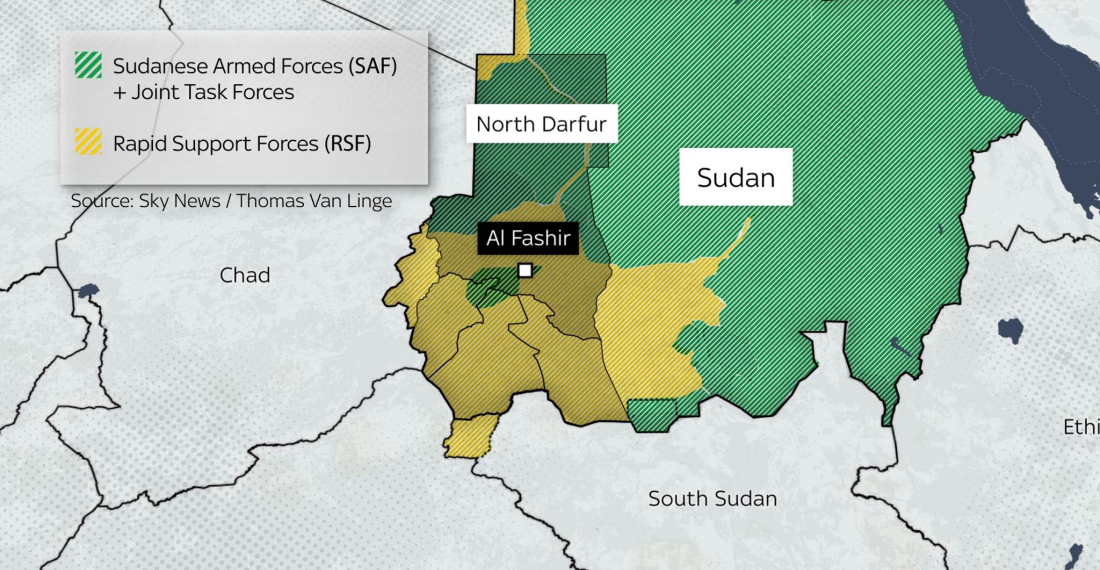
Sudan’s paramilitary forces killed hundreds of people at a hospital, including patients, after they seized the provincial capital of North Darfur over the weekend, according to the U.N., displaced residents and aid workers, who described harrowing details of the atrocities. The 460 patients and their companions were reportedly killed Tuesday 28 October at Saudi Hospital by fighters from the Rapid Support Forces in the city of el-Fasher, said Tedros Adhanom Ghebreyesus, the director-general of the World Health Organisation.
As part of their assault on el-Fasher, RSF fighters also went from house to house, beating and shooting at people, including women and children, witnesses told The Associated Press. Many died of gunshot wounds in the streets, some while trying to flee to safety, witnesses said.
Two years of fighting for control of Sudan has killed over 40,000 people, a figure rights groups consider a significant undercount, and has created the world’s worst humanitarian crisis with over 14 million displaced. The capture of el-Fasher by the powerful Arab-led force raises fears that Africa’s third largest nation may split again nearly 15 years after oil-rich South Sudan gained independence following years of civil war.
Sudanese residents and aid workers revealed harrowing details of atrocities by the RSF after it seized the army’s last stronghold in Darfur following more than 500 days of siege.
Fighters from the RSF “cold-bloodedly killed everyone they found inside the Saudi Hospital, including patients, their companions, and anyone else present in the wards,” according to the Sudan Doctors Network, a medical group tracking the war. “The Janjaweed showed no mercy for anyone,” said Umm Amena, a mother of four children who fled the city on Monday after two days, using a Sudanese term for the RSF.
RSF commander Gen. Mohammed Hamdan Dagalo, who is sanctioned by the U.S., acknowledged what he called “abuses” by his forces. In his first comments since the fall of el-Fasher, posted Wednesday on the Telegram messaging app, he said an investigation was opened. He did not elaborate.
Mini Minawi, the governor of Darfur, shared a video online that purported to show RSF fighters inside the Saudi Hospital. The minute-long footage shows bodies lying on the floor in pools of blood. A fighter fires a single shot from a Kalashnikov-style rifle into a lone man sitting up, who then slumps to the floor. Other bodies could be seen outside. The AP could not independently verify the date, location or condition under which the video was recorded.
Amena was among three dozen people, mostly women and children, who were detained for a day by RSF fighters in an abandoned house close to the Saudi Hospital in el-Fasher. The AP spoke with Amena and four others who managed to flee el-Fasher and arrived exhausted and dehydrated early Tuesday in the nearby town of Tawila, around 60 kilometers (37 miles) west of el-Fasher, which already hosts over 650,000 displaced.
The U.N. migration agency said more than 36,000 people have fled el-Fasher, mostly to rural areas around it. U.N. refugee agency official Jacqueline Wilma Parlevliet said the new arrivals told of widespread killings motivated by ethnic and political differences, including reports of people with disabilities shot dead because they were unable to flee, and others shot as they tried to escape. “It was a like a killing field,” Tajal-Rahman, a man in his late 50s, said over the phone from the outskirts of Tawila. “Bodies everywhere and people bleeding and no one to help them.”
Both Amena and Tajal-Rahman said RSF fighters tortured and beat the detainees and shot at least four people Monday who later died of wounds. They also sexually assaulted women and girls, they said.
In a report late Tuesday, the Yale School of Public Health’s Humanitarian Research Lab said that RSF fighters continued to carry out mass killings since they took over el-Fasher. The report, which relied on satellite imagery from Airbus, said it corroborated alleged executions and mass killing by the RSF around the Saudi Hospital, and at a detention center at the former Children’s Hospital in the eastern part of the city. The AP accessed and analyzed the same imagery, seeing objects and red stains on the ground at the sites that the lab identified as blood and bodies.
Sheldon Yett, the UNICEF representative to Sudan, said in an interview that the situation in el-Fasher, was “an absolute catastrophe,” with thousands of children already suffering from disease and famine before the takeover of the city by the RSF.
Footage of the attacks triggered a wave of outrage around the world. France, Germany, the United Kingdom and the European Union all condemned the atrocities.