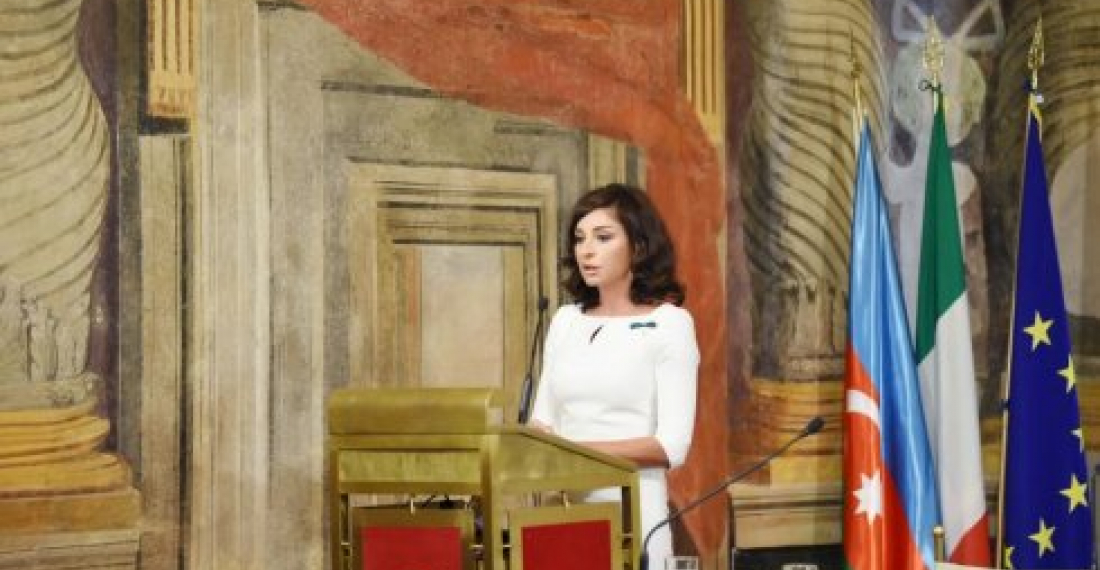
First Vice President of Azerbaijan, Mehraban Aliyeva, who is currently on an official visit to Italy, on Tuesday, (25 September) addressed the conference "100th Anniversary of the Establishment of the Azerbaijan Democratic Republic and the Strategic Partnership between Azerbaijan and Italy" held in the Giustiniana Palace in Rome. In her speech First Vice President Aliyeva spoke about relations between Azerbaijan and Italy, and addressed issues related to the Nagorno-Karabakh conflict.
The following is the full text of her speech
Dear Chairman of the Senate of the Italian Republic, Mrs. Casellati.
Dear participants of the event, ladies and gentlemen, dear friends.
I cordially greet all of you. First of all, Madam Chairperson, I want to express my deep gratitude to you for supporting us in holding in the Senate of Italy an event dedicated to Azerbaijan.
This conference is devoted to a very important event in the fate of our country. 100 years ago, the first democratic republic in the Muslim world - the Azerbaijan Democratic Republic was established. It lasted only two years. We are proud that at the beginning of the 20th century, the Azerbaijani people, relying on the ideas of progress and freedom, gained independence. In a short time, the Azerbaijan Democratic Republic undertook very important steps for our country. Democratic institutions began to be formed in Azerbaijan, the multinational parliament began to function, more than 200 laws, very important for the country, were adopted, including the voting rights for Azerbaijani women. The first secular school for Muslim girls was opened, the national flag of Azerbaijan was established, and our national army was created. Unfortunately, the young republic lasted only 23 months. Faced with serious geopolitical problems, our country lost its independence.
In 1991, Azerbaijan regained its independence, the Azerbaijani people became the master of their country and their fate. The Azerbaijan Democratic Republic laid the foundation for the foundations of the statehood of our country. Today, the Azerbaijani state and the Azerbaijani people have great respect for the memory of the founders of the Azerbaijani Democratic Republic, in our country and in the partner countries of Azerbaijan, events dedicated to the 100th anniversary are held.
After the restoration of Azerbaijan's independence, Italian-Azerbaijani relations are developing successfully. Inter-parliamentary friendship groups, an intergovernmental commission, function. In 2014, a joint Declaration on strategic partnership between Italy and Azerbaijan was adopted. The political dialogue is developing at a high level, the President of Azerbaijan has repeatedly visited Italy on an official visit. In July this year, the President of the Italian Republic, Mr. Mattarrella, paid a visit to Azerbaijan. This is a historical event, since for the first time in the history of Italian-Azerbaijani relations the head of the state of the Italian Republic paid a visit to our country. The visit was very successful, and I am sure that I contributed to strengthening our bilateral ties.
During the visit to our country, Mr. President Mattarella awarded me the Order of the Cross Crossman. It is a high honor for me, and, taking this opportunity, I want to once again express my deep gratitude to Mr. President.
Our economic relations demonstrate an excellent positive dynamics. Italy is the largest trading partner of Azerbaijan. There are 95 Italian companies operating in Azerbaijan. They cooperate with both the private sector and government agencies in various fields, and have established successful cooperation in the areas of services, trade, transport, agriculture, winemaking and other spheres.
In July this year, within the framework of the SOCAR Polimer project in Sumgait with the participation of the presidents of Azerbaijan and Italy, a polypropylene plant was opened. The contractor for the construction of this plant is the Italian company Maire Tecnimont. In February of this year, Maire Tecnimont and the State Oil Company of Azerbaijan signed an agreement on the modernization and reconstruction of the Baku Oil Refinery named after Heydar Aliyev. The total cost of only these projects is 2.5 billion dollars. The share of Maire Tecnimont in these projects is 1.3 billion dollars. These figures testify, on the one hand, about the scale of economic relations between Azerbaijan and Italy, and on the other hand, the dynamics and scale of economic development in our country.
Over the past 15 years, the economy in Azerbaijan has increased 3.2 times. The country invested $ 250 billion. Approximately half of these investments are invested in our country by foreign investors. Azerbaijan's external debt is only 20 percent of gross domestic product. We pursue a policy of social orientation. In recent years, the unemployment rate in our country has fallen sharply and is only 5 percent. Poverty declined from about 50 percent to 5.4 percent. The Davos World Economic Forum honored the economy of Azerbaijan with the 35th place in terms of competitiveness. According to the Inclusive Development Index, Azerbaijan ranks third among developing countries. All these indicators show that Azerbaijan has a stable situation both economically and politically, there is a perfect environment for investment. We invite Italian companies to our country, all doors are open to use the available conditions.
Azerbaijan is the leading state in the region. All large-scale projects are implemented on the initiative and with the participation of Azerbaijan. In October last year the official opening of the Baku-Tbilisi-Kars railway was held, and the railway was put into operation. This is the shortest path connecting Europe with Asia.
Our country contributes to the energy security of Europe. Azerbaijan together with the partner countries is successfully implementing the project "Southern Gas Corridor". In May this year the official opening of the project took place in Baku. The opening of the TANAP pipeline, which is the major part of the project, was held in June this year in the Turkish city of Eskisehir. The $ 40 billion project will transport Azerbaijani gas to Europe.
Azerbaijan is a peace-loving country, possessing an ancient civilization, ancient culture and history. In our country there has never been and is not any kind of confrontation on religious or national grounds. Representatives of various religions, cultures, nationalities lived for centuries in Azerbaijan in conditions of peace and mutual respect. It is no coincidence that Azerbaijan is still known in the world as one of the centers of multiculturalism. In our country, international forums devoted to multiculturalism are regularly held, a forum on intercultural dialogue. This initiative of Azerbaijan receives high support and evaluation from such influential international organizations as the UN, UNESCO, ISESCO. In 2008, the Ministers of Culture of the member states of the Council of Europe and the Organization of Islamic Cooperation met in Baku. This initiative was called the "Baku process". This year the "Baku process" celebrates its 10th anniversary. It continues and serves to establish a fruitful dialogue between nations and peoples.
Azerbaijan is a peace-loving country. We are building our policy with our neighbors and other states on the basis of mutual interests and mutual respect. But it should be noted with regret that for over 25 years the Azerbaijani people have suffered from the aggressive policy of Armenia. As a result of this policy, 20 percent of the internationally recognized territory of our country is under occupation, 1 million of our compatriots live in the situation of refugees and internally displaced persons. Only as a result of the Khojaly tragedy, over 600 innocent people, including women, children and the elderly, were brutally murdered one night. More than a thousand people have disappeared. Fourteen countries officially recognized the Khojaly tragedy as genocide. The resolutions adopted by the UN Security Council require urgent and unconditional withdrawal of the Armenian armed forces from the occupied territories. However, Armenia, grossly violating the norms of international law, continues its aggressive policy. I want to note once again that Azerbaijan is a peace-loving country, we are negotiating. We believe that the Armenian-Azerbaijani Nagorno-Karabakh conflict should be settled on the basis of international law, the territorial integrity of Azerbaijan should be restored, Nagorno-Karabakh and the surrounding 7 regions should be freed from occupation, all refugees and internally displaced persons should return to their native homes .
I want to note once again that Azerbaijan is a peace-loving country, we are negotiating. We believe that the Armenian-Azerbaijani Nagorno-Karabakh conflict should be settled on the basis of international law, the territorial integrity of Azerbaijan should be restored, Nagorno-Karabakh and the surrounding 7 regions should be freed from occupation, all refugees and internally displaced persons should return to their native homes. I hope that Italy, as the OSCE Chairman-in-Office, will play a big role in the settlement of the conflict.
Dear friends, I want to note once again that I am very glad to be in your wonderful city again - Rome. With deep satisfaction, I want to note that our ties - political, economic and humanitarian ties - are developing at a high level. I would like to particularly note the links in the humanitarian sphere. The Chairman said this, I believe that it is the humanitarian sphere, science, culture, education that brings people and peoples closer together, creating a more friendly environment, and we have made great strides in these areas. With a deep sense of satisfaction, I want to note once again that Italian-Azerbaijani relations are developing with positive dynamics. I am sure that friendly relations between our peoples will be strengthened in the future.
I want to once again express my deep gratitude to all of you for participating in this event, for hospitality. Many thanks, "