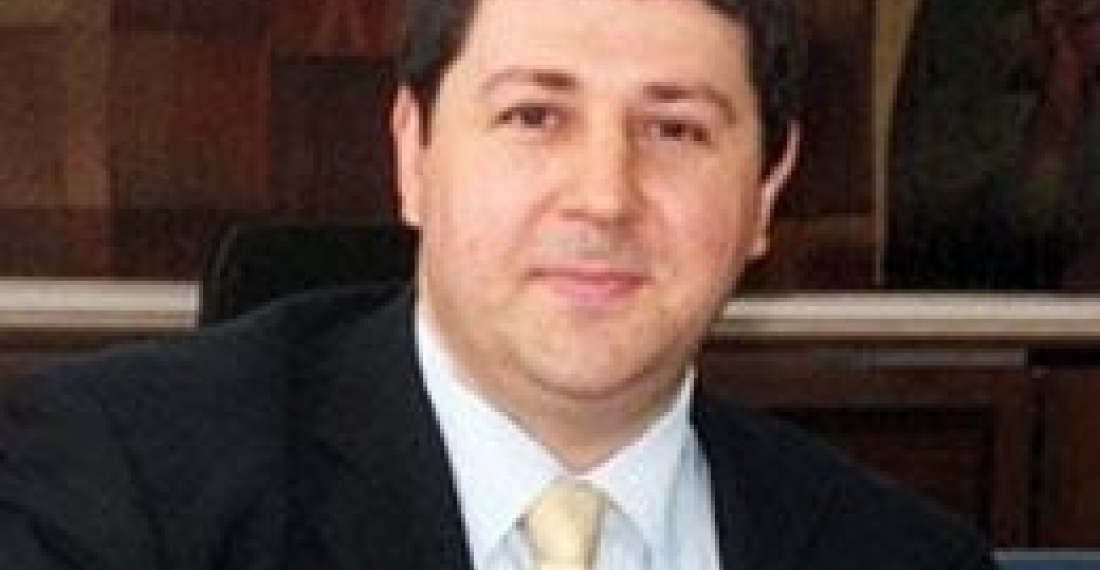
ArmInfo’s Interview with Director of European Geopolitical Forum (Brussels) Marat Terterov.
There is an opinion that Armenian President Serzh Sargsyan has initiated “European-style remodeling” of Armenia. The ruling Republican Party of Armenia has repeatedly made pro-European statements. What is Brussels’ attitude towards these statements?
Armenia is Russia's strategic partner in the Caucasus and a CSTO member. For this reason, we have got an impression that Armenia is under the Russian strategic umbrella in this region. At the same time, some people in NATO think that Armenia has got brilliant relations with NATO: several partnership programmes as well as different types of mellow cooperation with NATO. The same people think that unlike Georgia, which wishes to join NATO, Armenia is a good sample of a state, which can cooperate both with Russia and the western strong military force. As for the problem of European integration of Armenia at political and economic levels, the example of Armenia's communication with NATO is very interesting, as it is rather difficult for Armenia, as a post-Soviet country, to push the "delete" button regarding Russia.
Do you think the power elite of Armenia really has such a wish?
I don't think so, because the major part of Armenia's population permanently lives in Russia, not in Armenia. The Armenian Diaspora in the West consists of quite another type of people united by the Armenian idea, language, etc. And these people do not quite understand the local Armenians’ approach to a number of fundamental issues. Armenia is not Europe, North America or Australia. I understand that this may sound contradictory, but I assure you that in Europe, for instance in Brussels, it is very much easy to sell the idea that Armenia is Europe. I took part in many scientific and political discussions during which the Western Armenians were easily driving the idea that Armenia is a part of Europe and the EU and it should be within the European family. Even Russia is not a part of that family. Such a position of Diaspora even distances Armenia from Europe. Armenia is just a post-Soviet republic. It is neither France nor Western Europe.
Nor even Serbia…
Nor even Serbia, as by their organization, orders and standards the countries of the former Yugoslavia are much closer to Europe than the post-Soviet countries. For instance, the Serbian elite and youth easier integrate in Europe than the Armenian elite and youth.
In other words, the Armenian society itself is not ready for European integration…
The Armenian society is a very long way from it. Yerevan's statements about its wish to integrate in Europe are not enough. One should not forget that Armenia’s leadership itself needs to voice its wish from time to time. As for the Baltic countries, today they feel safe in the European Union, as they trust in the "mellow" military force of Europeans more than Russians. Armenia and the rest of the post-Soviet countries should strive for political alliances, as it is vitally necessary for them. Only the countries that have an energy sector are an exception: Azerbaijan, Turkmenistan and Kazakhstan. In this context, the statements by the leadership of Armenia about Armenia's intention to integrate in Europe are an absolutely normal phenomenon. The system of the European Union is first of all based on law-obedience. For this reason, when voicing an intention to integrate in this system, the Armenian authorities make us understand that one can invest big funds in the stable and law-obedient country. This shows that Armenia is not a cowboy territory or a "wild east". In this context, the government of Armenia is simply obliged to voice similar statements from time to time.
Let’s talk about the prospects of conclusion of the Association Agreement between the EU and Armenia.
I think that via signing of such an agreement Europe is trying to bring more stability, legality to the south of the Caucasus and to promote discussion among the South Caucasus states. In other words, the Association Agreement is a part of a general process on normalization of the situation in your region. This agreement will deepen the link between the region and Europe even more, taking into account the economic orientation of the agreement. The prospects for implementation of this agreement are not clear yet, as there are some obstacles in that way. The European parliament is not only a platform of pluralism but also a platform of lobbyism in Brussels. This means that for approval of any project drawn out by the European Commission, the project should pass through the European Parliament, which has a rather harsh attitude to many sensitive issues in the post-Soviet territory. First of all, the matter concerns the human rights violation in the former USSR countries. Therefore, the European Parliament, certainly, raises problems linked with elections in Armenia and the fact that many of your laws do not meet European standards. It is these factors that affect the prospects of signing the Association Agreement. Such is the reality, which hinders such countries like Armenia to come closer to Europe in a certain sense. For this reason, the process will be long enough. Moscow and Brussels have been trying to sign an agreement on strategic partnership for more than 5 years.
Will you name the first obstacle for Armenia?
The oligarchic system of the Armenian economy is the first obstacle. Joining any international organization supposes destruction of such a system. However, the availability of oligarchs is peculiar not only to Armenia but practically to any post-Soviet state.
Armenia is intensively invited to join the Customs Union in order to further join the quite vague Eurasian Union. What may such a project give Armenia?
I’d like to see the intensive development of that project, as I support the idea of creation of a certain Soviet Union light. Actually, such kind of a formation may provide very many positive factors for development of the post-Soviet area. In this area a lot of inter-ethnic, confessional, territorial, social problems arose after the collapse of the USSR. I think that creation of such a formation will contribute to removal of some of these problems. For instance, some experts think that Belgium is on the brink of disintegration now. Certainly, there will be no bloodshed, but it will still be very hard to decide who will be the owner of Brussels. However, even if Belgium becomes detached from the European Union, both of them will all the same remain in the European area. Scotland and Catalonia are also such examples. Europe itself would benefit from the creation of the Eurasian Union, as it would be much easier for the European Union to cooperate with the countries of the post-Soviet space. However, I do not see a specific legal framework yet, which would allow implementing the project on creation of the Eurasian area. For the time being we only see the political statements from Moscow, Minsk and Almaty. Consequently, it is a bit early now to expect Yerevan to outline its foreign political priorities under these conditions.
ArmInfo,
David Stepanyan
Friday, November 23