The International Committee of the Red Cross is one of the most active and respected international organisations world-wide. This is also the case in the Caucasus region where it has worked methodically and discreetly over the last twenty five years dealing with the consequences of the many conflicts that have afflicted the region
The ICRC is most famous for its work in war time, and for looking after and arranging for the exchange of prisoners of war. It has done this work in the Caucasus as well, and in recent years has been particularly active in assisting with the cases of Armenian and Azerbaijani soldiers and combatants who end up in enemy captivity. The ICRC is also active working on the cases on many missing persons from the past conflicts.
But there is also another side to the ICRC, less known and less glamorous. This is helping the frontline civilian communities affected by conflict. Some very important work has recently been taking place with communities around the line of contact separating Armenian and Azerbaijani forces in the Nagorno-Karabakh conflict zone.
According to the organisation's website, the ICRC delegation in Azerbaijan has helped many front-line communities, supporting livelihood activities and mitigating the risks of living close to the front line. One of its activities is building protective walls to shield homes from stray bullets, as people living near the front line are sometimes wounded or killed as they go about their daily activities. This is often not a simple task. An example is the plight of the Chalabi family who live in an Azerbaijani village Tap Garagoyonlu in Azerbaijan's Goranboy region.
"When the ICRC came to Tap Garagoyunlu to investigate the effect of the conflict on people in the village and offer its support, Chalabi Kishi's family asked if we could build a wall to protect the entrance against bullets. Given their location, it was clear that they were exposed and at risk," says Denise Duran, head of the ICRC's Baku delegation.
Before building such walls, the ICRC notifies the parties to the conflict that it intends to undertake work for the well-being of civilians. Through its office across the front line, the ICRC notified its plans and obtained pledges that ICRC teams and private contractors, or family members doing the work, would be able to work without the risk of shooting.
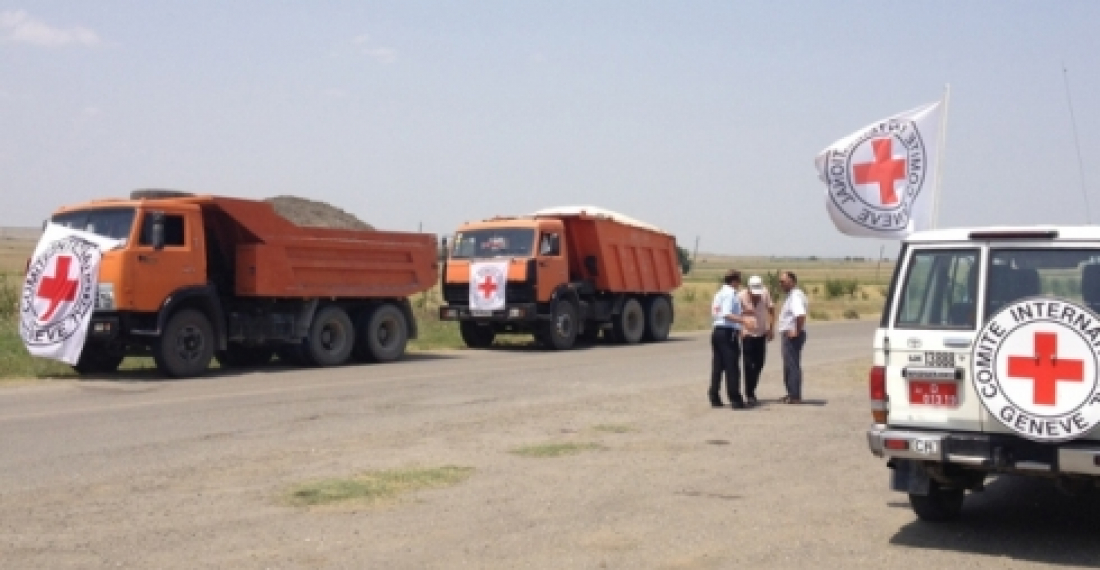
"The ICRC had to persuade truck drivers to bring bricks to Tap Garagoyunlu, as the area is known to be dangerous. They agreed to deliver only when we suggested temporarily marking their trucks with Red Cross emblems," says Ms Duran.
The Red Cross emblem signifies that activities of a purely humanitarian nature are taking place. The Geneva Conventions regulate who is entitled to use this emblem and obliges parties to armed conflicts to protect the personnel and objects displaying it and to facilitate their work.
"To make things even more complicated, the road behind Chalabi Kishi's house is very exposed to shooting and drivers are afraid to use it," explains Ms Duran. "Chalabi and his family had been entering their home from a neighbour's gate on foot for years so as not to risk using the road. But it's the only road by which we could deliver bricks and other building materials for the protective wall. Protected by the Red Cross emblem, trucks used that road for the first time in 19 years and delivered the materials in safety."
As the trucks entered the yard, Chalabi was speechless with happiness and amazement. His wife spoke for both: "Nobody was visiting us because they were afraid of getting shot. Now, we will have guests in our house again after 19 long years."
As is to be expected the ICRC works on both sides of the Nagorno-Karabakh conflict divide. At the moment the delegation of the ICRC to Armenia is implementing a number of programs in villages of the Tavush Region bordering with Azerbaijan, Sarah Epprecht, Head of the ICRC Delegation in Armenia, told Armenian News-NEWS.am.
She said the most vulnerable villages were selected as they are located near the border and villagers have less access to infrastructure and land.
"In 2013 we implemented projects on supplying drinking and irrigation water, distributed wheat seeds, fruit tree saplings," she said.
Other activities that are carried out both on the Armenian and Azerbaijani side concern the incidents involving or directed against the civilian population.
"In the event of an incident, we visit the area, collect information about the incident as far as it is possible, and then turn to the responsible authorities," Epprecht said.
Then, ICRC experts present information on their view and recommendations in terms of the violation of the International Humanitarian Law in connection with this incident.
source: commonspace.eu with www.icrc.org and news.am
photo: Garagoyunlu, Goranboy district, Azerbaijan. Trucks loaded with materials for the wall that will protect Chalabi Kishi and his family from bullets approach along a road that had not been used for 19 years, (picture courtesy of the ICRC).