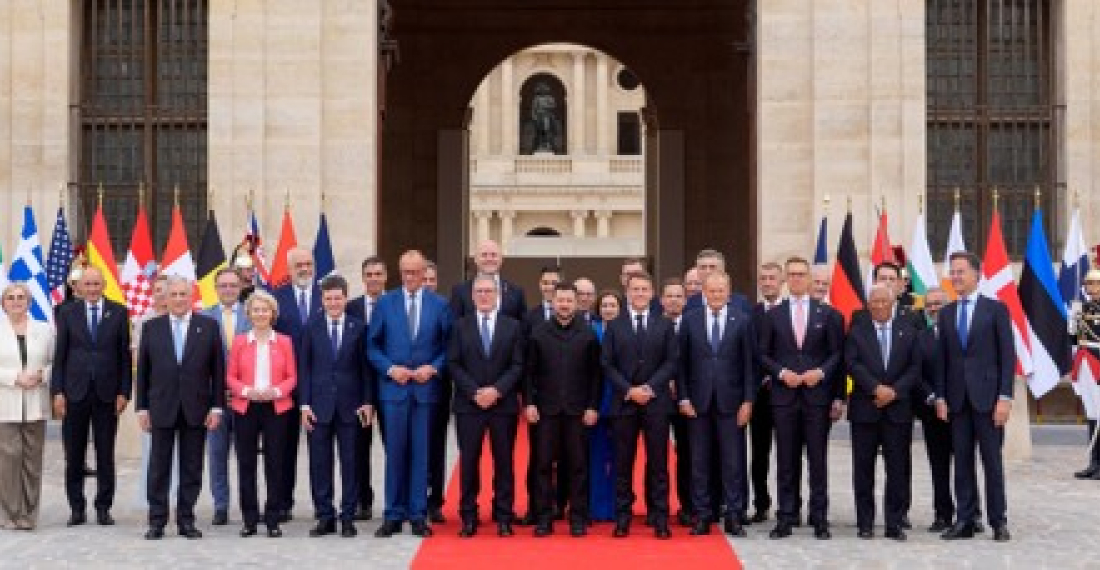
European leaders meeting in Paris on Monday (July 13) renewed their support for Ukraine by announcing new security initiatives, expanded military assistance and closer defence cooperation designed to strengthen Kyiv’s ability to defend itself against continued Russian attacks. Around 20 heads of state and government attended the meeting of the “Coalition of the Willing,” including French President Emmanuel Macron, Ukrainian President Volodymyr Zelensky, German Chancellor Friedrich Merz, British Prime Minister Keir Starmer and NATO Secretary General Mark Rutte.
The summit focused on increasing pressure on Russia while reinforcing long-term security guarantees for Ukraine. Participants reaffirmed their intention to support Kyiv “more quickly and more strongly” and said the measures were aimed at strengthening Ukraine’s position and encouraging Russia to engage in negotiations.
A central announcement concerned the Multinational Force for Ukraine (MNF-U), which is intended to provide reassurance and military support after a credible ceasefire comes into effect. According to the joint communiqué, the force would help regenerate Ukraine’s armed forces and contribute to security on Ukrainian territory once hostilities have stopped. Macron said multinational exercises would take place in neighbouring countries “in the coming months” to validate deployment plans and demonstrate that participating nations were prepared to operate jointly on land, at sea and in the air.
The meeting also resulted in the launch of a new anti-ballistic missile coalition bringing together Ukraine and nine European countries. Describing the initiative as “purely defensive,” participating governments said they would combine their defence industries, research capabilities and operational expertise to develop a shared European capacity to counter ballistic missile threats. The coalition will support the Freya project, a missile defence programme led by the Ukrainian company Fire Point that aims to provide a lower-cost alternative to existing systems such as the US Patriot interceptor and the Franco-Italian Aster missile. Macron said the project would combine the technological capabilities of participating countries and defence companies to accelerate protection for Ukraine.
Zelensky welcomed the announcement, describing the meeting as “a historic day for all of us.” He said Ukraine and its partners could jointly develop an anti-ballistic missile within twelve months and move towards affordable mass production. Strengthening air defence has remained one of Kyiv’s principal requests as Russia continues to launch frequent ballistic and hypersonic missile attacks against Ukrainian cities.
France also announced a significant expansion of its military assistance. Macron said Paris would supply Ukraine with 16 Rafale fighter aircraft, with the first expected to enter service in 2028–2029. France will also provide an initial batch of next-generation SAMP/T air-defence batteries, additional radar systems and support licensed production inside Ukraine of AASM guided bombs, Aster 30 surface-to-air missiles and Scalp cruise missiles. These measures are intended to strengthen Ukraine’s domestic defence industry while improving its ability to intercept aerial threats.
NATO Secretary General Mark Rutte participated in both the Coalition of the Willing meeting and the gathering of the Anti-Ballistic Missile Coalition. He stressed that continued support for Ukraine remained one of NATO’s highest priorities and recalled that alliance members had reaffirmed their “unwavering support” for Ukraine’s sovereignty and territorial integrity at last week's NATO Summit in Ankara. Rutte urged allies to continue supplying air and missile defence systems following recent Russian strikes on Kyiv and to deepen cooperation with Ukraine’s defence industry. He also noted that NATO members had pledged €70 billion in military equipment, assistance and training for Ukraine in 2026, with at least the same level of support planned for 2027.
Source: commonspace.eu with TF1 INFO (Paris), NATO (Brussels) and agencies