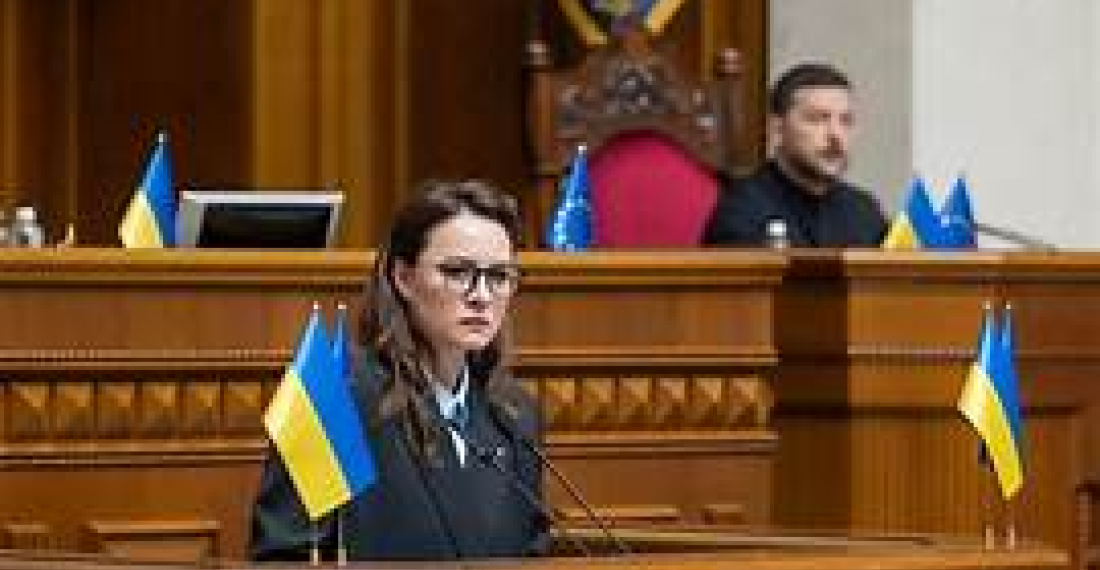
Ukrainian Prime Minister Yuliia Svyrydenko resigned on Sunday (July 12) after President Volodymyr Zelenskyy announced a broad restructuring of his government, saying Ukraine was "changing its political strategy." The overhaul, which requires parliamentary approval, would be the fourth major reshuffle of Ukraine's wartime administration since Russia launched its full-scale invasion in February 2022.
In a statement posted on X on July 12, Zelenskyy said he and Svyrydenko had agreed that "a reshuffle of the Cabinet is necessary." He thanked her "for her clear, steady and effective work as Prime Minister" and said she had been offered responsibility for "a new and important area of relations with a key partner," without identifying the country or specifying the position.
On the same day, Svyrydenko confirmed her resignation in a separate statement on X, describing it as "an honor" to have led the government "during one of the most difficult periods in Ukraine's modern history." She said she had discussed "next steps" with the president but did not elaborate on her future role. "I remain ready to serve the Ukrainian state and carry out every task aimed at strengthening Ukraine's position, defending our national interests and bringing a just peace closer," she wrote.
The 39-year-old economist became prime minister in July 2025 after previously serving as deputy prime minister and economy minister. During her tenure, she played a central role in securing a strategic minerals agreement with the United States, an initiative viewed as strengthening long-term U.S. engagement with Ukraine. She also helped manage the government's response to a major corruption investigation involving the state-owned nuclear company Energoatom, which resulted in the departures of several senior officials.
Under Ukrainian law, the resignation of the prime minister automatically triggers the resignation of the entire cabinet, with parliament required to approve both the government's resignation and the appointment of a new prime minister.
Zelenskyy has not announced who will succeed Svyrydenko: lawmakers from his Servant of the People party are scheduled to meet on July 14 to discuss the proposed changes to the government.
However, Ukrainian lawmakers have identified several possible candidates, including Energy Minister Denys Shmyhal, who served as prime minister from 2020 to 2025, Defense Minister Mykhailo Fedorov, and Naftogaz chief Serhiy Koretskyi. Opposition lawmaker Yaroslav Zhelezniak has suggested Svyrydenko could become Ukraine's next ambassador to Washington, although no official confirmation has been given.
Zelenskyy also announced planned changes to the leadership of Ukraine's law enforcement agencies and outlined several priorities for the incoming government. These include expanding licensed domestic production of U.S.-designed Patriot air defense systems, advancing Ukraine's European Union accession process, strengthening cooperation with Gulf states, and improving implementation of foreign policy commitments through dedicated senior officials.
Zelenskyy has regularly reorganized his administration during the conflict, arguing that renewed leadership is necessary to meet evolving wartime and diplomatic challenges. The newest reshuffle comes at a critical stage of the war, with Russia intensifying missile and drone attacks on Ukrainian cities while Kyiv continues long-range strikes targeting Russian military logistics and energy infrastructure.
Source: commonspace.eu with CBS News (New York), Deutsche Welle (Cologne), and Brussels Signal (Brussels). and agencies