Georgian electorate overwhelmingly votes for pro-European parties

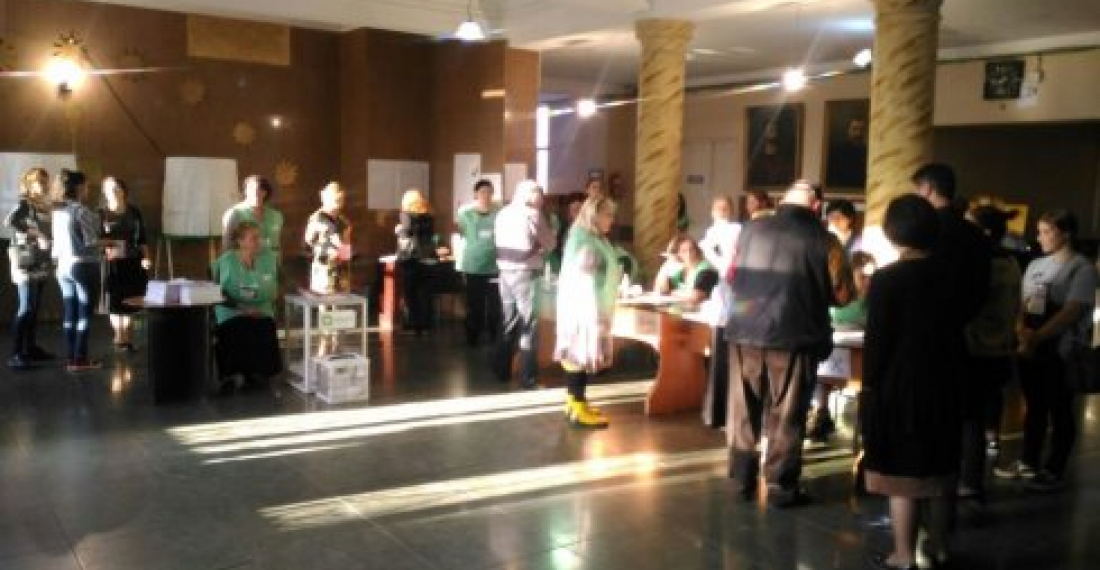
Elections were held in Georgia on 8 October, to elect a new 150-member parliament. The elections passed off peacefully, except for a handful of isolated incidents, and resulted in a convincing victory for the incumbent Georgian Dream (GD) party, which secured 48.65% of the vote. The United National Movement (UNM) retained its position as the main opposition party securing 27.13% of votes. Only one other party, the Alliance of Patriots, managed to pass the threshold to secure seats in the parliament, after getting 5% of the vote. A total of 1,814,276 voters cast their ballots, equivalent to 51,63% of the electorate.

The elections were deemed by a number of observers, as well as local civil society organisations, as having been the best ever held in the South Caucasian republic. This was due largely to the fact that they were competitive and well-organised, and held in an atmosphere where fundamental freedoms were respected. Over 80,000 local and international monitors, party representatives and journalists observed the election process, and ISFED, a respected local NGO, conducted a parallel vote tabulation which tallied with the official result.

There were a number of tense moments in the last phases of the campaign, on election day and during the counting process. An explosion in a car of an opposition MP, days before the poll, was completely out of tune with the rest of the election campaign which passed off remarkably peacefully. On election day, in one of the mainly Azerbaijani speaking regions, Marneuli, a crowd attacked a polling station; and during the count on the other side of the country, in Zugdidi, supporters of one candidate disrupted the counting. Overall however, the elections proved that democracy has taken root in Georgia.

GD hailed the election results as a vindication of its policies since taking power in 2012 in what remains a rare example of a peaceful transfer of power through the ballot box in the post-Soviet space. After agonising for several days on its post-election strategy, the UNM announced it will take its seats in Parliament, and participate in the second round of the elections, to be held later this month in those constituencies where the elections in the single seat majoritarian constituencies were inconclusive.

The vote gave an overwhelming endorsement to Georgia's pro-European parties. Both GD and UNM campaigned for closer relations with the EU and NATO, as did a number of other parties who did not win seats in the new parliament. The Patriots Alliance, a conservative force that has xenophobic tendencies, has an ambivalent position on the issue, although its leadership insists it is not against Georgia's European aspirations.

The election was a disappointment for a number of the smaller parties that failed to secure enough votes to pass the 5% threshold needed to get into parliament. The Republican party, led by the outgoing Chairman of Parliament, David Usupashvili, and the Free democrats, led by former Defence Minister, Irakli Alasania were among the parties that were squeezed out in the last days before the poll as the campaign turned into a polorised contest between GD and UNM. Supporters of the smaller parties at the last moment drifted back to the two main parties fearing their votes will be wasted if they vote for the smaller parties.

The elections on 8 October were not perfect, but they were the best Georgia ever held, and by far better than those seen in neighbouring countries. Georgia continues to be the exception in the post-Soviet space: determined to pursue a pro-European and Euro-Atlantic path, and embracing democratic principles and practices. These elections were a clear testimony of this.

The United States and the European Union congratulated Georgia on holding successful elections. A statement by the European Union stated that "The European Union is committed to a stable, democratic and prosperous future of Georgia. Once the electoral process has been completed, we look forward to working with the democratically elected new Parliament and Government to deepen our political and economic relations based on the joint commitments of the EU-Georgia Association Agreement. It will be important that all representatives elected to the new Parliament work together in the interest of Georgia."

Source: This report was prepared by the editorial team of Caucasus Concise


Related articles

Editor's choice
News
Russia adds pressure on Armenia ahead of key elections; recalls Ambassador in Yerevan for consultations

Russia adds pressure on Armenia ahead of key elections; recalls Ambassador in Yerevan for consultations

Ahead of key parliamentary elections,scheduled to be held in Armenia on Sunday, 7 June, Russia continues to attempt to put pressure on the Armenian Government led by prime minister Nikol Pashinyan. On 30 May, Russia recalled its Ambassador to Yerevan for consultations. A terse statement, published on the website of the Russian Foreign Ministry, said, "The Ambassador of the Russian Federation to the Republic of Armenia , S.P. Kopyrkin, has been summoned to Moscow for consultations in connection with the steps taken by the Armenian leadership to move closer to the European Union, which are detrimental to cooperation within the EAEU." This followed a statement issued the day before, by the leaders of the Eurasian Economic Union (EAEU) that challenges the Armenian trajectory towards approximating to the European Union. Vladimir Putin is undertood to have personally pushed the other four EAEU leaders to issue the statement, which said: "Taking into account the significant risks to the economic security of the member states of the Eurasian Economic Union (hereinafter referred to as the Union) arising in connection with the preparation of the Republic of Armenia for accession to the European Union, as well as the need to prevent the associated damage to the member states of the Union: decided that the members of the Eurasian Intergovernmental Council from the Republic of Belarus, the Republic of Kazakhstan, the Kyrgyz Republic and the Russian Federation will report at the next meeting of the Supreme Eurasian Economic Council in December 2026 on the possible consequences of the suspension of the Treaty on the Eurasian Economic Union with respect to the Republic of Armenia. We share the position on the need to hold a national referendum in the Republic of Armenia as soon as possible on joining the European Union or continuing to be part of the Eurasian Economic Union."
Editor's choice
News
The leaders of the states of the Eurasian Economic Union issued a tough statement warning fellow-member state Armenia of the consequences of its desire to join the European Union.

The leaders of the states of the Eurasian Economic Union issued a tough statement warning fellow-member state Armenia of the consequences of its desire to join the European Union.

The leaders of the states of the Eurasian Economic Union (EEAS) issued a tough statement warning fellow-member state Armenia of the consequences of its desire to join the European Union. The stark, sharply worded,  warning, comes days before crucial parliamentary elections in Armenia, scheduled for 7 June. The full statement said, “We, the Presidents of the Republic of Belarus, the Republic of Kazakhstan, the Kyrgyz Republic and the Russian Federation, Taking into account the actions of the Republic of Armenia aimed at joining the European Union, including the approval in 2025 by the National Assembly of the Republic of Armenia and the signing by the President of the Republic of Armenia of the Law of the Republic of Armenia "On the Start of the Process of Accession of the Republic of Armenia to the European Union", as well as the confirmation by the European Union of the European aspirations of the Government of the Republic of Armenia, expressed in the joint declaration following the first Armenia-European Union summit, adopted on 5 May 2026, Taking into account the significant risks to the economic security of the member states of the Eurasian Economic Union (hereinafter referred to as the Union) arising in connection with the preparation of the Republic of Armenia for accession to the European Union, as well as the need to prevent the associated damage to the member states of the Union: decided that the members of the Eurasian Intergovernmental Council from the Republic of Belarus, the Republic of Kazakhstan, the Kyrgyz Republic and the Russian Federation will report at the next meeting of the Supreme Eurasian Economic Council in December 2026 on the possible consequences of the suspension of the Treaty on the Eurasian Economic Union with respect to the Republic of Armenia. We share the position on the need to hold a national referendum in the Republic of Armenia as soon as possible on joining the European Union or continuing to be part of the Eurasian Economic Union. Astana, May 29, 2026” A meeting of the Supreme Eurasian Economic Council was held in Astana, Kazakhstan, on May 29, 2026. The meeting of the Supreme Eurasian Economic Council in a restricted format was attended by Russian President Vladimir Putin, Belarusian President Alexander Lukashenko , Kazakh President Kassym-Jomart Tokayev , Kyrgyz President Sadyr Japarov , Armenian Deputy Prime Minister Mher Grigoryan, and Chairman of the Board of the Eurasian Economic Commission Bakytzhan Sagintayev. From the Russian side, the meeting was also attended by Deputy Prime Minister and member of the Council of the Eurasian Economic Commission Alexey Overchuk and Presidential Aide Yury Ushakov . The heads of delegations from EAEU observer states, including President of Uzbekistan Shavkat Mirziyoyev , Vice President of Cuba Salvador Valdés Mesa, Minister of Industry, Mines, and Trade of Iran Mohammad Atabak, and CIS Secretary General Sergei Lebedev, joined the expanded meeting . Following the meeting of the Supreme Eurasian Economic Council, a number of documents were signed .

Popular

Editor's choice
Interview
Thursday Interview: Murad Muradov

Thursday Interview: Murad Muradov

Today, commonspace.eu starts a new regular weekly series. THURSDAY INTERVIEW, conducted by Lauri Nikulainen, will host  persons who are thinkers, opinion shapers, and implementors in their countries and spheres. We start the series with an interview with Murad Muradov, a leading person in Azerbaijan's think tank community. He is also the first co-chair of the Action Committee for a new Armenian-Azerbaijani Dialogue. Last September he made history by being the first Azerbaijani civil society activist to visit Armenia after the 44 day war, and the start of the peace process. Speaking about this visit Murad Muradov said: "My experience was largely positive. My negative expectations luckily didn’t play out. The discussions were respectful, the panel format bringing together experts from Armenia, Azerbaijan, and Turkey was particularly valuable during the NATO Rose-Roth Seminar in Yerevan, and media coverage, while varied in tone, remained largely constructive. Some media outlets though attempted to represent me as more of a government mouthpiece than an independent expert, which was totally misleading.  Overall, I see these initiatives as important steps in rebuilding trust and normalising professional engagement. The fact that soon a larger Azerbaijani civil society visits to Armenia followed, reinforces the sense that this process is moving in the right direction." (click the image to read the interview in full)