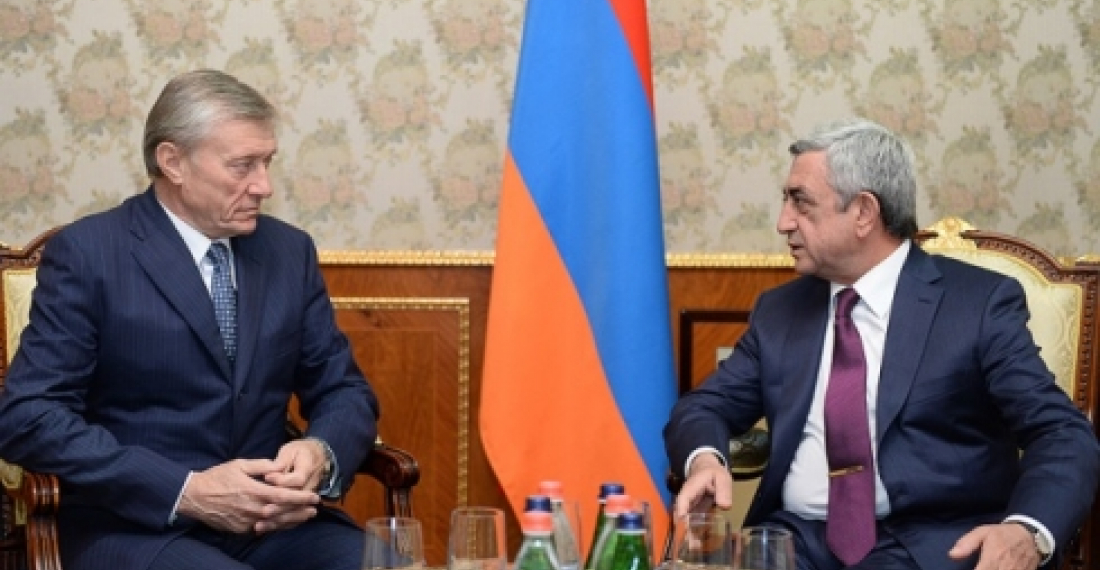
The visit of Nikolai Bordyuzha, the secretary general of the Collective Security Treaty Organization (CSTO) to Yerevan last week, and his subsequent trip to inspect the border between Armenia and Azerbaijan, has increased speculation about potential CSTO entanglement with the Karabakh conflict. The CSTO is a Russia led military alliance. The other members are Armenia, Belarus, Kazakhstan, Kyrgyzstan and Tajikistan.
In Yerevan, Bordyuzha, who is usually greeted and feted during his regular visits to the Armenian capital, was this time publicly rebuked by Armenian president Serzh Sargsyan. Both Sargsyan and Bordyuzha stated that the visit was directly connected with the serious incidents that took place in the summer in which a number of Armenians and Azerbaijanis were killed. Armenia is unhappy with the lack of solidarity by other members of the CSTO alliance.
According to the official website of the Armenian President:
"The president underscored that the position of a number of CSTO partners on issues being of paramount importance to allies, particularly on the Nagorno-Karabakh conflict, expressed in different international platforms, do not correspond to the common spirit of the negotiation process, contradict the statements and proposals of the OSCE Minsk Group, as well as to the documents endorsed within the framework of the CSTO."
Whilst the CSTO has in the past supported Armenia militarily with arms and training, as befits its status as a member of the alliance, it has largely kept away from being directly involved in the Karabakh conflict. This was mainly due to hesitation on the part of its other members to alienate Azerbaijan. Armenia now looks poised to leverage its influence as one of the CSTO's most active members to secure the backing of the organisation in its dispute with Azerbaijan. Many consider this to be an ominous sign with possible significant implications.
Regional analyst Richard Giragosian suggested Bordyuzha's visit to the border offers the Russian government an increased leverage and a stronger bargaining position with Azerbaijan. Russia is already the largest arms supplier to both Armenia and Azerbaijan, but whilst Armenia is heavily dependent on Russia economically, Azerbaijan has been able to forge a more independent foreign policy, thanks to its revenue from the sale of oil and gas.
In Yerevan, Bordyuzha was largely non commital, only saying that ahead of the upcoming session of the CSTO Council he is now studying the most acute security problems facing CSTO member states. "According to him, there are a few of them, including the situation pertaining to the mentioned heightened tensions in summer. Referring to the meetings held by the President of the CSTO Council Vladimir Putin in connection with those events, Nikolay Bordyuzha expressed the opinion that it is necessary to report and to discuss all those issues which can seriously affect the security of the CSTO member states at the upcoming session of the CSTO Council", the website of the Armenian President reported.
Commonspace.eu political editor said in a comment:
"Russian President Vladimir Putin has over the last year exerted considerable effort to bring Azerbaijan more tightly within the Russian sphere, and there are some signs that this policy is succeeding. An important test will come if Azerbaijan is persuaded to accept Russian or Russian-led CSTO peace-keepers in the Nagorno-Karabakh conflict zone. This possibility had been suggested when the cease fire between Armenia and Azerbaijan was agreed twenty years ago, but was then rejected outright by the late president of Azerbaijan, Heidar Aliev. Nikolai Bordyuzha's visit to the Armenia-Azerbaijan border, even though not directly in the conflict zone, may suggest that such a possibility is now again under consideration, although there has been no indication yet that Azerbaijan is about to change its stance of refusing Russian/CSTO peacekeepers. Last weeks' developments also reflect certain Armenian impatience with its CSTO allies and soon to be Eurasian Union partners. All have good relations with Azerbaijan and have made it clear that they are not willing to sacrifice them for the sake of Armenia. Armenia may therefore be learning the hard way that solidarity, and even military alliances, have their limitations. Furthermore any CSTO entanglement with the Karabakh conflict is bound to further complicate an already difficult situation."
source: commonspace.eu
photo: President Serzh Sargsyan with the Secretary General of the Collectiuve Security Treaty Organisation (CSTO) in Yerevan on 6 October 2014.