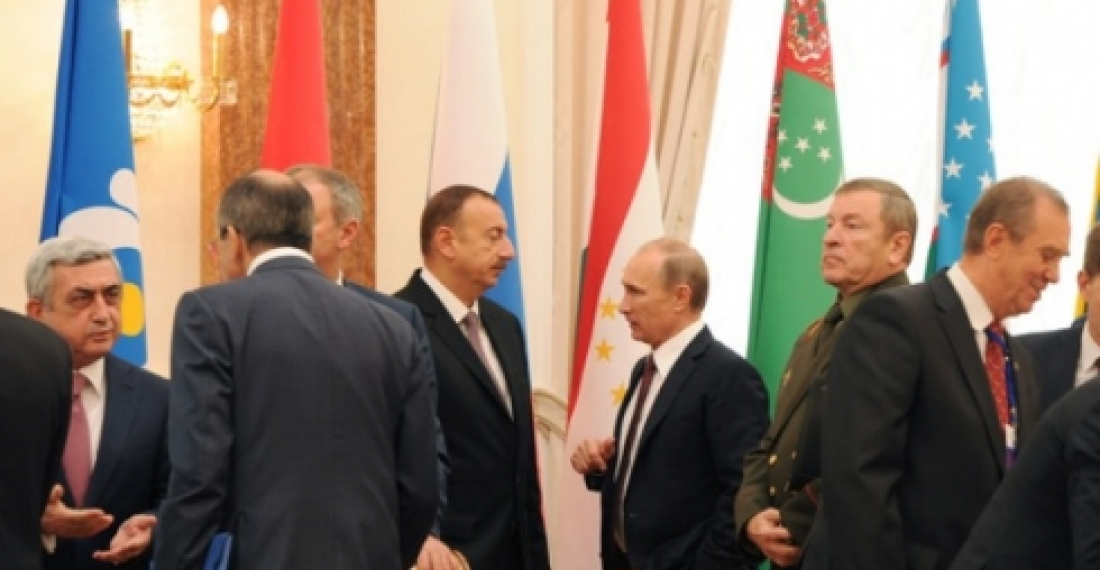
A summit meeting of the heads of state of the Commonwealth of Independent States (CIS) took place in Minsk, the capital city of Belarus, on Friday 10 October. This was the first full summit since the Ukrainian crisis erupted earlier this year. In many ways the crisis has highlighted the failure of the CIS as an efficient organisation that can deal with the many challenges that continue to overshadow the post-Soviet space nearly a quarter of a century after the collapse of the USSR.
The biggest challenge of all is how to manage the relationship between Russia and the other members. Some of the CIS members still think the CIS can offer a framework for defining Russia's role, and tame its expansionist instincts. But an underlying sense of exasperation pervades. The three Baltic republics never joined after the collapse of the USSR, and instead quickly became members of the European Union. Georgia joined late and left early. It also had hopes that the CIS could help redefine its relations with Russia, but bitterly disappointed after Russia recognised Abkhazia and South Ossetia, left the group in 2009. This year Ukraine started the process to leave the CIS also. This is not surprising following Russia's occupation and annexation of Crimea, in gross violation of Ukraine's territorial integrity - of which Russia, ironically, was a guarantor. Ukraine was only represented in Minsk at Ambassador level, as befits a country that is at the exit door.
The other participants tried hard to put up a brave face, hailing the CIS as an important forum in their set-piece speeches.
The activities of CIS have always complied with the principles of equality, mutual respect, good neighborhood and goodwill of all member states, Turkmen President Gurbanguly Berdimuhamedov said, according to Russia-24 TV channel. "Turkmenistan is confident that the potential of CIS may and should be used to maintain the regional security balance, prevent conflicts and approve the negotiation tools as the natural and acceptable means of resolving them," Turkmen president said.
Uzbekistan regards the CIS as a structure which gives great opportunity to maintain direct international dialogue, said Uzbek President Islam Karimov. He added that the CIS creates conditions to discuss vital issues, resolve the disputes and disagreements among the member states on the basis of the sufficiently strong legal framework, as well as the created mechanisms and tools of interaction.
Azerbaijan's President, Ilham Aliev, spoke of the need to discuss all issues of concern "in such an open and sincere atmosphere". He went on to add that Azerbaijan attaches great importance to its participation in the CIS.
In fact none of the big issues facing the CIS countries, including the serious differences between them, that has often led to violent confrontations between them, was on the agenda at the summit. Instead there were sharp exchanges between the Presidents of Russia and Moldova, criticism of the President of Ukraine for his absence, and a distinct cold atmosphere between some of the participants.
The leaders sought refuge in hankering back to the great victories of the Great Patriotic War (World War II). Russia's President, Vladimir Putin reminded his colleagues that next year would be the 70th anniversary of the end of that war. "Our common duty is to celebrate this momentous anniversary together," Putin said, whilst also taking the opportunity to invite his colleagues for the celebrations next May in Moscow.
Attempts to give the CIS some real significance have been ongoing throughout its existence. It seems that Kazakhstan, which now takes over the Chairmanship and will host the next Summit in Astana late next year, will have another go. Kazakh President Nursultan Nazarbayev said that the country will continue to work to turn the CIS into a framework for trade and economic relations, as well as making it a free trade zone. "Further cooperation covers transit and transport sphere, agro-industrial complex and food security," Nazarbayev said, adding that during its presidency of the CIS, Kazakhstan will also focus on issues of security in the sphere of humanitarian cooperation.
Commonspace.eu political editor said in a comment:
The biggest problem of the CIS is that it continues to be perceived both by its members and by the wider international community as an instrument of Russia. Whilst this is largely true, Russia has however failed to turn it into a genuine forum where problems between itself and the other members, and between the other members themselves, can be ironed out. So every time there has been a crisis in the region, the CIS has always found itself relegated to a passive, and largely useless role. Yet for both Russia and the other members it also has its uses, a channel of communication and an opportunity to reassure those in their respective countries who are still nostalgic for the past that all is not lost. Real co- operation in the post-Soviet space has however now shifted to other structures, including the newly established Eurasian Economic Union, and the Collective and Security Treaty Organisation. Here co-operation is more tangible. But not everybody who was in Minsk is ready for this type of co-operation. Moldova has already clearly opted for closer relations with Europe, and Azerbaijan and Turkmenistan are too protective of their national independence to follow Russia's lead. Putin's dream of recreating the USSR in some kind of modern version remains for the moment therefore a faraway utopia and is unlikely ever to be achieved except through force.
source: commonspace.eu, with additional reporting from news agencies.
photo: Leaders of CIS countries chatting informally after their summit in Minsk on 10 October 2014. relations between some of them was reported to be considerally chilly.