Opinion: 'Controversy over the use of the term "genocide" should not hinder the solemn and dignified marking by all of one of the darkest pages in 20th century human history.'
(This is an op-ed prepared by the political editor of commonspace.eu.)
Armenians all over the world are preparing to mark the 100th anniversary of the events in Anatolia during World War 1 which resulted in the massacre of large numbers of Armenians, and the forced displacement of many others. The Armenian Genocide, as it is often referred to, was one of the darkest pages in the history of mankind in the 20th century.
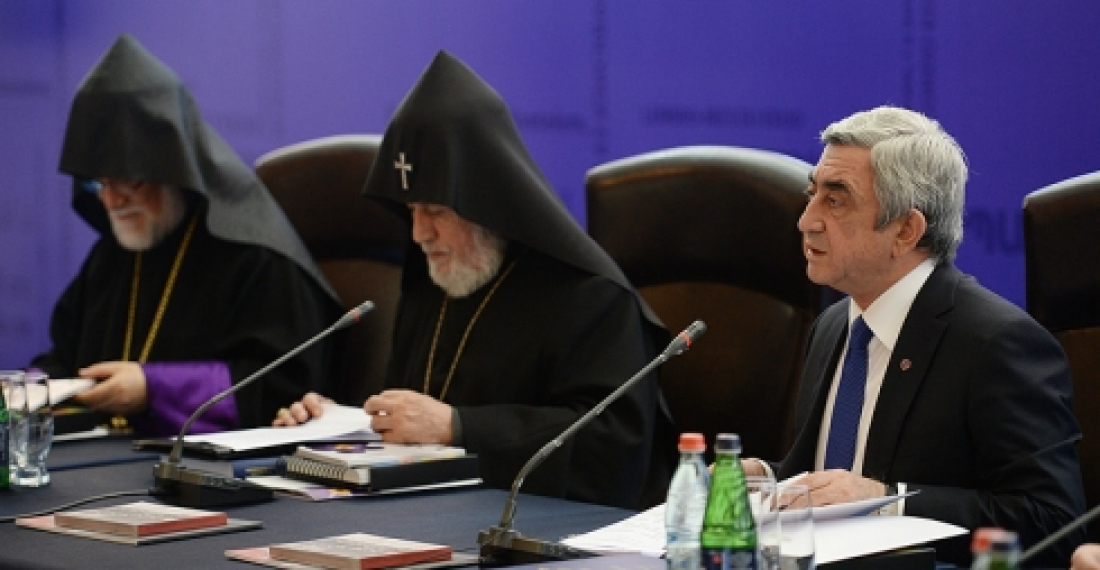
Last week, the State Commission set up to commemorate the anniversary met in Yerevan for its fifth meeting under the chairmanship of the President of Armenia, Serzh Sargsyan. According to the Press Service of the Armenian President, "besides the commission members, representatives of regional centenary committees, experts, diplomatic representatives of the Republic of Armenia and leaders of the Armenian Apostolic Holy Church dioceses took part in the enlarged session. The commission members discussed the political context around the 100th anniversary of the Armenian Genocide, the issue concerning the adoption of the Pan-Armenian Declaration on the 100th Anniversary of the Armenian Genocide, as well as issues pertaining to the commemorative events and the works of compiling a package of legal claims on overcoming the consequences of the Armenian Genocide."
The marking of the anniversary is not short of controversy. Speaking to the Commission, Armenian President Sarsyan said:
".... I sent invitations to a number state leaders and heads of key international organizations to take part in the centenary events. I would like to inform you that a series of states and organizations have accepted them. Some states have confirmed their presence through high-level delegations. Some of them have noted that they want to spend that day together with the Armenian communities of their countries. I am asking both the state commission members and the regional committees to join the diplomatic representatives of the Republic of Armenia in ensuring as broad participation as possible in the coming events and in the international media forum to be held at the end of March. It is particularly important, taking into account Turkey's short-sighted and cynical decision to edit its own history through marking the anniversary of the Gallipoli Battle on the day commemorating the 100th anniversary of the Armenian Genocide. It is said that in politics all means are good, but I think that by doing it, official Ankara did itself a disservice."
Turkey continues to reject the claim that what happened in Anatolia in 1915 was a genocide. The present Turkish government has taken some modest steps to reconciling its position with that of Armenia, but for Armenians this is not enough, and the anniversary is bound to be a divisive one. It is not only Turkey however that has a problem with the characterisation of the massacres as genocide. Most countries argue that since the term genocide was accepted as a legal term after the second world war it cannot be used in the context of events that happened thirty years earlier. The issue is not simply one of semantics, but has huge legal and financial implications, not least since a perpetrator of genocide would have to pay compensation, which in this case will amount to billions of dollars to levels which no one has as yet quantified.
These differences however should not be allowed to hinder the commemoration of the anniversary. Controversy over the use of the term "genocide" should not hinder the solemn and dignified marking, by all, of one of the darkest pages in 20th century human history. Many had hoped that the 100th anniversary will bring a closure to the controversy and some way could be found to reconcile the different positions. Clearly this has not happened. The anniversary unfortunately will be divisive, possibly creating even new divisions. This is very unfortunate. This notwithstanding however the anniversary will offer an opportunity for one and all to reflect on what happened one hundred years ago. Those who do so also need to reflect on how to go forward. How to ensure that such human tragedies do not happen again, and on how establishing peace in the Caucasus must be one of the priorities in this direction.
This op-ed was prepared by the political editor of commonspace.eu.
photo: President Serzh Sargsyan with leaders of the Armenian Aposrtolic Church at the fifth session of the State Commission on Coordination of events for commemoration of 100th anniversary of Armenian Genocide held in Yerevan on 29 January 2015. (Picture courtesy of the Press Service of the President of Armenia).