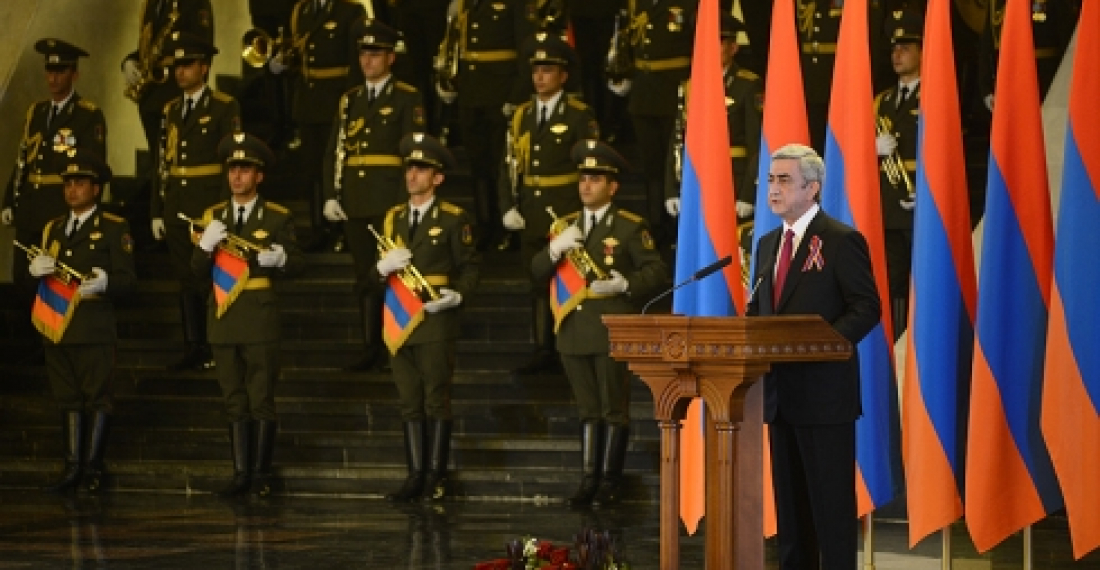
Armenia on Saturday celebrated the 22nd anniversary of its independence. President Serzh Sargsyan visited the Yerablur pantheon to pay tribute to the memory of those that sacrificed their lives for Armenia's independence.
He was accompanied by the Catholicos of All Armenians Garegin II, and the President of the Nagorno-Karabakh Republic Bako Sahakyan and other high-ranking Armenian officials. President Sargsyan addressed guests at a reception at the Karen Demirjian Sport and Concert Complex during which he outlined the vision that guides the current Armenian authorities in their endeavours.
The President said,
"For a long time our nation was compelled to solve not development but primarily existential problems. Today, the task has changed: now we are calling to life projects which are dealing with the strengthening and development of the Armenian Statehood. Certainly, security is the number one priority for everyone in this world, and we are no exception. Security-related issues will always be in the focus of our attention, just as they are today. We are constantly searching for ways to boost our economy, and we have achieved certain results. We are setting goals to expand the borders of possible, so that each year with a precise regularity we are able to increase salaries and pensions. Along the way, we are carrying out our reforms, which provide steady development for stronger democracy, good governance, the rule of law, and progress in all other areas. Our policies are directed towards these objectives.
The stance of the Armenian authorities and our society is clear-cut. We have had enough of wars, perturbations, abrupt U-turns and adventurism. We need unfailing defense, peaceful work and sustainable development, and we are doing just that. Perhaps a little slowly, perhaps with some slip-ups along the way but definitely not when it comes to the most important issues and definitely not when it comes to fateful decisions.
Armenian State means realization of the Armenian dream - this is the greatest symbolism of today's holiday. The re-establishment of our independence in 1991 made our nation's centuries-long dream come true. Our brothers and sisters in Diaspora and, first and foremost, the citizens of Armenia nourish and make part of their own dream, which came true. Are we able to raise our dream fulfilled to new heights in the contemporary world? Yes, we are, if we neither underestimate, nor overestimate our capabilities. For one who is traveling down a rocky pathway it is absolutely crucial to evaluate painstakingly each step along the way."
Commonspace.eu political editor said in a comment:
"This was the first independence anniversary since President Sargsyan's re-election for a second term earlier this year. In his speech marking Independence Day the President sought both to appeal to the nation to take strength from the battles of the past, but also to be confident of the future, making it clear that 'the sovereignty of Armenia was unalterable under any circumstance.' Armenia faces a number of challenges with regards to its internal political system, its economics, as well as its security. Sargsyan's speech was a rallying call for Armenians to unite around the core idea of statehood. Sargsyan is a cautious politician, and this was also reflected in his speech. He told his audience 'For the last twenty-two years, we have been traveling a new road, which has often appeared narrow and rocky just as our mountain pathways. We have been moving forward cautiously and prudently because we carry great responsibility on our shoulders,' a message perhaps to his critics who accuse him of presiding over a period of stagnation and who want to see changes in the country faster."
source: commonspace.eu
photo: President Sargsyan making his Independence Day address in Yerevan on 21 September 2013.(Photo courtesy of the Press Office of the President of Armenia.)