The Russian Newspaper Nezavisimaya Gazeta carried the folllowing article on the forthcoming Summit of the Commonwealth of Independent States to be held in Dushanbe on 2-3 Septemberhe (reprinted here from a translation from news.az)
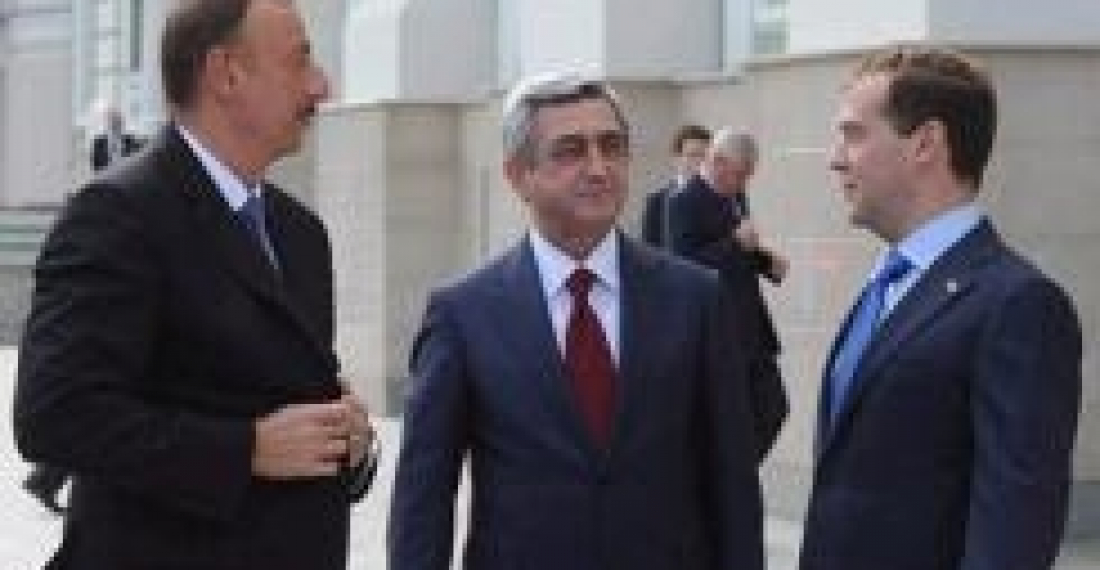
Instead of celebrations of its 20th anniversary, the CIS will have to calculate losses on that day. President of Azerbaijan Ilham Aliyev will not come to Dushanbe to attend the Commonwealth summit scheduled for 2-3 September. The reason is supposed to be the failed talks on Karabakh, which Aliyev held with Dmitriy Medvedev in Sochi.
Experts consider this step to be a signal to Moscow-Russia ceases to be a mediator in the conflicts resolution in its partners’ eyes. Additionally, fraternal capital cities accuse it of launching commercial wars to inflict economic and political compromises that are favorable for the Kremlin. These opinions are primarily voiced in GUAM states including Georgia, Ukraine, Azerbaijan and Moldova.
Thus year, declared the year of CIS in the Commonwealth countries, turned not the luckiest one, especially in integration affairs that were planned to move beyond the Customs Union (Russia, Belarus, Kazakhstan).
“Putin has practically blocked the free trade area, which was the goal of all the CIS countries. Without it, all the rest programs of the Commonwealth, that are variants of mutual assistance in different spheres, are a ground to ask: why is that? It is especially actual in Ukraine, where people say that Gazprom is preparing a new gas war for us, pushing us to membership in the Customs Union”, said director of the Kiev Institute of Political Analysis and International Research Sergey Tolstov.
He said Viktor Yanukovich will not follow Ilham Aliyev’s example and will not reject participation in Dushanbe directly. However, if the style of relations that Moscow uses in the dialogue with CIS partners continues, the Ukrainian President will find many other ways to avoid the Commonwealth summits. “The factor that the CIS can be used as a area to smooth differences between the commonwealth members, will stop working now”, Tolstov said.
“The fact that Aliyev has done this step is bad for Russia, since it is losing its image of a mediator in its partners’ eyes, gaining another one of an Armenian lobbyist. The steps of Aliyev, a cautious and wise politician, show (from Aliyev’s positions) what he has been brought to. It is sad also for the CIS, which marks its 20th anniversary without Georgia”, the expert of the Moscow Center of Carnegie Alexei Malashenko said.
“Aliyev’s step confirms disability of the CIS. The proof is the constant trade wars and interstate conflicts in its framework”, Malashenko commented to NG.
The report that Azerbaijani President Ilham Aliyev will not take part at the upcoming summit of the CIS heads of states came yesterday, causing a plenty of questions. The main is that why official Baku changed its decision three days after it first confirmed its participation. Official sources do not comment on the reason of such an unexpected change of plans.
It has promoted suppositions that Aliyev’s demarche is mostly connected with the recent events in the negotiation process to settle the Armenian-Azerbaijani conflict over Nagorno Karabakh. They say that Baku is not satisfied with the position of mediators, particularly, their unwillingness to exert pressure on Armenia, which has been holding seven biggest and economically important regions of Azerbaijan under occupation for almost 20 years.
“Azerbaijan does not ignore the CIS summit and will be represented at the high level-by head of the Cabinet of Ministers Artur Rasizade. I will not be surprised if leaders of some other CIS countries will do the same. It is not the first time that it occurs, which is why the situation should not be dramatized”, famous political scientist, member of the committee on international relations of the Azerbaijani parliament Rasim Musabayov told NG.
He said ‘even format CIS summits have turned into a club of post-Soviet presidents. The meetings of the past decades adopt and implement decisions only on minor, rather ritual issues like celebrations of a jubilee of victory in the Great Patriotic War. For this reason, the summits are interesting as a venue for bilateral meetings. It is not a secret that most presidents arrive to the CIS summit, if they have a preliminary agreement about the meeting with the Russian president. In this sense, there is no motivation for participation of President Aliyev in the CIS informal summit in Dushanbe, Musabayov said.
“Azerbaijan maintains stable bilateral relations with all CIS countries and these relations do not need the CIS support. Ilham Aliyev has met the Russian president Medvedev just recently in Sochi and discussed the Russian-Azerbaijani relations and the situation around the Karabakh issue in detail”, Musabayov said. All the same, he said ‘the stiff determination of the Armenian side to promote the possibility of secession of Nagorno Karabakh in any form has done the continuation of the negotiation process unpromising at this stage. For this reason, the trilateral meeting of Aliyev, Medvedev and Sargsyan is senseless and not planning. In this case, there is no need to go to Dushanbe and waste time”, said the political scientist.
Azerbaijan and Ukraine are members of GUAM, the regional organization, once founded as an element, curbing Moscow’s ambitions in the post-Soviet area. Georgia was first to quit the CIS. Moldova was also ready to do so, but it follows its more influential neighbor-Ukraine. The latter is by far trying to preserve friendly ties with ‘fraternal’ Russia. But these relations have currently been put to the test. Yanukovych, who also have other commitments, for instance, towards the EU and IMF cannot ignore them, as he cannot do so with the national interests of his country.
The Ukrainian president also does not want to give its own transportation system to Russia, like Belarus did. “Yanukovych will never give the keys to the internal market of Ukraine to Russia”, Tolstov said. He noted that ‘Moscow will exert pressure on Kiev to force Ukraine to the transit agreement to prove to the EU that the Ukrainian transit is not reliable and thus lobby the Southern stream. For this reason, it is not ruled out that Ukraine should be expected to be the next to make a step back from the CIS. There is no doubt that in this event, Moldova will follow it.
Analysis
Russian newspaper speculates about the absence of Ilham Aliev from the summit of the CIS in Dushanbe on 2-3 September