Analysis: The body of a dead soldier becomes the latest bargaining chip in the messy Karabakh conflict.

This analysis was prepared by the editorial team of commonspace.eu

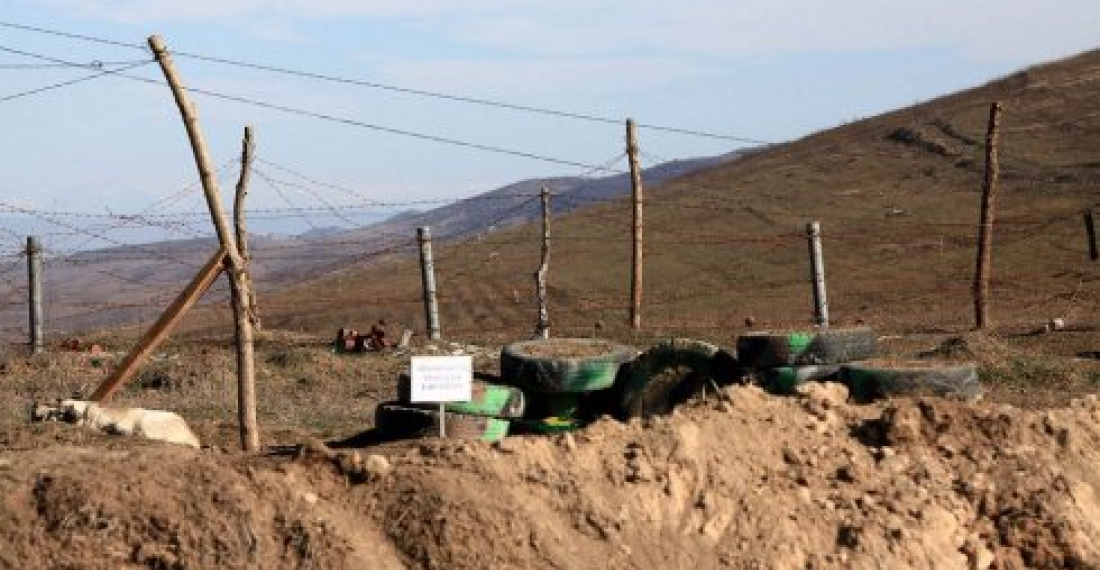
Early on the 29 December, as the world was preparing to say farewell to a difficult 2016, and to welcome in the new year, an incident happened on the international border between Armenia and Azerbaijan, some distance away from the Nagorno-Karabakh conflict zone, as a result of which both sides suffered casualties. The numbers are not clear since both sides give conflicting accounts of the incident, and of the number of people killed or wounded. Both sides accuse the other of provoking the incident, and of subsequently giving a response..

This incident has some different characteristics to similar occurences happening on a regular basis around Nagorno-Karabakh. There was an almost instant response from the Collective Security Treaty Organisation (CSTO), the Russia led military organisation of which Armenia is a member, but Azerbaijan is not. The position of the CSTO has always been that it cannot get involved in incidents in the Karabakh conflict zone, but that the international border was a different matter. This was an opportunity for the organisation to proof the point. It did, in a statement by its Secretary-General, Nikolay Borduzha within hours of the incident being reported, expressing concern but also adding,

 "We assess such actions in the territory of a CSTO member state as a provocation, especially against the backdrop of the quite serious incident in the Nagorno-Karabakh Republic, in April of this year, with the use of heavy weapons and military equipment".

Without mentioning Azerbaijan by name, by saying that the incident happened on the territory of a member state (which could only mean Armenia since Azerbaijan is not a member) the statement suggested that this was an Azerbaijani incursion into Armenian territory. Furthermore the reference to the "Nagorno-Karabakh Republic" - the unrecognised entity that de facto controls the territory of Nagorno-Karabakh with Armenian support - was unprecedented in a statement by an international organisation. As expected, Azerbaijan's reaction was furious.

The following day, Armenia used facebook to tell the world that it had responded to the incident.  In an entry on the page of the spokesperson of the Ministry of Defence of Armenia, Artsrun Hovhannisyan, 

"The logical development of the Azerbaijani provocation on Thursday took place tonight. The Armenian army divisions carried out retaliatory actions, and as a result, the adversary suffered four more casualties"

The situation on the ground stabilised by New Year's Eve, but the political fall out continues. Unlike during the escalations in April of last year, when Moscow seemed to be on top of things from start to finish, this time round the Kremlin appears to have been caught unawares. A terse statement was issued by the Russian Foreign Ministry on 30 December, said

"According to information, clashes have occurred on the Armenian-Azerbaijani border. Casualties are reported among the troops on both sides. We express our condolences to the families who lost their loved ones. We urge the parties to continue adhering strictly to their obligations to maintain the ceasefire and immediately take all necessary steps to stabilize the situation. As for the statement of Secretary General of the Collective Security Treaty Organization, the position of the CSTO member states on the Nagorno-Karabakh conflict is clearly expressed in their joint statement in Yerevan on October 14, 2016".

In the meantime, it was also announced that Nikolay Borduzha's term as CSTO Secretary General expired on 31 December. No replacement has yet been named. The Armenians say it is their turn to hold the position, but there is evident disagreement within the CSTO on the matter. It is not clear if Borduzha was forced to retire, even before his successor has been named - as the Azerbaijanis seem to suggest, or whether the normal procedure  was followed, and he simply retired on the day that his mandate expired. Armenian officials continue to insist that the next Secretary General should be Armenian, although a decision on this is now not likely before April. The controversial 29 December statement continued to appear for a few days on the CSTO website, but when accessed on 12 January, the website was down, and a notice said that it was under construction. (see link)

The rest of the international community watched all this in silence, partly because it was holiday time in Europe and elsewhere, partly because it was trying to understand what was going on. Finally, a statement was issued by the OSCE Minsk group co-Chair countries on 9 January, twelve days after the original incident took place. By this time, another issue had cropped up. Armenia was holding the body a of dead Azerbaijani soldier killed in the original skirmish on 29 December, and was by all accounts refusing to hand it over. The statement of the co-Chair therefore had also to take this into account, as it was now under a lot of pressure from Azerbaijan to solve this issue. The statement of the co-Chair therefore said,

"Baku and Yerevan continue to accuse each other of a December 29, 2016 attempted incursion on the Armenian-Azerbaijani border resulting in casualties. Armenian Armed Forces are still holding the body of an Azerbaijan serviceman killed in the fighting.

Violations of the ceasefire are unacceptable and are contrary to the acknowledged commitments of the Parties, who bear full responsibility, not to use force. The Co-Chairs urge the leaders of Armenia and Azerbaijan to strictly observe the agreements reached during summits in Vienna and St. Petersburg in 2016, including obligations to finalize in the shortest possible time an OSCE investigative mechanism. The Co-Chairs also urge the return, without delay, of human remains, in accord with the agreements of the Astrakhan Summit of 2010, bearing in mind the exclusively humanitarian nature of this issue. We call upon the Parties to cease mutual accusations and undertake all necessary measures to stabilize the situation on the ground."

These developments are a classic example of how the current situation around the Karabakh conflict can easily spiral into a complicated international dispute, and the weakness of the ability of the international community to even assess the situation on the ground, let alone control it. The Armenians insist that they have proof that the incident was provoked by Azerbaijan and that it was initially an Azerbaijani incursion. The Azerbaijanis dismiss this outright, and say that Armenia was trying to create an incident that could embroil the CSTO in the conflict.

However, once more, one other ugly aspect of this conflict has emerged. Not for the first time, we are seeing a blatant violation of international humanitarian law. There is enough anecdotal evidence to suggest that both sides committed serious violations international humanitarian law during the April 2016 fighting. On this occasion Armenia's refusal to hand back the body of a dead soldier is unacceptable. The ICRC is working hard to get this matter resolved as soon as possible. An ICRC spokesperson in Baku said on Tuesday (10 January) "We acknowledge that an investigation is going on in Armenia regarding that incident. Nevertheless the body should be returned as soon as possible to the family. The ICRC stands ready in its role of neutral intermediary to enable the handover of the body".

It is unfortunate and unacceptable that the body of a dead soldier has become the latest bargaining chip in this sad saga.

The international community in the meantime needs to be extremely vigilant and not take its eye off the ball in the Karabakh conflict. This will be more and more difficult in what is a very difficult time for the international system, but the consequences of failing to react firmly and in a timely manner to incidents may have grave consequences.

This anlaysis was prepared by the editorial team of commonspace.eu



Latest

Editor's choice
Monday Commentary
Monday Commentary: PEACE IN OUR TIME?

Monday Commentary: PEACE IN OUR TIME?

Making peace between Armenia and Azerbaijan was never going to be simple, nor easy, nor quick. It is taking time, writes Dennis Sammut in this Monday Commentary. “There is a sense of realism coming from the leaders of the two countries – President Ilham Aliyev of Azerbaijan and prime minister Nikol Pashinyan of Armenia, that frankly, is necessary and welcome”, he writes. At a time when conflicts are raging all over the world – from Ukraine to the Gulf, from Africa to South Asia, the prospect that Armenia and Azerbaijan had finally, after decades of conflict that left thousands of dead and many more displaced, decided on embarking on a journey of peace was welcomed. Peace between Armenia and Azerbaijan can be top-down up to a point. Both leaders have spent political capital preparing for a peace deal. But both are aware that their people are not ready for peace yet. In fact, in Armenia, most of the elite are negative toward a peace deal with Azerbaijan. Pashinyan needs time to persuade his countryfolk. That is why 2031 is realistic. Ilham Aliyev runs a tighter shop, but he is also not immune to public opinion. Every time someone hits a landmine in Karabakh, which unfortunately happens often, peace comes into question. Which is why Aliyev chooses to sound hardline, more often than not. In pursuing the peace agenda, both Aliyev and Pashinyan need to proceed cautiously. But they are right in making peace the central issue in their agenda. It is the main issue, and the one that will define them in history. So forward, cautiously but resolutely! In pursuing the peace agenda, Aliyev and Pashinyan need to be supported clearly and unambiguously. There are too many people in Baku and Yerevan who are sitting on the sides, waiting. The international community is not doing enough. It is time to be counted. Otherwise, the spoilers will win, and the region will go back to its bad habits. (Click the image to read the full commentary).

Popular

Editor's choice
Monday Commentary
Monday Commentary: European-Azerbaijan relations need an intensive and multifaceted dialogue that is frank and honest

Monday Commentary: European-Azerbaijan relations need an intensive and multifaceted dialogue that is frank and honest

Last week I visited Baku, Azerbaijan. My visit was relatively short, but very intensive, and had many meetings with stakeholders and colleagues. When I arrived in Baku first time in 1996,  Azerbaijan was a different country: weak, poor, and shaken by defeat in war. For thirty year the Karabakh issue dominated the agenda: the political agenda but also the popular mindset. Now, thirty years later, Azerbaijan has returned to Karabakh, and peace with Armenia is on the horizon. It is a new era for Armenia-Azerbaijan relations, for the South Caucasus, but also for Europe.  But we cannot be complacent: the Peace agreement has been initialed but not signed; borders remain closed; TRIPP is ambitious but remains an idea; and there are spoilers who want to turn the clock back. We must not allow them, and in this Europe and Azerbaijan must work together. Europe’ vanguard organization is the European Union – it is a free union of 27 member states; it is a strong global economic force, and increasingly a diplomatic and military force too. But it remains “work in progress” and can often appear dysfunctional. It often lacks collective and institutional memory. In its dealings with Azerbaijan the EU has made many mistakes – not least opening the delegation here late – in 2008. It sometimes appears condescending. Some utterances from the European Parliament and from some quarters in some member states are not understandable even for me. They irritate the Azerbaijanis, but serve no other purpose But Azerbaijan has also not handled relations with the EU well. It has failed to respond when the hand of friendship reached out; and it confused irritating actions, sometimes by well-meaning people; sometimes by outright spoilers, with strategic action. In short, EU-Azerbaijan relations have suffered from a lack of proper dialogue. This dialogue must be frank, honest and multi-faceted involving different segments of society on both sides.   Is Azerbaijan Europe? When Azerbaijan applied to join the Council of Europe in the 1990s, there were some who opposed, saying this was not Europe. I was one of the people who argued that Armenia and Azerbaijan may be on the periphery of the continent geographically, but were European in essence. Certainly their elites. During the discussion on 4 September in Baku, my friend Farhad Mammedov, mentioned that Azerbaijan is not interested in joining the EU, and was now close to the Central Asian countries in the 5 plus 1 format. Neither things mean that Azerbaijan is not Europe. There are several European countries that are not in the EU, and do not want to be, for example Norway and Switzerland. Iceland has recently voted to stay out of the EU. The UK was a member and left. Europe is bigger than the EU, and the holding of the European Political Community summit in Baku in 2027 proves that. Despite all the rhetoric, I never heard the president of Azerbaijan  saying that Azerbaijan is not Europe, nor have I heard any European president say it either. Not wanting to join the EU and forging close relations with neighbouring regions does not make Azerbaijan any less European. It is only logical that when Europeans talk to Azerbaijan they talk like family. The conversation is often frank. It must also be honest, and Europeans need always to remember this too. A frank, honest and multi-faceted dialogue A frank, honest and multifaceted dialogue will contribute to relations between Azerbaijan and the rest of Europe: it will avoid misperception, which unfortunately is very common on both sides; it will provide a forum where problems can be discussed and resolved, and it will increase mutual trust, so that together common problems can be addressed. (click image to read the full Monday Commentary)
Editor's choice
Monday Commentary
Monday Commentary: “The barren rocks of Aden” and “These lands of Yemen are so ruthless”

Monday Commentary: “The barren rocks of Aden” and “These lands of Yemen are so ruthless”

There are two early 20th-century tunes that mark foreign attempts to occupy and “pacify” Yemen. The Scottish tune “The barren rocks of Aden” marks the mobilisation of Highland soldiers, enlisted to be deployed to the Yemeni port of Aden, that in 1837 became the last colony to be incorporated into the British Empire. The tune talks of the harshness of the terrain, but is celebratory, It was even played as a farewell tune to Sir William Luce at the parade in Sharjah celebrating his end as “British Viceroy” in the Middle East in 1966. The second tune is an Anatolian lament. As Ilker Sezer reminded us this weekend, in his weekly feature on “Turkiye Today”, it “mourns the tragic fate of Ottoman soldiers dispatched to the harsh, remote deserts of Yemen during the fall of the empire, young men who marched away from their villages and never returned home. Most of their names, and numbers, were never recorded. Yet, their fate left a mark on the Turkish psyche.” Subsequent invaders have discovered that Yemen is a grave that cannot be overcome by the strength of modern technology, and that whilst Yemeni society is splintered and divided, building a reliable alliance with Yemeni factions is difficult. These are the harsh lessons facing Saudi Arabia, as the Kingdom faces its biggest challenge in its modern history. The leadership of the Kingdom now has to respond decisively. At stake is their very credibility. This is likely to be a long and messy conflict. Saudi military objectives need to be focused: to box in the Houthis rather than destroy them. This is likely to include: (a) regaining territory lost on the Red Sea coast; (b) control over Bab el Mandeb Strait; (c) some kind of cordon sanitaire on the Saudi-Yemeni border; and if things go well (d) the capture of Sanaa. All this would not eliminate the Houthi problem, but it will contain it. In the end the Saudis will have to continue managing Yemen with a mixture of carrot and stick. For the moment, the stick is likely, but the carrot cannot be forgotten either. (click the image to read the Monday Commentary in full)