


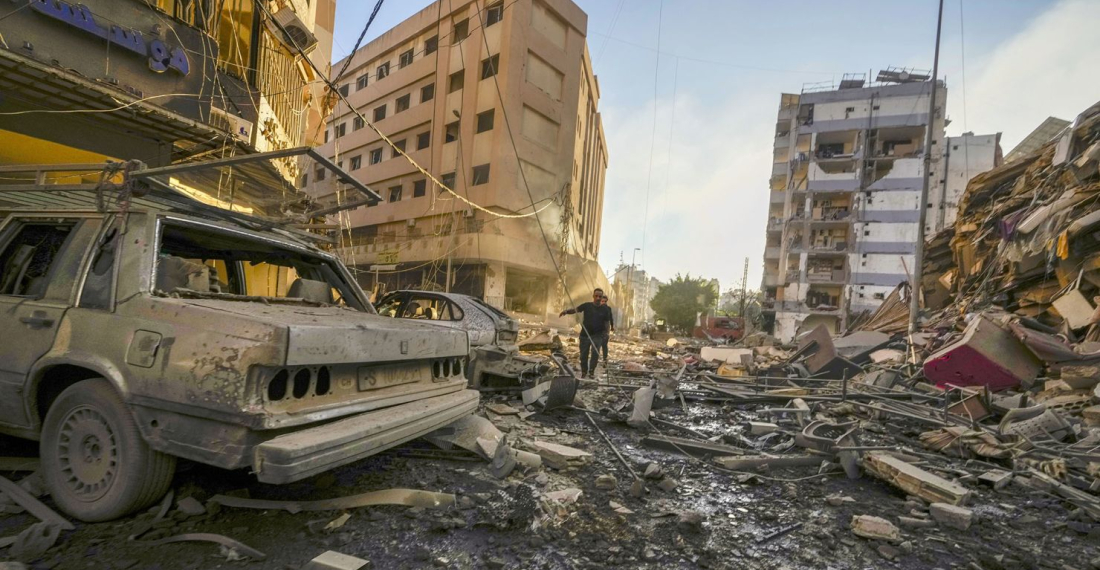
Lebanon is on the brink. Yesterday, Wednesday, 8 April, Israel conducted a vicious attack on civilian targets across the Lebanese capital, Beirut. Hundreds of people were killed. Thousands lost their homes, adding to the hundreds of thousands already displaced in the last three weeks. An already fragile Lebanon is now on the brink. The international community - and especially Europe - must now step up to save Lebanon.
In this op-ed for commonspace.eu, Alexandra Dumitrescu says
Israel has made claims that it intends to continue its occupation and possibly even annex southern Lebanon. Israel's finance minister, Bezalel Smotrich, said on 23 March that Israel should extend its border with Lebanon up to the Litani River. Since then, all of the Litani’s main bridge crossings have been bombed and severely damaged, if not fully destroyed. As Maha Yahya, the Director of the Malcolm H. Kerr Carnegie Middle East Center, put it in her article for Foreign Affairs, “By joining the battle, Hezbollah inextricably tied Lebanon’s fate to the larger war. But it is also clear that Israel is using the war and Hezbollah’s provocations to justify a much larger—and potentially devastating—assault on Lebanon itself.”
Here is her op-ed in full:
After deplorable social media threats where the American President Donald Trump boasted over the possibility of committing genocide and war crimes in Iran over the closure of the Strait of Hormuz, Washington and Tehran agreed on a two-week ceasefire on Wednesday (8 April) with the help of Pakistan. This was followed by efforts on both sides to frame the outcome as a national victory:
Donald Trump wrote on social media,
“...subject to the Islamic Republic of Iran agreeing to the COMPLETE, IMMEDIATE, and SAFE OPENING of the Strait of Hormuz, I agree to suspend the bombing and attack of Iran for a period of two weeks. This will be a double-sided CEASEFIRE! The reason for doing so is that we have already met and exceeded all Military objectives, and are very far along with a definitive Agreement concerning Longterm PEACE with Iran, and PEACE in the Middle East.”
Iran’s State TV Announcement [the full statement can be read here] stated,
“The enemy, in its unfair, unlawful, and criminal war against the Iranian nation, has suffered an undeniable, historic, and crushing defeat”.
While the Gulf countries breathed a sigh of relief after 5 weeks of facing the brunt of Iran’s retaliation, Lebanon has been pretty much sidelined in the 2-week ceasefire. The Pakistani Prime Minister, Shebaz Sharif, had previously said that the ceasefire extended over Lebanon. However, Prime Minister Benjamin Netanyahu’s office said on Wednesday (8 April) that the ceasefire does not include Lebanon and that its war against Hezbollah would continue. On the same day, Israel carried out its largest attack on Lebanon, killing at least 254 people and wounding 1,265. The areas targeted were in Beirut, the Bekaa Valley, Mount Lebanon, Sidon, and several villages in southern Lebanon. Iran immediately stated that it was ready to exit the ceasefire agreement if Israel “persists in violating the truce in Lebanon”. The defence minister of Israel mentioned that Iran and Lebanon should be treated differently, and the aim was to “change the reality in Lebanon and remove threats from the residents of the north”.
While the war in Iran has been the focus of much of the media, the war in Lebanon must not be sidelined. According to Al Jazeera, since 2 March, more than 1,530 people have been killed, including more than 100 women and 130 children. The war has already led to more than 1.2 million people displaced, almost one-fifth of the population of Lebanon.
The War in Lebanon since 1 March 2026:
On 1 March, Naim Qassem, the leader of Hezbollah, ordered the launch of rockets and drones into Israel in retaliation for the assassination of the Supreme Leader Ali Khamenei on 28 February. In response, Israel sent hundreds of airstrikes across the south of Lebanon, Beirut, and the Bekaa Valley. On 16 March, Defence Minister Israel Katz announced a “targeted ground operation” in southern Lebanon, intended to block the return of hundreds of thousands of displaced Shiite civilians, and explicitly compared it to Israel’s extensive campaign in Gaza.
This led to Israel issuing evacuation orders to villages in the south, amounting to 10% of the Lebanese sovereign territory, resulting in more than one million people being forcibly displaced. The majority of displaced people are Shiites. Due to the widespread destruction that happened subsequently, many of them will be unable to return home. UN experts and international legal bodies have warned that the forced displacement of civilians in Lebanon, due to intense Israeli airstrikes, blanket evacuation orders, and the destruction of infrastructure, is illegal and may amount to war crimes and crimes against humanity under international law.
Israel has made claims that it intends to continue its occupation and possibly even annex southern Lebanon. Israel's finance minister, Bezalel Smotrich, said on 23 March that Israel should extend its border with Lebanon up to the Litani River. Since then, all of the Litani’s main bridge crossings have been bombed and severely damaged, if not fully destroyed. As Maha Yahya, the Director of the Malcolm H. Kerr Carnegie Middle East Center, put it in her article for Foreign Affairs, “By joining the battle, Hezbollah inextricably tied Lebanon’s fate to the larger war. But it is also clear that Israel is using the war and Hezbollah’s provocations to justify a much larger—and potentially devastating—assault on Lebanon itself.”
What is the Hezbollah movement, and how did it begin?
Hezbollah, meaning “The Party of God,” emerged in response to Israel’s 1982 invasion of southern Lebanon. The 1982 war, also known as the Second Israeli invasion of Lebanon, began on 6 June with Israel’s forces attacking southern Lebanon. Israel was attempting to destroy the Palestine Liberation Organization (PLO), which established its bases in southern Lebanon after Palestinian groups were forced to flee the Jordanian Civil war (1970-1971) and the Palestine war (1948). Israel used the assassination attempt of Shlomo Argov, Israel's ambassador to the United Kingdom, as a casus belli, blaming the PLO that was operating in Southern Lebanon in preparation for the attempt.
At the time of Israel’s second invasion, Lebanon was already experiencing a civil war rooted in tensions between Sunni Muslims, Maronite Christians, and Shiite Muslims, each responding differently to the Palestinian presence. The arrival of Palestinians strengthened the Sunni demographic, while Shiite communities felt sidelined by the ruling Christian minority.
A group of Shiites, inspired by the revolution in Iran, the largest Shiite country, took up arms against Israel in response to Israel’s second invasion of Lebanon [the first invasion was in 1978, also against the PLO]. Hassan Nasrallah helped found Hezbollah in the early 1980s and defined the movement for the next 30 years. The group’s 1985 manifesto called for the withdrawal of Western power, the end of the state of Israel, and pledged allegiance to Iran’s supreme leader. Iran has since been the biggest supporter of Hezbollah, and although perceptions varied across Lebanese society, many saw Israel's final withdrawal from Lebanon in 2000 as a victory due to Hezbollah’s guerrilla tactics. For Hezbollah, armed resistance is seen as necessary, as it argues that Israel has an expansionist agenda backed by the United States.
After Hamas’s attack on 7 October 2023, Hezbollah also joined the fight against the Israeli government. As recorded by Human Rights Watch, the fighting between Hezbollah and Israel has brought many deaths, with more than 4000 deaths in Lebanon between October 2023 and January 2025, including more than 316 children, 240 health and rescue workers, and 790 women. The two sides agreed on a ceasefire that came into effect on 27 November 2024. The agreement reaffirmed UN Security Council Resolution 1701, which calls for the disarmament of non-state armed groups in Lebanon. Despite the ceasefire, Israel continued targeted attacks in Lebanon.
In January 2025, the new Lebanese President, Joseph Aoun, claimed that disarming Hezbollah would be an aim of the state. In September 2025, the Lebanese Armed Forces presented a plan on how to disarm Hezbollah in 5 stages, but it would be contingent on Israel halting its military operations and withdrawing from Lebanon, as set out in the November 2024 ceasefire agreement. Hezbollah argued that it will not disarm as long as Israeli forces remain in Lebanon.
The current situation:
Since the consistent renewal of attacks since March 2026, the Lebanese government has tried to isolate Hezbollah to seek an end to the devastating war that it has not chosen to take part in. On 2 March, the government banned Hezbollah’s military activities, expelled from the country all members of Iran’s Islamic Revolutionary Guard Corps, and cancelled visa-free agreements with Iran.
However, Israeli narratives surrounding the occupation or potential annexation of southern Lebanon have contributed to increased support for Hezbollah’s cause. Hezbollah has consistently argued that armed resistance is necessary to confront Israel, while portraying government-led diplomatic efforts as a form of betrayal. Hezbollah has also been actively engaged with the displaced Shiite communities to consolidate their support. Maha Yahya argues that “By adopting a maximalist position and refusing to respond positively to the Lebanese government’s work to enforce the state’s monopoly over arms, Israel is reinforcing Hezbollah’s narrative that only armed resistance can liberate Lebanese territory”.
The Lebanese government is experiencing a multifaceted crisis; while it is trying to advocate for a ceasefire diplomatically with Israel and keep Hezbollah under control, it now faces the challenge of helping 1.2 million displaced people and Israel, which is committed to leveling to the ground many Shiite communities in the South. This is on top of the previous economic hardship that began in 2019. In his aforementioned tweet, Trump mentioned the ceasefire would bring peace to the Middle East, yet Lebanon continues to face the spillovers of a war it did not want or need. Israel needs to remain committed to the agreement on 27 November 2024, allow the Lebanese government to disarm Hezbollah, and respect the sovereignty of Lebanon’s recognised borders. Otherwise, Israel will once again enable the spread and support of extremism.
source: Alexandra Dumitrescu is Project Manager and International Coordinator at LINKS Europe



