


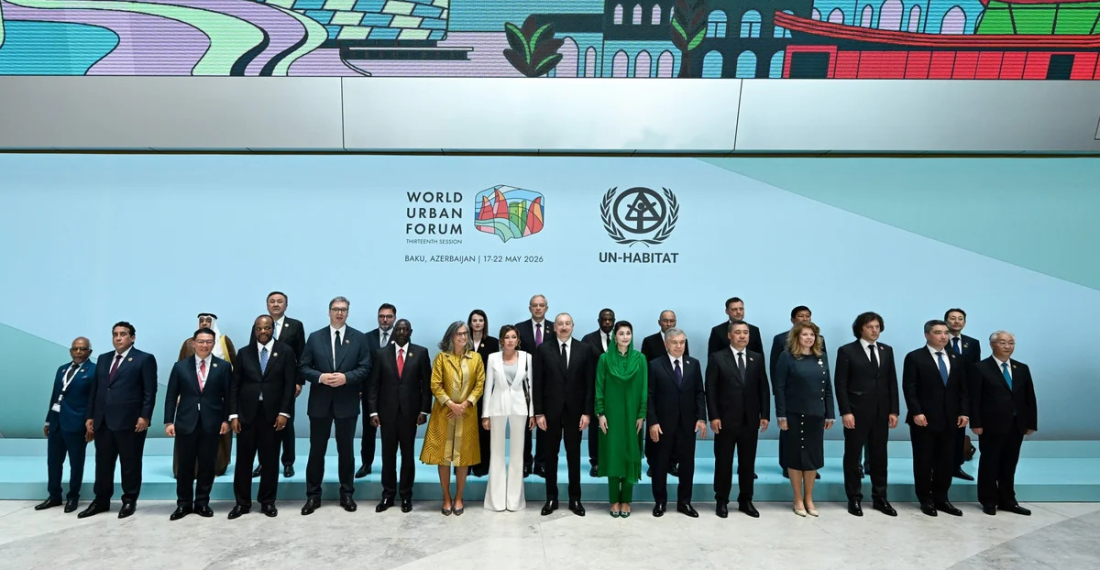
Azerbaijan hosts the 13th Session of the UN World Urban Forum

Azerbaijan is hosting the 13th session of the World Urban Forum from 17 to 22 May 2026. The World Urban Forum (WUF) was established by the United Nations in 2001 to address one of the world’s most pressing challenges: rapid urbanization and its far-reaching effects on communities, cities, economies, climate change, and public policy. 

Anacláudia Rossbach, Under-Secretary-General and Executive Director of the United Nations Human Settlements Programme (UN-Habitat) says: “At the Forum, we will address crucial challenges, such as housing, land use, urban planning, governance and participation. We will listen to diverse stakeholders and tackle key issues: how to ensure affordable housing for all, transform informal settlements, recover and rebuild, and enhance climate resilience. We need to build strong coalitions for better solutions to challenges posed by the global housing crisis."

This year’s WUF is themed “Housing the World: Safe and Resilient Cities and Communities” and the Azerbaijani hosts are focusing on how housing intersects with climate change, social equity, economic development, and crisis recovery. The theme is central and brings attention to climate change, a transboundary challenge that is currently being sidelined from most political agendas due to conflicts, militarisation, and the rise in far-right politics. 

The event itself was directly affected by the very issue it sought to address; Baku experienced severe rainfall that flooded streets, homes, and even the conference venue. In a video reported by OC Media, participants were seen crossing the water, holding their shoes in their hands, and with their pants rolled up. Despite this unfortunate event, the forum brought together over 40,000 people from around 182 countries to discuss the different issues.

While the WUF does not produce legally binding decisions, the forum seeks to provide a platform for policy dialogue. This year’s forum particularly focused on the world housing crisis, boldly asking participants, “The global housing crisis: what is the plan?” While building more may seem to be a quick fix, the panel encouraged countries to plan for sustainable urban development and cooperation with both the scientific community and the local civil society. 

In his opening speech, the Azerbaijani President, Mr. Aliyev, stated that “in many parts of Azerbaijan, urban development is progressing very rapidly, and definitely this important gathering and the expertise of our friends from the United Nations and numerous guests who visit us will help all of us to learn more, to learn from each other, to learn from positive experiences, and also to talk about our mistakes.”

While the forum is not expected to reach major policy recommendations, it brings attention to climate resilience and, importantly, to shared international experience. This is a point that should be explored further, particularly when it comes to the South Caucasus. All three countries are affected by pollution, water scarcity, extreme heat, and extreme rainfall. Georgia’s Black Sea coastline, an area crucial for trade, faces significant risks from rising sea levels. By contrast, the Caspian Sea is retreating, posing threats to coastal infrastructure, food security, and local livelihoods. The countries also share two transboundary rivers, the Kura and the Aras, both of which face severe pollution.

While the region is affected in different ways by climate change, there are no regional strategies to manage water resources, share information, or coordinate responses. During the conflict between Armenia and Azerbaijan, this lack of coordination was understandable; however, now, it seems like a missed opportunity. 

LINKS Europe, in November 2025, published a report written by Armenian and Azerbaijani experts that addressed environmental peace-building. The report proposed different areas of cooperation when it comes to shared environmental problems. These ideas shared in the report were not abstract but rooted in local knowledge and pragmatism. Armenia and Azerbaijan are taking significant steps towards institutionalising peace, and these developments should not be underestimated. However, a common regional strategy that addresses climate change in the South Caucasus is one area that cannot be afforded to be overlooked. 

Source: This briefing was prepared by the editorial team of Commonspace.eu

Related articles

Editor's choice
News
Uzbekistan calls for bigger voice for Central Asia in the UN

Uzbekistan calls for bigger voice for Central Asia in the UN

Uzbekistan called for a more effective and representative United Nations on September 23, as presidential administration chief Saida Mirziyoyeva used her address to the UN General Assembly to seek support for the country’s candidacy for a nonpermanent Security Council seat in 2035–2036. Speaking at the Assembly’s 81st session in New York, Mirziyoyeva argued that international cooperation remains necessary despite growing geopolitical divisions. She endorsed UN Secretary-General António Guterres’ UN80 reform initiative and called for an expanded Security Council, arguing that international rules should be applied consistently rather than according to the interests of powerful states. Uzbekistan’s planned chairmanship of the Non-Aligned Movement in 2027 was presented as another platform for promoting dialogue. Her emphasis on multilateralism also fits a broader Central Asian effort to increase the region’s role in international institutions. Kyrgyzstan, for example, will hold its first Security Council seat in 2027–2028. Mirziyoyeva also highlighted regional cooperation, pointing to improved relations among Central Asian states over longstanding border and water disputes. On Afghanistan, she urged countries not to view it solely as a security threat, stressing the importance of creating conditions for peaceful development. She linked Uzbekistan’s international agenda to domestic reforms, citing economic growth, falling poverty and expanded education. Climate and water security also featured prominently, with the Aral Sea serving as an example of the consequences of poor environmental management. (click image to read more)
Editor's choice
News
Kazakhstan declares national day of mourning after tragedy

Kazakhstan declares national day of mourning after tragedy

Kazakh president, Kassym-Jomart Tokayev, declared September 25 a national day of mourning following the deaths of servicemen during military exercises in the Caspian Sea. Twelve Kazakh servicemen died after being swept into the Caspian Sea during the Khazar Qorgany–2026 naval exercises in the Mangystau region on Thursday (September 24). The incident occurred after weather conditions suddenly deteriorated and winds intensified during a combat training mission. In a Telegram post, the Ministry of Defence reported that 19 servicemen had been swept into the sea. So far, three have been rescued, one of whom was hospitalized, while 12 bodies have been recovered.  Search operations were continuing for the remaining four servicemen. A large-scale rescue and recovery effort has been launched, involving Kazakhstan’s Naval Forces, the Ministry of Emergency Situations, aviation assets and other relevant services.   Deputy Prime Minister Kanat Bozumbayev, who is leading a government commission at the scene, ordered a continuous, round-the-clock search for those still missing. Authorities were also instructed to provide financial and other assistance to the families of the deceased. (click image to read in full)

Popular

Editor's choice
Interview
Thursday Interview: Murad Muradov

Thursday Interview: Murad Muradov

Today, commonspace.eu starts a new regular weekly series. THURSDAY INTERVIEW, conducted by Lauri Nikulainen, will host  persons who are thinkers, opinion shapers, and implementors in their countries and spheres. We start the series with an interview with Murad Muradov, a leading person in Azerbaijan's think tank community. He is also the first co-chair of the Action Committee for a new Armenian-Azerbaijani Dialogue. Last September he made history by being the first Azerbaijani civil society activist to visit Armenia after the 44 day war, and the start of the peace process. Speaking about this visit Murad Muradov said: "My experience was largely positive. My negative expectations luckily didn’t play out. The discussions were respectful, the panel format bringing together experts from Armenia, Azerbaijan, and Turkey was particularly valuable during the NATO Rose-Roth Seminar in Yerevan, and media coverage, while varied in tone, remained largely constructive. Some media outlets though attempted to represent me as more of a government mouthpiece than an independent expert, which was totally misleading.  Overall, I see these initiatives as important steps in rebuilding trust and normalising professional engagement. The fact that soon a larger Azerbaijani civil society visits to Armenia followed, reinforces the sense that this process is moving in the right direction." (click the image to read the interview in full)


