


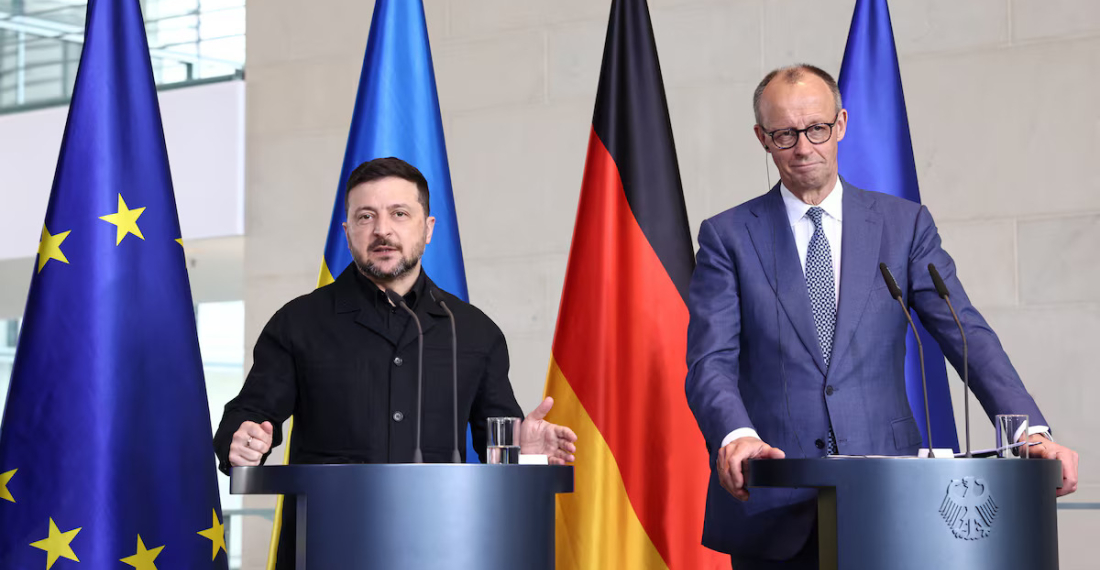
German Chancellor proposes “associate member” status for Ukraine to assist peace and regional security

In a letter to EU leaders accessed by Reuters on Thursday (21 May), German Chancellor Friedrich Merz proposed interim EU associate status for Ukraine to facilitate a peace deal between Russia and Ukraine and aid continental security provisions.

The proposed incorporation of Ukraine under a new status of “associate member” would enable Ukrainian officials to sit in on EU summits and ministerial meetings without voting rights.

Furthermore, Merz’s statement urged EU members to incorporate Ukraine within the bloc’s mutual assistance clause “in order to create a substantial security guarantee”.

A route to EU accession could prove essential to securing Ukrainian public support for President Zelensky's peace deal, especially in the possible event that Ukraine does not regain complete control of territories or join the NATO ​military alliance, analysts say.

Despite this, European officials have pointed out that full membership in the EU in the next few years may be unrealistic.

Merz’s proposal attempts to bridge Ukraine’s current status as a candidate country at the start of the EU accession process, with the ambitious calls for hasty admission to the bloc.

“My proposal reflects Ukraine's particular situation, a country at war. It will help facilitate the ongoing peace ‌ talks as part of a negotiated peace solution,” Merz wrote, adding this was “essential not only for Ukraine's but for the entire continent's security”.

Merz suggested a snap-back mechanism, or sunset clause, that could be invoked if Ukraine fails to comply with fundamental rights, rule of law, or structural reform standards.

Merz assured leaders that this proposal would not impede the admission processes of candidate countries that have been working to join the EU for a long period. Rather, Merz ushered the bloc to “look into innovative solutions” in paving paths toward EU membership.

Source: comonspace.eu with Reuters and DW

Related articles

Editor's choice
News
International Election Observation Mission finds that Armenians were offered a genuine choice against a backdrop of direct foreign pressure and uneven campaign opportunities

International Election Observation Mission finds that Armenians were offered a genuine choice against a backdrop of direct foreign pressure and uneven campaign opportunities

Farah Karimi, Special Co-ordinator and leader of the short-term OSCE observer mission, said that: “The concentration of arrests and criminal prosecutions against opposition figures contributed to perceptions of selective justice, while a polarized media landscape, inflammatory rhetoric, misinformation, and persistent foreign pressure and interference challenged Armenia’s democratic resilience and the integrity of public debate. This underscores the importance of continued efforts to strengthen democratic institutions, safeguard fundamental freedoms, and foster public trust in democratic processes. ” Damien Cottier, Head of the delegation of the Parliamentary Assembly of the Council of Europe, argued that “The Armenian elections took place in a particularly tense geopolitical context, with direct foreign interference. In particular, pressure and threats from Russian authorities reached an unprecedented and worrying level.” Janez Lenarčič, head of the election observation mission from the OSCE Office for Democratic Institutions and Human Rights, stated that “Armenia’s voters were given – and took – the opportunity to make a genuine choice in a professionally managed election process and a vibrant and pluralistic, if often highly polarized campaign. “Unfortunately, they had to make that choice against the backdrop of unprecedented foreign interference and pressure, in the form of punitive trade measures and day-by-day threats of further negative consequences contingent on which choice they made”. == click image to read full report

Popular

Editor's choice
Interview
Thursday Interview: Murad Muradov

Thursday Interview: Murad Muradov

Today, commonspace.eu starts a new regular weekly series. THURSDAY INTERVIEW, conducted by Lauri Nikulainen, will host  persons who are thinkers, opinion shapers, and implementors in their countries and spheres. We start the series with an interview with Murad Muradov, a leading person in Azerbaijan's think tank community. He is also the first co-chair of the Action Committee for a new Armenian-Azerbaijani Dialogue. Last September he made history by being the first Azerbaijani civil society activist to visit Armenia after the 44 day war, and the start of the peace process. Speaking about this visit Murad Muradov said: "My experience was largely positive. My negative expectations luckily didn’t play out. The discussions were respectful, the panel format bringing together experts from Armenia, Azerbaijan, and Turkey was particularly valuable during the NATO Rose-Roth Seminar in Yerevan, and media coverage, while varied in tone, remained largely constructive. Some media outlets though attempted to represent me as more of a government mouthpiece than an independent expert, which was totally misleading.  Overall, I see these initiatives as important steps in rebuilding trust and normalising professional engagement. The fact that soon a larger Azerbaijani civil society visits to Armenia followed, reinforces the sense that this process is moving in the right direction." (click the image to read the interview in full)


