


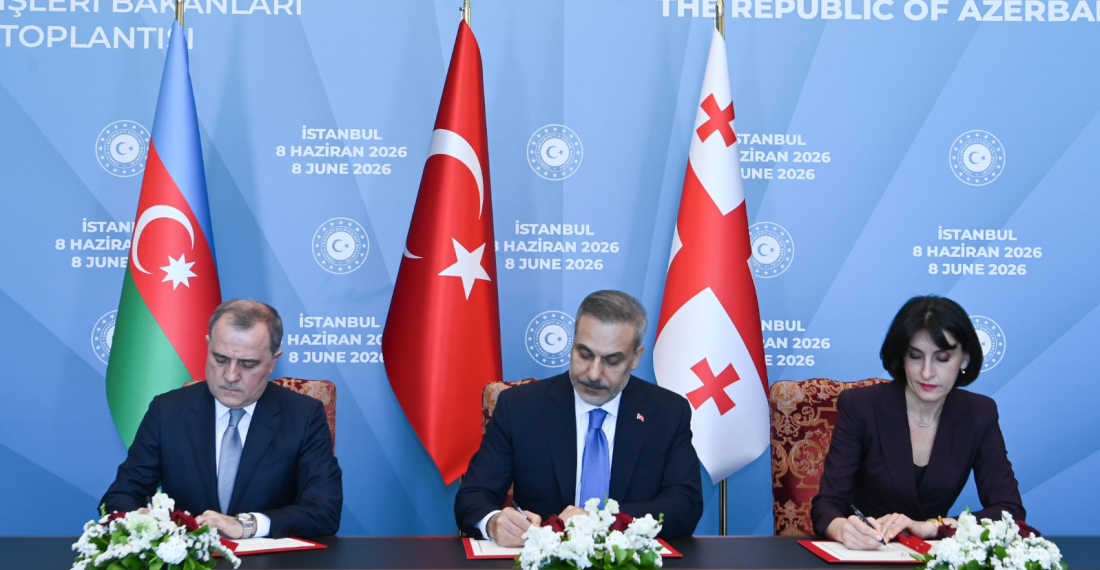
The foreign ministers of Türkiye, Azerbaijan and Georgia met in Istanbul on Monday (8 June) for the tenth trilateral meeting of the three countries, signing the Istanbul Declaration and reaffirming their commitment to regional cooperation, connectivity and stability in the South Caucasus.
Hosted by Turkish Foreign Minister Hakan Fidan, the meeting brought together Azerbaijani Foreign Minister Jeyhun Bayramov and Georgian Deputy Prime Minister and Foreign Minister Maka Botchorishvili. The three ministers used the meeting to review ongoing cooperation across politics, trade, transport, energy, security, culture and technology, while also addressing the wider geopolitical pressures affecting the region.
In their statements, the ministers presented the trilateral mechanism as one of the most successful formats of regional cooperation in the South Caucasus. Fidan said the platform had become a “consultation ground” that produces results and builds trust, noting that it had supported cooperation for almost 14 years. He added that Türkiye sees the mechanism as one of the guarantees of peace, stability and sustainable prosperity in the region.
Connectivity and energy security formed the centre of the discussions. The ministers highlighted the growing importance of the Middle Corridor as a route linking Europe and Asia, especially at a time of disrupted supply chains and regional instability. They also welcomed the Baku-Tbilisi-Kars railway reaching full capacity, describing it as a key component of the wider East-West transport network.
Energy cooperation was also emphasised as a pillar of the trilateral partnership. The ministers pointed to the Baku-Tbilisi-Ceyhan pipeline, the Baku-Tbilisi-Erzurum project and the Southern Gas Corridor as examples of infrastructure that has strengthened both regional economies and European energy security. They also discussed the development of green energy corridors and the potential for further cooperation in renewable energy, technology, agriculture and innovation.
The ministers also addressed the Armenia-Azerbaijan peace process. Türkiye and Georgia both welcomed the positive dynamics between Baku and Yerevan, while Fidan said Türkiye continued its normalisation process with Armenia in close coordination with Azerbaijan. The speakers framed peace between Armenia and Azerbaijan as a major opportunity for the South Caucasus, arguing that stronger connectivity could help reinforce the social and economic basis of peace.
At the same time, the ministers warned that the region remains exposed to wider security risks, including the Russia-Ukraine war, tensions around Iran, conflict in the Middle East, cyber threats, organised crime and hybrid warfare. They stressed that diplomatic and political channels should be prioritised, international law respected, and ceasefires transformed into lasting peace.
Georgia’s foreign minister also reiterated that Russia’s occupation of Abkhazia and South Ossetia remains a security challenge for Georgia and the wider region, thanking Türkiye and Azerbaijan for their support for Georgia’s sovereignty and territorial integrity.
The Istanbul Declaration reaffirmed the three countries’ support for each other’s sovereignty, territorial integrity and internationally recognised borders, while setting out plans to deepen cooperation in trade, investment, transport, energy, security, climate action and people-to-people links. The declaration describes the Middle Corridor, the Baku-Tbilisi-Kars railway, the Baku-Tbilisi-Ceyhan pipeline and the Southern Gas Corridor as key to regional connectivity and European energy security. They agreed to strengthen cooperation against terrorism, organised crime, cybercrime and hybrid threats, and confirmed that the next trilateral foreign ministers’ meeting will be held in Georgia in 2027.
Source: commonspace.eu with Republic of Türkiye Ministry of Foreign Affairs



