In this third and final article in a series of three pieces about different aspects of the Yemeni diaspora, Hisham Almahdi discusses the realities, roles and possibilities that the global Yemeni diaspora can play in their efforts to rebuild the future of Yemen. The first article in this series can be read here, and the second article can be read here.
While the role of the Yemeni diaspora in the ongoing conflict is largely characterised by a combination of possibilities and challenges, any efforts on their part to rebuild the future of Yemen suffer from limitations, and usually yield few tangible results. This is due to problems both within the diaspora itself - as is the case with the Yemeni diaspora in Germany - as well as external factors that limit the range, nature and efficacy of any role that the diaspora could play.
Yemenis suffer from a range of existential worries that negatively affect any role they could play in rebuilding the future of Yemen
Humans tend not to expend essential time and energy on trivial matters in times of severe danger. Civilisations thrive in peace and prosperity, and not in times of war.
Yemenis are no exception. They find themselves in a day-to-day struggle with poverty and war, facing a bleak future that impacts their interest in everything else. Consequently, young Yemenis often refrain from artistic, intellectual, cultural, and academic activities, which are also, in one way or another, linked to activism, politics, unions, and leading societal roles.
The majority of the Yemeni diaspora - which is often very highly educated - marginalises the importance of basic intellectual and artistic activities such as reading or writing, as they consider them to be a distraction, and a waste of time and resources when compared to the situation in Yemen. Things get more complicated with regards to art, sociology, philosophy, or even sport. The majority of Yemenis studying abroad end up working in fields such as engineering and medicine, mainly because of the professions' societal reputation and the promise of financial stability. This produces an abundance of professionals but a scarcity of researchers, intellectuals, artists and athletes.
There is indeed a subconscious fear that makes many Yemenis - and even those who enjoy peaceful and stable lives - unable to pursue anything unrelated to the list of immediate priorities and concerns. Indeed, those escaping a burning home do not think of what should happen to their kitchen utensils or video games.
The situation is especially bad for the Yemeni diaspora in the Gulf countries, and especially Saudi Arabia, where about half of the global Yemeni diaspora lives. They suffer from a great deal of existential worry about themselves and their families, rendering a large number of Yemenis worldwide apathetic or reluctant to dedicate themselves to working hard for the sake of feeding their far-away families, or engaging in other artistic or intellectual activities that could help Yemenis worldwide navigate the unknowns that they and their compatriots are facing.
The rest of the diaspora in other parts of the world, however, has been able to think about what could be done without having to worry about where the next warm meal and good night’s sleep will come from. Liberating Yemenis across the world from such existential fears could be a first step among many on a long road towards creating a sustainable peace in Yemen.
The reality is, unfortunately, quite different, as even those in Europe are still imprisoned by either a mentality of fear that does not entertain matters considered “unnecessary”; or they are trapped in a cycle of seeking financial security, mainly due to certain social structures. As the main breadwinners in a European economic system, Yemeni men, who are most often married with children, often tend to fulfil their “societal responsibilities” towards the extended family by effectively earning two incomes in order for the household to be financially stable. Indeed, rates of employment in women in the diaspora are relatively low, despite high levels of education and freedoms. This could be the subject of further research.
The internationality and complexity of the conflict complicates any role that the Yemeni diaspora could play in rebuilding the future of Yemen
The nature of the current war poses many problems for both individual and collective efforts. What is happening is not a simple rebellion or a civil war with clear parties and agendas; and neither is it an oppressive dictatorship. The conflict in Yemen is a mixture of many issues that have been silently and violently growing, and is vulnerable to the appetites of international players for whom the fate of the Yemeni people is not a priority or concern. Average Yemenis can’t help but constantly ask themselves a whole range of questions for which there are no clear answers.
“What can we do to stop Iran backing the Houthis in their destructive expansionist project? How can we stop the UAE from taking over Socotra, or supporting the separatist militia? How can we stand against Saudi Arabia imprisoning and controlling our government? What about the refusal of the US to designate the Houthis as a terrorist group? How can we stop the US from seeing Yemen as a card in their Middle East game, pressuring Saudi Arabia into more arms deals, dragging Iran into negotiations, and benefiting from instability in the region? What about the UN that gets involved only when Houthis are about to lose territory, often stopping progressive advancements on the ground? What about the warlords in Europe and the US who benefit from the war, and lobby to change countries' position on it? What can a Yemeni do against violent and dictatorial militias in the north and south, when even UN organisations find themselves cooperating with these militias?”
These questions and many more like them are what render many Yemenis feeling hopeless and desperate. Instead, many in the diaspora understandably feel that it makes more sense to focus their efforts on humanitarian aid and helping their families and friends, rather than trying to build broader initiatives with real impact.
The security situation inside Yemen severely restricts in-country and diaspora Yemenis' ability to affect real change
Some members of the diaspora consider it too risky to raise their voices or take part in any movement out of fear that their families back home could be punished. The situation in Yemen makes going back there even more dangerous. Sanaa Airport was only recently opened after years of closure; the brutal Houthi siege on Taiz, which still has no foreseeable solution, makes going there an adventure in itself; and the worn-out roads under militia control are nothing less than life-threatening.
A while ago some Yemeni students were killed and others were kidnapped by the separatist militia as they were heading back to visit their families in Sanaa from Aden airport. A similar situation can be seen on the road leading to the Saudi-Yemeni border where many families have lost their lives or were badly injured because of bad maintenance and poor services on the desert road.
Especially in Houthi-controlled areas, there are also financial limitations on freedom as the militia forces business owners to support their “Holy War” with regularly increasing “donations and taxes”. All this heavily limits the freedom of Yemenis in the diaspora in different ways, and negatively affects the realisation of any individual or collective efforts on the ground.
The failure of the UN and international organisations
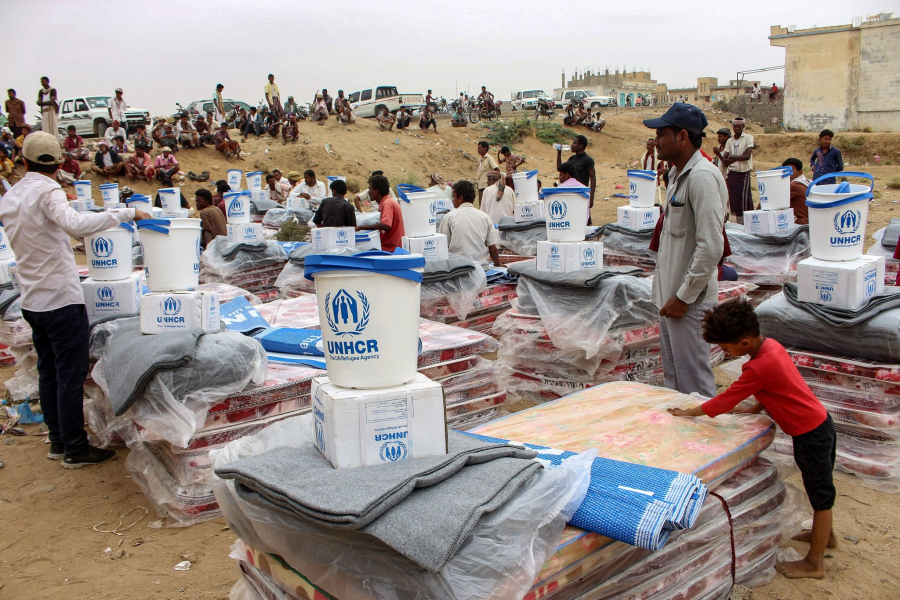
Yemenis are also angry at international organisations claiming to be helping Yemenis and solving the conflict. A great deal of this anger comes from corruption in these organisations, which although being a global matter, becomes intensified in conflict zones.
An Associated Press report from 2019 investigates corruption within the WHO and UNICEF in Yemen. Among the prominent claims are accusations of millions of dollars being deposited in personal bank accounts, unqualified people in astronomically high paying jobs, suspicious contracts, and tons of donated medicine and fuel going missing. Staffers are accused of shielding Houthi rebel leaders in agency vehicles, cooperating with Houthis, and even obstructing investigations of corruption.
Meanwhile, a report by the UN's expert panel from 2021 estimates that, in 2019, the Houthis diverted $1.8 billion for salaries and basic services to fuel the war; the internationally recognised government also diverted another $423 million away from food aid towards traders. I have personally witnessed aid trucks being hijacked, and donated food and medicine being sold in markets. I have also known people going from rags to riches off ill-gotten gains after working for these organisations.
In 2019, a campaign called “Where is the money?” was started by Yemenis demanding transparency and detailed reports on the whereabouts of hundreds of millions of dollars of aid. The response, however, was very disappointing, consisting of little more than a handful of social media posts, pictures showing poor families receiving supplies of food, and small humanitarian projects.
This is only the tip of the iceberg. Claims of corruption in international organisations is a matter of great importance that needs more studies and investigations. Efforts on this front are still limited, and suffer from a lack of support and attention. Even supposing these claims are not true, the failure of international organisations to achieve any impact at all, despite hundreds of millions of dollars of funding, fuels the sense of helplessness and hopelessness among the diaspora which has little or no financial capacity of its own. This makes Yemenis further doubt how worth their while it is trying to get involved.
What could be done?
The story of the Yemeni diaspora is unfortunately that of failures, factions, disagreements, and struggles. There are a number of factors within the diaspora itself - as well as out of its control - that play a big role in immobilising and dividing the diaspora. Regarding what is possible and doable, however, there are a couple of measures that could make some difference.
One can begin by redirecting and reorganising the many scattered, random or even useless initiatives. A number of TV channels, newspapers and blogs were launched in the first few years of the war, many of which are in or have relocated to countries like Turkey, the UAE, and Lebanon. These channels are supposed to educate the public and raise awareness, but are in fact tools of polarisation and constitute another separate war between media outlets, with each trying to push its own narrative.
The main problem with these efforts is the focus on speaking to Yemenis themselves - and especially the ones in Yemen - which doesn't achieve much in the mid- and long-term. Instead, these efforts could be directed towards reaching host societies and communities. There already seems to be a focus on talking to decision-makers in those countries under a foolish presumption that they don't already know anything about Yemen. Moreover, this same presumption assumes that when they do learn something about Yemen, they will start to care and go out of their way to try to help. These presumptions tend to forget that decision-makers are politicians hungry for votes, and wherever public opinion is, they are ready to do whatever it takes to win it.
The fact is that global media outlets barely report anything about Yemen, despite the UN declaring the situation there as one of the worst humanitarian crises since WWII. Therefore, it would be safe to assume that the majority of people around the globe know little to nothing about Yemen; and if they do, then it is likely to be something superficial such as the claims that it is a proxy war between Iran and Saudi Arabia, or between Sunnis and Shiites.
Redirecting these efforts into raising awareness on a global level can affect the policymakers who would then be pushed into adopting a position on these issues. One must caution, however, that any such efforts will be fruitless if exploited for political gain.
Supporting journalists, artists, writers and academics
People don't tend to sympathise with numbers as much as they do with pictures, music, and shared human experiences. Therefore, media outlets, with the assistance of different organisational bodies, could support artists and researchers as they tend to have a further reach to both societies and decision-makers compared to traditional reporting methods. Furthermore, researchers could help craft stronger and more helpful policies, reports, and aid campaigns, as well as providing timely recommendations on how to help in a way that actually brings results.
It is indeed true that the current war has many powerful international players who are out of reach for the average individual. Yet the various conflicts among Yemenis themselves are an urgent matter that must be dealt with. It is a shame that the potential of tens of thousands of young academics is simply wasted because of partitions and disagreements that immobilise their organisational bodies, destroy their sense of who they are, and distract them from efforts to help. Therefore, dealing with and reconciling divides in the Yemeni diaspora’s identity crisis should also be a priority.
Papers, artworks, books, public discussions and much more besides could try and answer the question of who Yemenis are, what common ground unites us, and where we are headed. The effects of such efforts would not be seen immediately, but would surely play a role in the future of the whole nation. The current narrative pushed by nationalists in the last three years, notwithstanding its occasional toxicity and absurdity, has proven how important these discussions are in reshaping the collective consciousness and uniting people around a form of common shared identity.
Another tendency that must be addressed is the fact that media attention, support and aid are largely limited to big cities like Sanaa and Aden. One must instead look at Yemen as a whole. Tehama in the west barely gets any attention, and the siege of Taiz has been left untouched despite the catastrophic situation. Marib, as a new hotspot for Yemenis from all around the country, also needs a re-evaluation of its role and importance. This is not to mention the majority of Yemenis who actually live in rural areas, and are ignored as if the war only affects those in metropolitan centres.
A long road ahead, but a road nevertheless
The Yemeni diaspora still has a long road ahead before it can finally overcome its disputes and partitions, and can play any role in the future of the nation. This is not to say that no efforts exist, but rather that they are very limited, unsuccessful, and even problematic in some cases. Having a real impact on the ground is unbelievably hard in a conflict involving international players and local militias, compounded by total chaos at government and state levels. Therefore, in the meantime, there need to be short and long-term plans focusing on people, education, identity, and collective consciousness.
The Yemeni diaspora must arrive at a unified and realistic vision, overcoming its internal divisions. It is only by overcoming all of this that the diaspora could have some hope in playing a positive role in rebuilding the future of Yemen.