
In this first article in a series of three pieces about different aspects of the Yemeni diaspora, Hisham Almahdi discusses the history, development and nature of the global Yemeni diaspora, and notes how its varying waves and changes have impacted all three. The second article can be read here, and the third article in this series will be published in due course.
There are about 6-7 million Yemenis spread across the six continents, at least according to Mohammed Al-Adil, Yemen's deputy minister of expatriates, and several other official and unofficial sources. Compared to Yemen’s total population of over 30 million, the size of the diaspora is indeed significant, although it is unclear whether the diaspora is included in the overall population count. Almost half of the diaspora (3 million Yemenis) live in Gulf countries, mostly Saudi Arabia, where Yemenis, alongside their South Asian counterparts, make up the backbone of the oil producing nations' labour force. Other estimates report that the number of Yemenis in Egypt is somewhere between 500-900 thousand, with another 58,600 and 12,000 Yemeni nationals in the US and UK respectively. This is not to mention second- and third-generation migrants who have been abroad for decades, as well as tens of thousands in countries like Djibouti, Malaysia, Turkey, and Jordan.
This article will attempt to offer a new analytical perspective on the nature of this widely-spread diaspora, and discuss how in the past decade it has been linked to and continues to interact with its original community back home, and how the diaspora is structured and operates. This analysis will navigate the subject by taking into account the complicated socioeconomic circumstances that the diaspora finds itself in - and at times even caused by it - as well as looking at the various organisational groups that make up the Yemeni diaspora.
Before exploring the role of the diaspora, however, this analysis needs to establish some basic details, and from three main angles: firstly, how many migrants there are and where they are located; secondly, who are the ones to have made it across international borders and what were the circumstances surrounding their various immigration waves; and finally, what were the important distinctions between the periods of these migrations, and how they affected the behavioural tendencies of the migrants.

History and Nature
A relatively important distinction to make is between the different eras of migrations in Yemen’s recent history, as they affected migrants’ nature as well as their destinations. A pivotal year was 2014, when the Houthi militia took over the country after a coup that ignited the war that has now lasted for eight years. The distinction here is not between refugees and migrants, but rather the type of people who migrated and their host countries.
Until 2014, Yemeni migrants were mainly workers, mostly traders and labourers (or economic migrants, as some might say) who preferred countries like Saudi Arabia, where they could spend years doing hard and even humiliating work but all the while benefitting from favourable currency exchange rates, sending almost all their money back to their families in Yemen. This money was and still is an important asset for the Yemeni economy as it amounts to anything between 4 and 8 billion dollars yearly, and provides income for millions across the country. Those who considered moving to the western hemisphere preferred countries like the US and the UK, largely due to language, the countries’ general societal reputation or people’s perception of them, and the relative ease with which one could acquire citizenship. The latter made it easier to invite other family members, or even to give citizenship to other families through “economic marriage”; that is to say, money in exchange for a new passport. Other migrants with different backgrounds existed as well, but this general case shows how the nature of the diaspora was unique back then, especially compared to how it became after the war.
Things started to change dramatically after 2014. Political activists, politicians, professionals (especially doctors and engineers), as well as the upper classes started to flee the country, first heading to Malaysia and Jordan, as they were two of the few countries to offer Yemenis visa-free entry after all embassies shut their doors in 2015. This wave then reached Turkey, Europe, Egypt, Canada, and many other countries all over the world. This change was mainly due to the difficulties that accompany fleeing and residing in a different country, both on the financial and bureaucratic levels.
On the one hand, the outside world was not accessible for most Yemenis, not only because of the economic situation placing half the country under the poverty line, or even because most of the population (about 62%) resides in rural areas with little to no public services and seriously limited social mobility. Any potential ways out were hard in themselves and made harder due to changes seen throughout the years, before and after the war. Rather, the geographic location of Yemen locks it between Gulf countries (who are parties in the war themselves), other Arab countries that have conflicts of their own, and the Red Sea. Any destinations beyond the immediate neighbourhood became even harder to reach due to visa acquisition regulations so complicated that it was sometimes even impossible to get a visa.
The Trump administration, for example, placed Yemen on a list of seven Muslim-majority countries that were banned from the US, separating families and causing great economic losses for those who could not return. Europe, on the other hand, already had a very complicated visa-application procedure, which became even harder after transferring Yemeni cases to the embassies in Oman and several other countries, which then only accepted certain types of visa applications, like those for students. Even then, students needed a blocked bank account with about 10,000 euros, which is not something anybody could pull off, let alone take the risk of travelling to a different country just to apply for a visa which has a high refusal rate. Tourist and medical visas were, mostly, not even taken into consideration for a long time, mainly due to the fear that Yemenis could apply for asylum once they arrived in Europe.
Moreover, the cost of flights skyrocketed as the national airline “Yemenia” was the only operating airline from 2015, a monopoly that the company exploited by making a simple five-hour trip cost well over a thousand dollars. Adding to all that is the decline of the currency (the Yemeni Rial) as the black market took over, doubling exchange rates and halving the value of local income, pushing up inflation.
All of this means that even if a single Yemeni individual, let alone a family, decides to flee the country, they will most likely not have any viable countries to go to. The road to Europe is too far to take a boat or to pay a smuggler to get in, and too expensive to even consider applying for and travelling to, not to mention even living in. The same goes for Canada and many other “developed” countries. Furthermore, Saudi Arabia, which hosts about half of all Yemeni migrants, is gradually kicking them out and making their lives there sometimes impossibly difficult. Policies that expelled tens, and even hundreds of thousands of Yemenis after the Gulf war in 1991, continue today in the form of hostile nationalisation of the labour market and capital, forcing Yemenis to flee either back to Yemen, or along with their capital to countries like Turkey that welcome foreign investments.
As a result, Yemenis found themselves cornered. The majority that did not have or could not afford the means or the ways to flee found themselves among an estimated 4 million internally displaced Yemenis, in addition to thousands who had nowhere to go but East Africa, or had to stay put and suffer in silence. The minority that did have the means, however, went on to take over the diaspora and almost completely reshape its nature and behaviour. An important side note here is that the youth, especially students, were the main exception in this case, as many of them preferred sacrificing and selling everything they had for a chance of a better, safer future. Basing our analysis on these numbers and incidents helps us understand how this diaspora thinks and acts, and how its relationship to its home and people is formed.
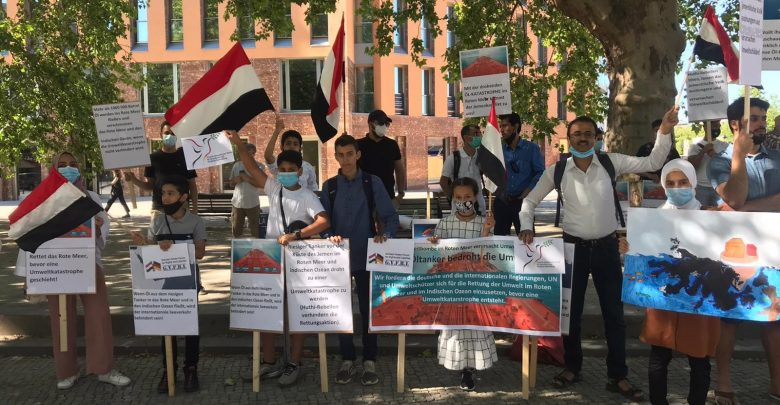
Organisational Bodies:
It is indeed essential to have a closer look at how Yemeni communities abroad tend to organise themselves, as organisational patterns seem to influence any role these groups could play. These organisational bodies tend to be similar among Yemeni communities throughout different countries, all sharing experiences, and regulating their activities using various organisational methods, thus allowing for a broader analysis. Among the most prevalent organisational methods, the following provide a general description that is true for most of the communities in the diaspora:
Communities:
This broad term is often used to describe both organised entities as well as the collective diaspora in a country, which can easily lead to confusion. In this case, we mean the former. Communities usually focus on connecting members of the diaspora, and in some cases acting as their representative with the authorities, as well as organising events and helping those in need. Contrary to common belief, there is no certainty of a unified Yemeni community in any given host country. A single country could have a couple of communities that may or may not work together under a unified organisational entity. The main reason for this is usually when the various communities arrived in certain parts of a country, leading to the formation of communities local to their regions within a single country. However, what strengthens such separation is usually political partition and disputes, leading to communities working independently, and even countering the efforts of each other, especially on a political level, but also on organisational and service levels.
Unions:
Although mainly student unions, there are other unions for doctors, engineers, and others. These unions usually try to serve their members (and even non-members) by providing a wide range of services attending to their immediate needs, providing consultation, communicating with official institutions in the host countries, and organising events and courses. Unions have shown throughout the recent decade a potential exceeding that of communities, especially because of the new young blood regularly pumped into it, and thanks to a relative openness to the new society and country with which they engage. It must be mentioned, however, that this potential remains mostly untapped and very limited in its effect for similar reasons as the communities.
(Political) movements:
These are the least organised of all. These movements are usually motivated by a wide range of causes, from supporting certain political parties, to creating new ones usually in the name of peacemaking, as well as feminist, nationalistic, humanitarian, and cultural movements. What sets these apart from unions and communities is their fragility and even absence of any organisational structures, the ambiguity of their goals and working mechanisms, idealism, and the frequency of their rise and fall.
Political movements usually try to achieve some form of an impact on the ground. This could be through influencing public opinion, trying to influence the policymakers in the host countries, organising summits and discussions, and sometimes even starting some aid campaigns.
Clubs:
These are mostly intellectual and cultural, sometimes even athletic. These clubs are the smallest and most limited form of organisation for Yemenis in the diaspora. Clubs usually encounter more difficulties in attracting members, as there is a certain reluctance from the public to get involved in intellectual, academic and artistic activities for reasons that will be mentioned in subsequent pieces.
The activities of clubs are mostly limited to regular meetings and intellectual cultural discussions in the best cases, and rarely produce any material deliverables like research papers, artworks, or informational/educational material etc.