The war in Yemen has had a severe impact on the learning, and general cognitive and emotional development of the younger generation, writes Shaima Ameen Abdullah for commonspace.eu. "In light of the polarisations that the country is experiencing, there is a need for a clear vision and an effective strategy in setting priorities for reforming the educational process in accordance with the country's circumstances and the available capabilities, especially in stable areas where more reform is possible," she adds.
Yemen is currently going through what can be described as a tragedy and misery with profound consequences on many aspects of daily life. The war has consumed both the lives and the consciousness of Yemeni citizens. One of the key affected sectors is education, where there is currently a crisis.
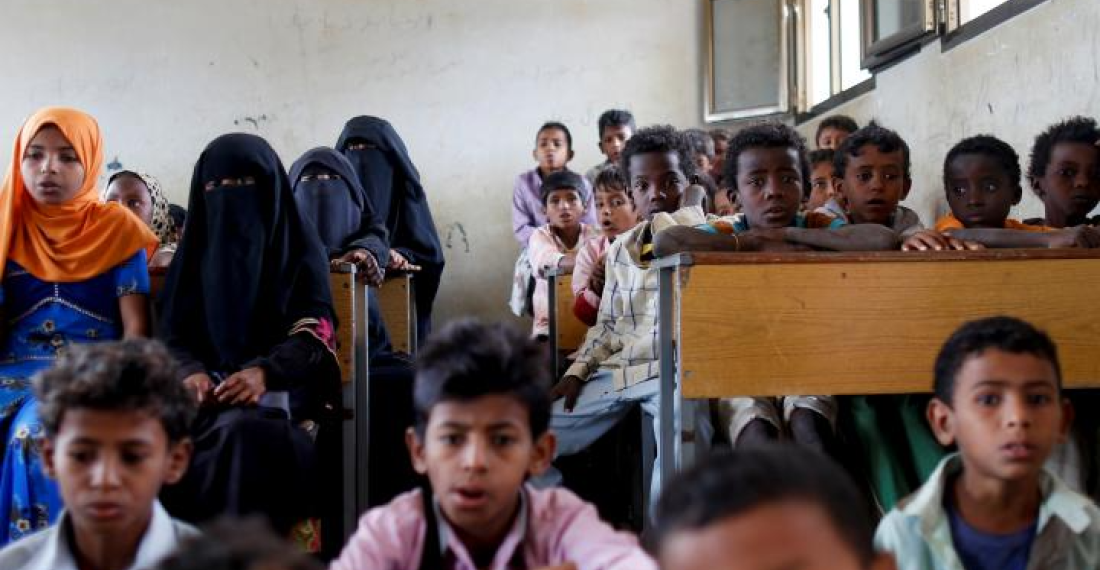
According to UNICEF estimates, about two million children are already out of school, with the number projected to increase to six million if the war continues. Even before the war, the situation of education in Yemen was already bleak. For decades, the educational system had been experiencing continuous deterioration. The current war only added an extra burden to this weakened system.
This deterioration in education in light of the conflict can be attributed to many causes. Since the beginning of the war in 2014, attacks on schoolchildren, teachers, and educational infrastructure have had devastating effects on the country's education system and affected the accessibility of education to millions of children. The damage, closure, and transformation of schools into military barracks have also limited the accessibility to schools for millions of children. An estimated 2,916 schools (at least 1 in 4 schools) have been destroyed, partially damaged or used for non-educational purposes as a result of eight years of conflict in the country.
The conflict and the ongoing disruption of education have also had a severe impact on the learning, and general cognitive and emotional development of the younger generation in Yemen, as well as on the mental health of the estimated 10.6 million school-age children in the country. UNICEF has also warned that further deterioration can have profound consequences on children in the long term.
Displacement Camps
Students in displacement camps across the country also struggle to continue their education for many reasons. Often, there is no room for students in schools operating nearby, or students lack certain documentation that are required for enrollment. The Executive Unit for the IDP Camps Management stated in a study issued on 12 January 2022 that the number of children of school age at the camps is 491,600, of whom 246,499 are males and 245,101 are females.
Despite the overcrowding, humanitarian organisations, in cooperation with the offices of the ministry of education, coordinate the enrollment of the displaced students into nearby schools. However, these efforts are not enough and do not cover all the student population that is displaced in various camps. Schools in areas that did not suffer much from the war are already overcrowded so shifting students to new locations would not make much difference.
The issue of displaced families and students cannot be resolved soon because fighting can break out at any moment, and most operating schools are far from the frontlines which makes it a security challenge for those from these areas wanting to attend school.
Other factors contributing to the increase in vulnerabilities in the educational process include the fact that more than two-thirds of teachers have not regularly received their salaries since 2016, or have stopped teaching in search of other income-generating activities, forced displacement, or for political and sectarian reasons.
Education in Houthi-controlled areas
In the areas controlled by the Houthis, the group has transformed the almost free school system into a system that imposes higher registration fees than the usual symbolic fees in place before the war. This has led to the dropout of many students whose families cannot pay the sums of money for them, due to poor economic conditions.
Yet perhaps the biggest impact on education in Houthi-held areas is the changing of the educational curricula for primary and preparatory mid-level students. The Houthis have systematically added lessons with ideological features that promote and advocate their extremist ideas. These recent changes reflect the Houthis’ political and ideological ambitions as they shape an order that normalises violence. The Houthis are thereby preparing a future generation to be loaded with ideas that guarantee the continuation of its project.
Besides changing the curricula, the Houthis did not provide the books for schools and educational establishments as was required, but rather sold them commercially in local shops and stalls. This further generated a stream of income for the Houthis while further adding costs to families with children.
Educational Reform: a way forward
In light of the polarisations that the country is experiencing, there is a need for a clear vision and an effective strategy in setting priorities for reforming the educational process in accordance with the country's circumstances and the available capabilities, especially in stable areas where more reform is possible.
Radical changes must be made in the essence of the educational process and its system, starting with reforming the goals, objectives and educational philosophy, but also addressing expected educational outcomes and the prospects of education. Such changes must match the needs for Yemeni society and the next generations.
One of the key actions in this vein is to allocate more government budget for the development of education and making the curriculum and educational approach neutral and unbiased. Along with government reforms, media and civil society initiatives should also concurrently engage in discussions and dialogue about how best to reach solutions on the ground to address the challenges to education. Such ideas, recommendations and suggestions can then ultimately help the government enact policies relevant to the future of education in the country.
Scholarships, foreign exchanges, new curricula, and media attention are required
Another important step is to allocate more funding to scholarships and foreign exchanges. This can help to widen expertise and knowledge which can in turn help rebuild in the post-conflict phase. Additionally, the government should renew educational expertise, in terms of teachers, trainers and academic supervisors.
This new cadre can then further develop the educational curricula in accordance with contemporary trends and needs of the society. Renewing and developing and the educational curricula is perhaps one the most crucial steps in the process due to the changes that the Houthis have enacted, but also because of the lack of renewal during the past several years due to the conflict. Besides making the curricula unbiased, it is also important to conduct regular review and assessment to ensure the curricula meets the demands of society.
To ensure that education remains a top priority, the government must include provisions related to educational reform in any negotiations with the Houthis since the latter enacted changes in education in areas under their control. To elaborate, educational content that fuels sectarianism and divisions must be removed and instead implement neutral educational content.
During the process of reforming education, there needs to be media attention towards the current challenges to education in order to raise public awareness of how disastrous the situation can be if the current status quo continues. Lastly, it is also important that the local and international communities realise the magnitude of educational problems in Yemen, which are no less harmful than the size of the material and human damage suffered by Yemenis.