


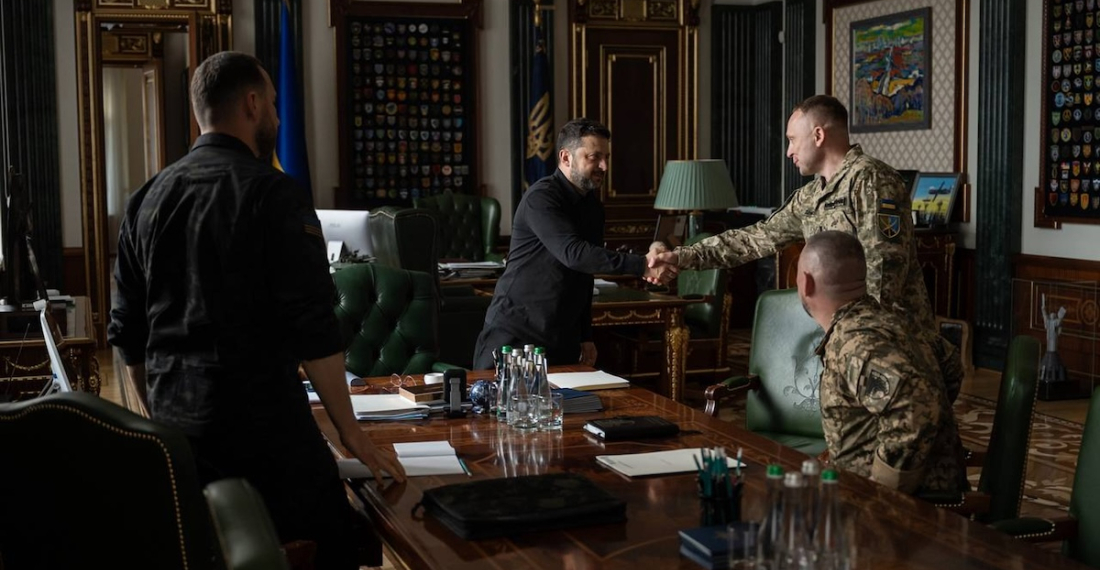
Ukrainian President Volodymyr Zelenskyy dismissed General Oleksandr Syrskyi as commander-in-chief of the armed forces on Monday (July 21), appointing Major General Mykhailo Drapatyi to replace him following several days of nationwide protests demanding Syrskyi's removal. The decision comes less than a week after Zelensky dismissed Defence Minister Mykhailo Fedorov, a decision that propelled the largest anti-government demonstrations in Ukraine since Russia's full-scale invasion in the first place.
Announcing the appointment, Zelenskyy said he had held a series of meetings with military commanders before reaching his decision. "Our shared wish is one – victory over the enemy and conditions at the front and in pressure on Russia that would force Russia toward peace," he wrote on social media. The president thanked Syrskyi for his leadership during the defence of Kyiv and operations in the Kharkiv and Kursk regions, adding: "I am grateful to Oleksandr Syrskyi and to every one of our warriors for Ukraine's strong front-line positions."
Drapatyi, who previously commanded Ukraine's Land Forces and is widely regarded as one of the country's most respected frontline commanders, called the appointment "an absolute responsibility." In a Facebook post on July 21, he wrote: "Serving Ukraine has always been an honour for me... I will work responsibly, with focus and with respect for the people defending our state."
The crisis was triggered by Zelensky's decision on July 15 to remove Fedorov after only six months as defence minister. A former minister for digital transformation, Fedorov had become the public face of Ukraine's military modernisation, overseeing the expansion of drone production and advocating reforms to procurement, mobilisation and battlefield command. After his dismissal, he accused Syrskyi of blocking key reforms, and argued that a new command culture is needed to preserve soldiers' lives and accelerate innovation.
Syrskyi rejected the criticism, and insisting that "my job is war," he remained focused on defeating Russia rather than engaging in disputes with the Defence Ministry. He also argued that reducing the conflict to a personal rivalry between himself and Fedorov would only benefit Moscow.
However, the dispute quickly spilled into the public sphere. Thousands of demonstrators gathered in Kyiv and other cities, calling for Fedorov's reinstatement and Syrskyi's dismissal. These protests were joined by veterans, soldiers on leave and several senior military figures, who heavily criticised Syrskyi's leadership, particularly his reliance on costly, Soviet-style tactics.
Alongside Drapatyi's appointment, Zelensky instructed the new commander to present an updated defence strategy, continue reforms to the corps system, accelerate weapons and drone deliveries, strengthen air defences and overhaul mobilisation. The president also said he had offered Fedorov another senior government role focused on coordinating Ukraine's technology sector, although it remains unclear whether the former minister will accept the position.
Source: commonspace.eu with AP News (New York) and Radio Free Europe/Radio Liberty (Prague), with agencies
Photo: Ukraine president Zelenesky with new head of the Ukrainian Armed Forces, Major General Mykhaili Drapatyi



