


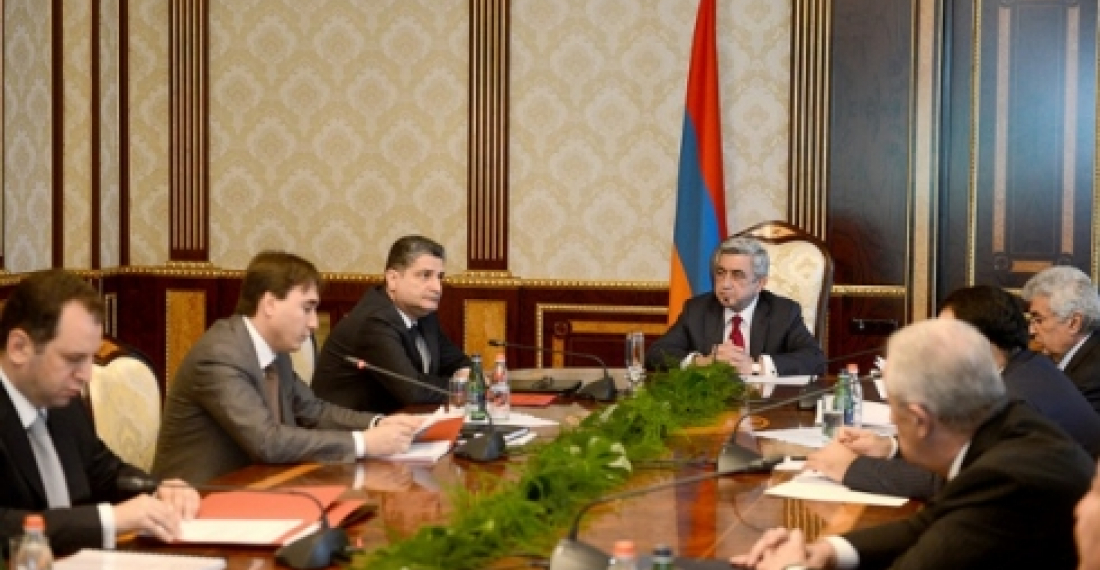
Armenian president Serzh Sargsyan has over the last few days held meeting with his National Security Council and with his newly appointed Cabinet of Ministers. The Armenian leader spoke about Armenia's success in the economic sphere in 2012 and lambasted neighbouring Azerbaijan.
Speaking to the National Security Council on 5 June, Sargsyan hailed economic growth in 2012. He said:
"Today, difficulties are plenty in Armenia. Nobody argues that. However it is also true that the tendencies of Armenia's economic development are promising. In 2012, we registered a 7,2 % economic growth. This high tempo of economic activity is present also in 2013, and this is taking place when inflation is not high and is manageable.
Yes, Armenia's economic growth in 2012 exceeded that of all neighboring states. Unlike some of the countries endowed with natural resources, including the neighboring states, in Armenia economic transformation and diversification of economy are truly yielding results. As a result, among 188 countries of the world Armenia in 2012 was the 23rd among the countries with the largest economic growth.
This allowed to finally reinstate the pre-crisis situation, while registering growth in all main areas of economy. It was possible to maintain the level of the pre-crisis output and revenues even though the formerly dominating construction area had cut down by almost a half. It means that in the process other areas of economy expanded, their development substituted for and exceeded the output of the construction area bringing forth new areas of production and services, contributing to the establishment of a more robust economic structure. And this is happening when the state revenues have almost doubled. These facts are undeniable and registered not only by us. However it doesn't mean that we should be satisfied or complacent about that. Of course, not.
We should restructure our economy, area by area, both in form and content. We are building a new economy. Instead of fighting against the consequences of the hail, we should be able to gradually start the production of the anti-hail systems locally, instead of subsidizing irrigation, we should be able to manufacture the dropping irrigation systems, should be able to commence project which will serve as locomotive for entire areas, for instance to assemble fast and inexpensive greenhouses, starting from the manufacturing of all necessary devices up to, let's say, production of sun batteries. And so on. We must encourage projects like these, and we have already started doing so."
Sargsyan also used the meeting to lambast Azerbaijan. He said:
"In 3 or 4 years, the picture of the region will be entirely different. We must be ready for that. Experts are expecting Azerbaijan's inevitable fiasco in already two-three years. In perfect line with the dictatorial rules, the authorities of that country are engaged only in serving to its people the image of the Armenian people as their enemy, spreading disgusting notions about us. However social, political and economic mines within Azerbaijan are threatening to explode and do so pretty soon and it looks like they will go off all together. In the face of chronic decline in the production of oil and gas, the leadership of the neighboring country continues to use the acquired revenues in a way which was not conceivable even for their adversaries. Feasting now - this is the logic of their current policies. Revenues are being wasted at the meteoric speed on one-time attractions: huge, eye-popping construction projects, financing of social programs, which they will have to cut tomorrow and wasting billions in different corners of the world for just one night of flattery - activities which those who can see two steps ahead make everything clear.
From the other side, the effects of the dictatorship and dictatorial regime are become visible: imprisonment of the opponents, almost total unawareness on the existence of free media, coercion and enormous corruption in that country will double along with the process of decrease of the inflow of petrodollars. I believe nobody doubts that. Two years ago, the young Azerbaijanis were intimidated and silent, however today even if in small groups they've already started talking that the time has come to speak out. Tomorrow is very close; the tomorrow when social networks in that country will be outlawed.
I have brought up this topic because the authorities of that country instead of dwelling on their own problems, well being of their own people, building of their own society are busy with "tending to our wounds", are trying to teach us how to live as I've already mentioned through the dissemination of filthy notions about us."
The Armenian leader told his Security Council,
"We must carry on with the modernization and diversification of our economy in order to be able to get more favorite conditions in the anticipated restructuring of the region. On this course we may not holdup even for a minute. Holdup is no option."
Serzh Sargsyan continued with this theme when he met members of his Cabinet of Ministers on Saturday. He told the Ministers:
"Expectations from this government are great, and I don't see any impediment for not working efficiently. On the contrary, I believe that now favorable conditions have been established. We have stated on many occasions that through our work accomplished in the past, we have created the base for a significant breakthrough. The performance of this government will be judged by the results only, strictly by definite results."
source: commonspace.eu with the Press Service of the President of Armenia
photo: Serzh Sargsyan addressing members of his National Security Council on 5 June 2013. (picture courtesy of the Press Service of the President of Armenia.)



