Opinion: It is unlikely that new policies of the Biden administration will benefit Armenia

The new US administration may decide to challenge Russia in the South Caucasus, but this will not work in Armenia's interest, and will not address Armenian concerns on the post-war situation in Karabakh, argues Benyamin Poghosyan in this op-ed for commonspace.eu

The election of Joe Biden as President of the United States has raised many hopes around the world that the era of American isolationism launched by President Trump, has finally ended. Almost all are looking forward to the new American drive towards multilateralism, and for the US to resume its leadership role of the "liberal world order". America’s EU and NATO allies hope for more US engagement in Europe, and more consistent policy towards Russia, while the US Asian allies expect a more coordinated approach towards Asia. One of the first steps of the new administration was the decision to bring back the US into the Paris climate agreements, raising expectations of an upcoming multilateralist agenda. The South Caucasus is not an exception in this context. Given the strategic shake-up in the region as a result of the 2020 Karabakh war, regional experts seek to understand what will be the US policy towards the new status quo that emerged after the November 10 trilateral statement of Armenia, Azerbaijan, and Russia.

Of course, much will depend on what will happen in US – Russia relations. The Biden administration's willingness to extend the new START treaty for five years, which otherwise is due to expire in February 2021, may be an indication that the new US administration will seek to find common ground with the Kremlin. Some experts argue that the extension of the new START is probably the only issue where US and Russian interests overlap, whilst in all other spheres the new administration will push forward a tougher policy towards Russia. Among the Armenian expert community there is however a general understanding, that regardless of the ups and downs in the US – Russia relations, the US is dissatisfied with the outcome of the new Karabakh war, which saw the US and OSCE Minsk Group sidelined, increased the Russian influence in both Armenia and Azerbaijan, and made Turkey an influential player in the region.

According to this logic, the US will seek to challenge the new status quo in Karabakh, to reinvigorate the Minsk Group activities, and to end the Russian monopoly over the conflict resolution process. The US will seek to replace Russian peacekeepers with international forces with OSCE or UN mandate and will demand to determine the NK final status through the organization of a legally binding expression of will, as was elaborated in the Madrid document. Meanwhile, Russia will do everything to, in practice, prevent the resumption of the OSCE Minsk Group activities and to restrict the US and France's influence over future developments in Nagorno Karabakh. However, this perception of reality has some flaws.

The first problem with this narrative concerns the presumption of Russian actions to restrict the activities of the Minsk Group. In reality, the Kremlin may be the most interested player to see Minsk Group back to center stage. As a result of the 2020 Karabakh war, Azerbaijan gained more than was envisaged by any settlement option under discussion, while Armenia and Nagorno Karabakh lost almost everything. This means that Armenia will in the future be constantly complaining and putting forward demands – the return of the Armenian POWs many of whom Azerbaijan has now declared as terrorists, determining the status of Nagorno Karabakh, a process which the Azerbaijan President and Ministry of Foreign Affairs officially declared as having been thrown to the dustbin of history, at least partly return to Armenian control some of the territories taken by Azerbaijan during the war, etc. In the current situation, complaints and demands on all these issues are sent to Moscow, and the failure of the Kremlin to satisfy these demands will raise new anti-Russian feelings among Armenians. We already face a situation in Armenia where an MP of the ruling faction publicly declares that the return of all Armenian POWs requires only one phone call from president Putin to president Aliyev, and if President Putin does not make this call, it is a sign of contempt towards Armenia and Armenians. Obviously, the Kremlin is not happy with this situation as it does not want to be perceived as the sole actor responsible for dealing with Armenian grievances, and the Kremlin appears fatigued by constant Armenian complaints. Thus, the Kremlin is interested to re-launch the Minsk Group activities. It will enable Russia to tell Armenians to speak about their problems also with President Biden and President Macron, asking them also to call President Aliyev, and put pressure on him. By doing this Russia will share the responsibilities with the US and France for future developments.

The suggestion that the US will seek to organise a referendum in Nagorno-Karabakh to determine the final legal status of the region, and will oblige Azerbaijan to organize such a referendum and to accept the results, does not sound realistic too. First of all, the US has no incentive to ruin its relations with Azerbaijan especially after the launch of the Southern gas corridor, a project firmly supported by President Obama administration of which Biden was the Vice President. After a decisive victory in the 2020 Karabakh war, Azerbaijan solidified its position as the most important state of the South Caucasus, and the new US administration will take this into account while shaping its policy towards the region. Besides the above-mentioned considerations, it is obvious that within its current borders (approximately 3000 square km), Nagorno Karabakh cannot be a viable independent state, and it will require a constant and significant military deployment to deter new attacks by Azerbaijan.

The US may start the discussion within the Minsk Group to replace Russian peacekeepers with a multination force, but this may not happen at least until November 2025, as any such decision either within the UN Security Council, or within the OSCE, requires Russian approval. Most probably the US will increase its humanitarian assistance to Armenia to overcome the implications of the war and to support refugees from Karabakh who now live in Armenia, but nothing more.

As for the US policy towards the entire region, this will depend on US – Russia relations. If a decision will be made in Washington to decrease Russian influence in the region as a part of a Russia containment policy, the main target will not be Karabakh but Armenia itself, since now Yerevan is more dependent on Russia than at any other time since the collapse of the Soviet Union, while Azerbaijan at least has Turkey to balance Russian influence. However, in this case, no bright future waits for Armenia. Regardless of numerous disagreements and tensions between the US and Turkey, the only leverage for the US to fight Russia in the South Caucasus is Turkey. This means that the US will seek to use Turkey in its anti-Russia policy, which itself predicts nothing good for Armenia. Yerevan currently is virtually squeezed between Azerbaijan and Turkey, and will be squeezed more if transport links from Turkey to Azerbaijan via the Nakhijevan Autonomous Republic and Armenia's Syunik region will be opened. Despite all rhetoric that this will bring advantages to Armenia, as Azerbaijani and Turkish investments will pour into the country – along with rich Turkish and Azerbaijani tourists who will spend money in Armenian hotels, clubs, and restaurants – the strategic goal of Azerbaijan and Turkey is to weaken Armenia as much as possible. Baku and Ankara are determined to force Armenians to forget about Nagorno Karabakh, and essentially be transformed into a bigger Adjara where Turkish and Azerbaijani businesses will have equal or even more rights than Armenians, and the local population will only serve as a low-cost working force.

Thus, one may conclude that the US will not make any moves to significantly change the current status quo in Nagorno Karabakh to the benefit of Armenians, while a possible American containment policy of Russia may end up transforming Armenia into a client state of Turkey and Azerbaijan.

Related content on commonspace.eu: The elusive quest for peace in the South Caucasus 

Source: This op-ed was prepared for commonspace.eu by Benyamin Poghosyan, Founder and Chairman of the Center for Political and Economic Strategic Studies in Yerevan.
Photo: A Sky News photo-montage of Biden and the Whitehouse (picture courtesy of Sky News  (London) 
 
The views expressed in opinion pieces and commentaries do not necessarily reflect the position of commonspace.eu or its partners

 

Latest

Editor's choice
Monday Commentary
Monday Commentary: PEACE IN OUR TIME?

Monday Commentary: PEACE IN OUR TIME?

Making peace between Armenia and Azerbaijan was never going to be simple, nor easy, nor quick. It is taking time, writes Dennis Sammut in this Monday Commentary. “There is a sense of realism coming from the leaders of the two countries – President Ilham Aliyev of Azerbaijan and prime minister Nikol Pashinyan of Armenia, that frankly, is necessary and welcome”, he writes. At a time when conflicts are raging all over the world – from Ukraine to the Gulf, from Africa to South Asia, the prospect that Armenia and Azerbaijan had finally, after decades of conflict that left thousands of dead and many more displaced, decided on embarking on a journey of peace was welcomed. Peace between Armenia and Azerbaijan can be top-down up to a point. Both leaders have spent political capital preparing for a peace deal. But both are aware that their people are not ready for peace yet. In fact, in Armenia, most of the elite are negative toward a peace deal with Azerbaijan. Pashinyan needs time to persuade his countryfolk. That is why 2031 is realistic. Ilham Aliyev runs a tighter shop, but he is also not immune to public opinion. Every time someone hits a landmine in Karabakh, which unfortunately happens often, peace comes into question. Which is why Aliyev chooses to sound hardline, more often than not. In pursuing the peace agenda, both Aliyev and Pashinyan need to proceed cautiously. But they are right in making peace the central issue in their agenda. It is the main issue, and the one that will define them in history. So forward, cautiously but resolutely! In pursuing the peace agenda, Aliyev and Pashinyan need to be supported clearly and unambiguously. There are too many people in Baku and Yerevan who are sitting on the sides, waiting. The international community is not doing enough. It is time to be counted. Otherwise, the spoilers will win, and the region will go back to its bad habits. (Click the image to read the full commentary).
Editor's choice
News
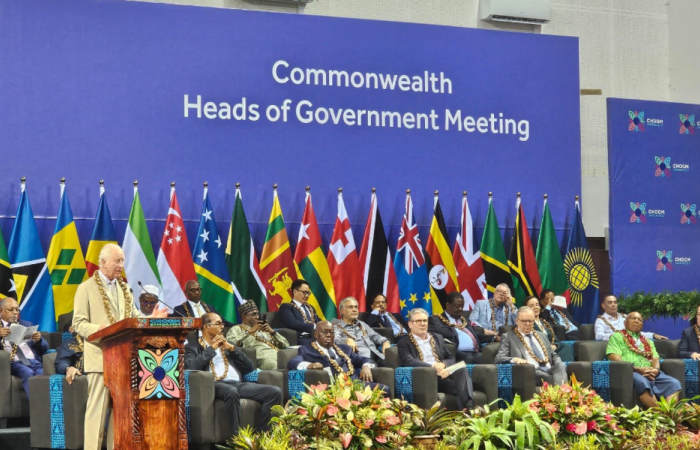
King calls slave trade a 'shameful chapter' during Commonwealth address

King calls slave trade a 'shameful chapter' during Commonwealth address

King Charles has described the transatlantic slave trade as a "shameful chapter of history" that filled him with "profound sorrow" as he opened a summit of Commonwealth leaders in the Caribbean. He said the trade in enslaved persons "still casts a shadow" over the association of nations. There have been calls from some for the UK to make a formal apology for its historic role in the slave trade ahead of the Commonwealth Heads of Government Meeting (Chogm) in Antigua and Barbuda, but there was not one in the King's address. Prime Minister Andy Burnham, also at the summit, has said that he is open to Britain issuing a formal apology but has ruled out financial reparations. While there was no direct apology, the King did offer some contrition - and there was also an acknowledgement that he had personally learnt more about the legacy of the slave trade. He said: "The transatlantic trade in enslaved persons still casts a shadow over these islands and other members of our Commonwealth. "As I have said before, that shameful chapter of history is one that fills my heart with horror and my soul with the most profound personal sorrow." (click image to read more).

Popular

Editor's choice
Monday Commentary
Monday Commentary: European-Azerbaijan relations need an intensive and multifaceted dialogue that is frank and honest

Monday Commentary: European-Azerbaijan relations need an intensive and multifaceted dialogue that is frank and honest

Last week I visited Baku, Azerbaijan. My visit was relatively short, but very intensive, and had many meetings with stakeholders and colleagues. When I arrived in Baku first time in 1996,  Azerbaijan was a different country: weak, poor, and shaken by defeat in war. For thirty year the Karabakh issue dominated the agenda: the political agenda but also the popular mindset. Now, thirty years later, Azerbaijan has returned to Karabakh, and peace with Armenia is on the horizon. It is a new era for Armenia-Azerbaijan relations, for the South Caucasus, but also for Europe.  But we cannot be complacent: the Peace agreement has been initialed but not signed; borders remain closed; TRIPP is ambitious but remains an idea; and there are spoilers who want to turn the clock back. We must not allow them, and in this Europe and Azerbaijan must work together. Europe’ vanguard organization is the European Union – it is a free union of 27 member states; it is a strong global economic force, and increasingly a diplomatic and military force too. But it remains “work in progress” and can often appear dysfunctional. It often lacks collective and institutional memory. In its dealings with Azerbaijan the EU has made many mistakes – not least opening the delegation here late – in 2008. It sometimes appears condescending. Some utterances from the European Parliament and from some quarters in some member states are not understandable even for me. They irritate the Azerbaijanis, but serve no other purpose But Azerbaijan has also not handled relations with the EU well. It has failed to respond when the hand of friendship reached out; and it confused irritating actions, sometimes by well-meaning people; sometimes by outright spoilers, with strategic action. In short, EU-Azerbaijan relations have suffered from a lack of proper dialogue. This dialogue must be frank, honest and multi-faceted involving different segments of society on both sides.   Is Azerbaijan Europe? When Azerbaijan applied to join the Council of Europe in the 1990s, there were some who opposed, saying this was not Europe. I was one of the people who argued that Armenia and Azerbaijan may be on the periphery of the continent geographically, but were European in essence. Certainly their elites. During the discussion on 4 September in Baku, my friend Farhad Mammedov, mentioned that Azerbaijan is not interested in joining the EU, and was now close to the Central Asian countries in the 5 plus 1 format. Neither things mean that Azerbaijan is not Europe. There are several European countries that are not in the EU, and do not want to be, for example Norway and Switzerland. Iceland has recently voted to stay out of the EU. The UK was a member and left. Europe is bigger than the EU, and the holding of the European Political Community summit in Baku in 2027 proves that. Despite all the rhetoric, I never heard the president of Azerbaijan  saying that Azerbaijan is not Europe, nor have I heard any European president say it either. Not wanting to join the EU and forging close relations with neighbouring regions does not make Azerbaijan any less European. It is only logical that when Europeans talk to Azerbaijan they talk like family. The conversation is often frank. It must also be honest, and Europeans need always to remember this too. A frank, honest and multi-faceted dialogue A frank, honest and multifaceted dialogue will contribute to relations between Azerbaijan and the rest of Europe: it will avoid misperception, which unfortunately is very common on both sides; it will provide a forum where problems can be discussed and resolved, and it will increase mutual trust, so that together common problems can be addressed. (click image to read the full Monday Commentary)
Editor's choice
Monday Commentary
Monday Commentary: “The barren rocks of Aden” and “These lands of Yemen are so ruthless”

Monday Commentary: “The barren rocks of Aden” and “These lands of Yemen are so ruthless”

There are two early 20th-century tunes that mark foreign attempts to occupy and “pacify” Yemen. The Scottish tune “The barren rocks of Aden” marks the mobilisation of Highland soldiers, enlisted to be deployed to the Yemeni port of Aden, that in 1837 became the last colony to be incorporated into the British Empire. The tune talks of the harshness of the terrain, but is celebratory, It was even played as a farewell tune to Sir William Luce at the parade in Sharjah celebrating his end as “British Viceroy” in the Middle East in 1966. The second tune is an Anatolian lament. As Ilker Sezer reminded us this weekend, in his weekly feature on “Turkiye Today”, it “mourns the tragic fate of Ottoman soldiers dispatched to the harsh, remote deserts of Yemen during the fall of the empire, young men who marched away from their villages and never returned home. Most of their names, and numbers, were never recorded. Yet, their fate left a mark on the Turkish psyche.” Subsequent invaders have discovered that Yemen is a grave that cannot be overcome by the strength of modern technology, and that whilst Yemeni society is splintered and divided, building a reliable alliance with Yemeni factions is difficult. These are the harsh lessons facing Saudi Arabia, as the Kingdom faces its biggest challenge in its modern history. The leadership of the Kingdom now has to respond decisively. At stake is their very credibility. This is likely to be a long and messy conflict. Saudi military objectives need to be focused: to box in the Houthis rather than destroy them. This is likely to include: (a) regaining territory lost on the Red Sea coast; (b) control over Bab el Mandeb Strait; (c) some kind of cordon sanitaire on the Saudi-Yemeni border; and if things go well (d) the capture of Sanaa. All this would not eliminate the Houthi problem, but it will contain it. In the end the Saudis will have to continue managing Yemen with a mixture of carrot and stick. For the moment, the stick is likely, but the carrot cannot be forgotten either. (click the image to read the Monday Commentary in full)