


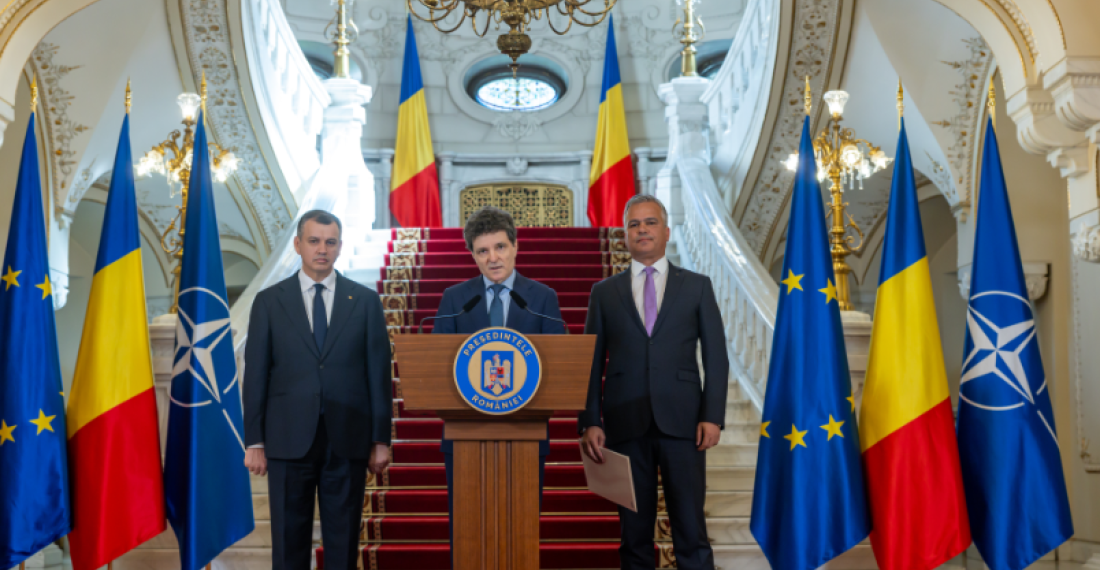
Following the fall of the Romanian government on 5 May, President Nicușor Dan has been required to consult political parties and nominate a new prime minister-designate to form a government. Yet, after more than a month of debate, Romania remains without a clear path towards a stable governing majority.
During this political turmoil, a drone entered Romania’s airspace and hit an apartment building in Galati on 29 May. Two people were taken to the hospital after suffering burns from the explosion. 70 other people were evacuated from the building. A week later, on Friday (5 June), another maritime drone exploded in the port of Constanta. This time, thankfully, there were no victims.
Both incidents were followed by a wave of misinformation claiming that Romania was on the verge of being drawn into the war in Ukraine. On top of all of this, Diana Sosoaca, Romanian Europarliamentarian and leader of the SOS (S.O.S. Romania) party, went to Putin’s economic forum in St Petersburg last week and stated that “Romanians want peace with Russia. We do not want to support Ukraine…We admire your force and the Russian people”. All these manipulated narratives further fuelled existing political polarisation and public anxiety at a time when the country was already grappling with political instability and heightened security concerns.
These events cannot be taken out of context, and to be understood, they need to be properly analysed.
Navigating Political Turmoil in Romania:
To understand why the government fell on 5 May, it is necessary to first examine the political context that led to its collapse. Following the annulment of the Romanian presidential election at the end of 2024, the re-run election in 2025 resulted in the victory of independent center-right candidate Nicușor Dan. The new president brokered the formation of a governing coalition comprising “pro-EU” parties PSD (Social Democratic Party), PNL (National Liberal Party), USR (Save Romania Union) and UDMR (Democratic Union of Hungarians in Romania), which was approved by parliament on 23 June 2025. Under the coalition agreement, PNL leader Ilie Bolojan would serve as prime minister for the first two years, with the position rotating to the PSD in 2027. The far-right wing parties AUR (Alliance for the Union of Romanians), S.O.S. Romania, and POT (Party of Young People) remained in opposition.
Bolojan’s government did not have an easy task; Romania had at the time and continues to have the highest budget deficit in the EU. In 2025, the governmental deficit was at 7.9% of GDP, and it was projected to narrow to 6.2% of GDP in 2026 after Bolojan introduced austerity plans. In principle, the deficit grew because successive governments, especially PSD-led ones, spent more and more money on public sector salaries, pensions, and social benefits. However, government revenue (mainly from taxes) did not increase enough, and/or tax collection is poor and does not cover those costs. As a result, the state started spending more than it earned, causing the budget deficit to grow.
The austerity plans were introduced to address this problem. At first, they affected the education sector and the working class. However, when Bolojan attempted to implement fiscal consolidation in the public sector, he faced resistance from PSD.
Bolojan argued that Romania was “losing billions in euros in wasted profit from state-owned companies, which artificially increase their expenses, mostly on wages.” To address this, he proposed listing key state-owned energy and transport companies on the stock exchange, aiming to impose transparency, accountability, and basic market discipline on a sector long characterised by inefficiency and political interference. However, these reforms directly threatened entrenched interests within PSD-linked networks in the state-owned sector. Therefore, PSD moved to take down Bolojan’s government to protect its influence over long-established channels of influence within Romania’s public sector architecture.
AUR, the far-right opposition party led by George Simion, has seen a rise in public support by capitalising on widespread dissatisfaction with Romania’s political establishment. As the PSD party moved against Bolojan’s government, AUR saw an opportunity, and the two parties aligned in parliament to support a motion that ultimately brought down the government on 5 May. It is important to mention that while AUR remains in opposition, it continues to be one of the most popular parties in Romania and is seen by many as an alternative to the usual political parties. George Simion has also appeared at different MAGA events in the US and cultivated relationships with prominent MAGA figures, including Steve Bannon and Jack Posobiec.
Since the fall of the government, President Nicusor Dan had to discuss with all the political parties and propose a new prime minister who could form a government. If the prime minister-designate fails to secure a parliamentary majority, the president must restart consultations with political parties to identify another candidate. If two consecutive nominees fail to obtain a vote of confidence, the Constitution allows for the dissolution of Parliament, but only under specific conditions: at least 60 days must have passed since the first nomination attempt, and consultations with parliamentary leaders must have taken place. However, dissolution is not automatic or obligatory. The president may continue nominating candidates and seeking parliamentary support for the formation of a government.
On Thursday (4 June), President Nicusor Dan proposed independent politician Eugen Tomac as prime minister. According to an analysis by Recorder, an independent Romanian media platform, Eugen Tomac was chosen because he is independent and is not necessarily opposed by the different parties. Tomac grew as a politician in ex-Romanian President Traian Băsescu’s shadow. He has good connections with the Republican Party in America, and in Brussels, he is a rather respected member of the European Parliament. However, different analysts have argued that, despite being an independent candidate, it will be difficult to form a government and convince the parties, who at the moment do not want to cooperate with one another for different political reasons.
On Sunday (14 June), the worries of the experts came true. As Eugen Tomac was unable to convince the parties to form a coalition, Nicusor Dan, without consulting the parties, nominated Adrian-Ioan Veştea, First Deputy Prime Minister of PNL. This took the Romanian people completely by surprise. The media immediately exploded. Many, particularly within the PNL, warned that the decision could fracture the party, with some members remaining loyal to the ousted prime minister, Bolojan, while others may view Veştea’s nomination as a chance to preserve their place in government. Bolojan, who remains the leader of the PNL party, argued that this move without prior consultations “is a stab in the back”. AUR’s leader argued that such a move means that “[Nicusor Dan] does not care about the political parties, does not care about the constitution or democracy. These are the same people who cancelled the elections…and took away Călin Georgescu’s rightful position as Romania’s president”.
In the meantime, the outgoing government remains in a caretaker capacity with limited powers until a new cabinet is confirmed.
When Drones Strike and Disinformation Spreads:
Amid this political uncertainty, Romania also experienced a series of security incidents. On 29 May, a drone entered Romanian airspace and struck an apartment building in Galați, injuring two people. According to a report released by the Romanian Ministry of Foreign Affairs on 31 May, the drone was identified as Russian. However, both within Romania and internationally, including during an emergency meeting of the UN Security Council requested by Romania, there was debate over whether the drone could indeed be conclusively identified as Russian. This is the wrong debate to focus on; what matters is that a drone entered the Romanian airspace and injured civilians. The focus should be on how to improve security mechanisms to ensure it does not happen again.
Focusing on the drone’s provenance risks missing the larger point. The drone entered Romanian airspace because of Russia’s illegal war against Ukraine. Without that war, there would be no chance for such incidents to affect Romania’s security. However, the debate over whether the drone was indeed Russian also benefits Russia. Various videos questioning the drone’s origin relied on conspiracy theories and rhetoric similar to that commonly used in pro-Russian narratives to cast doubt on the type of drone involved. In addition, the wave of misinformation that followed, likely encouraged by Russian networks, intensified these anxieties. Videos circulating online claimed that Romania would now join the war or that NATO and Brussels would use the incident as a pretext to launch an attack from Romanian territory. These videos and the debate over whether the drone can be conclusively identified as Russian may serve Russia’s interests by creating uncertainty, fuelling confusion, and reinforcing a sense of insecurity among the Romanian public.
Press One found that two major disinformation channels spread AI-generated content before and after the incident, reaching over 20 million views. One of these channels had reportedly been created only two days before the incident and had already accumulated 3.7 million followers, while the other spread alarmist messages just two hours before the drone crash, including a fake warning that Raed Arafat was urging Romanians to prepare. Such propaganda fuelled the anxieties of many people who had already been exposed to narratives promoted by AUR, POT, and S.O.S., which frequently warned that Romania could be drawn into a war with Russia. In this context, as Romanian NGO Funky Citizens explains, the goal of disinformation is not necessarily to convince people of one specific version of events, but to create confusion, fear, and doubt before verified information becomes available.
It did not help that only one week later, on Friday (5 June), a maritime drone entered the port of Constanța and exploded. This time, the drone was confirmed by the Ukrainian navy as belonging to Ukraine. According to Ukrainian officials, control over the maritime drone had been lost as a result of Russian attacks in the Black Sea. The Constanța incident happened when public attention was already focused on drones, after a week of intense online discussion and coordinated amplification of the topic.
Much of the misinformation and conspiracy claims gained traction in Romania, including among highly educated people. This is partly rooted in low public trust in political institutions, the ineffectiveness of governmental institutions in publishing information, and the limited critical media literacy. The governmental crisis also adds to the problem. The parties quickly used the drone to push different messages out; AUR argued that snap elections are needed; SOS argued that the drone is not Russian and that “not just Zelensky but NATO and Ursula von der Leyen are pushing Romania into a war with Russia”; PNL argued that Romania and NATO allies need to coordinate security better and blamed PSD and AUR for being anti-nationalistic; PSD called for the formation of a responsible government that can choose experts in dealing with national security. The competing narratives and the lack of a unified voice increased confusion in society.
Next steps for the government:
The government in Romania can no longer afford to continue this crisis. Political debate is a healthy sign of any democracy; however, polarising narratives, threats, and scandals are not. They contribute to confusion and decrease the trust in the capabilities of the parliament. The worst of all is that the political vacuum is amplifying public anxiety and creating opportunities for extremist narratives to dominate.
Some priorities should be:
- Form a Stable Government Quickly: Political parties should prioritise national stability over partisan interests and work constructively towards establishing a governing coalition. Nicușor Dan should make every effort to help political parties reach a coalition agreement that is fully in line with the Constitution. Ignoring constitutional procedures would risk giving extremist parties a powerful argument against the current government, enabling them to question its legitimacy and further fuel political instability.
- Management of the Budget Deficit: Particular attention should be given to reducing inefficiencies within state-owned enterprises, strengthening public procurement oversight, and eliminating wasteful spending that does not contribute to economic growth or public welfare. At the same time, Romania should focus on increasing government revenues by improving tax collection rather than significantly raising tax rates. Romania continues to face one of the largest VAT collection gaps in the European Union, resulting in substantial annual revenue losses. Expanding tax digitalisation, strengthening anti-fraud mechanisms, and improving the capacity of the National Agency for Fiscal Administration (ANAF) would allow the state to collect a larger share of taxes already owed under existing legislation. In parallel, the government should accelerate the absorption of European Union funds and investments under the Recovery and Resilience Facility to reduce pressure on the national budget and support economic growth.
- Progressive Taxation: The austerity measures set in place have put a lot of pressure on the population. Progressive taxation could help ease this burden by shifting more responsibility onto higher earners and reducing the impact on lower- and middle-income households, who are most affected by rising costs.
- Accelerate Airspace and Coastal Defence Modernisation: The recent drone incidents in Galați and Constanța highlight the need for Romania to accelerate the modernisation of its airspace and coastal defence capabilities. Romania should invest in expanding low-altitude radar coverage, deploying additional counter-drone systems in vulnerable regions along the Danube and Black Sea coast, and improving the integration of civilian and military surveillance networks. Enhanced cooperation with NATO allies should also be pursued to improve intelligence sharing, early warning capabilities, and operational coordination.
- Launch a National Media Literacy Initiative: Romania should complement its security and counter-disinformation efforts with a comprehensive national media literacy initiative. The government should work with educational institutions, civil society organisations, journalists, and technology companies to develop programmes that help citizens identify disinformation, understand how algorithms amplify content, and recognise the growing use of artificial intelligence in information manipulation. Media literacy education should be integrated into school curricula and supported by public awareness campaigns targeting adults.
- Romania should appeal to both the EU and NATO for additional support. At the European level, the government should work closely with EU institutions to secure technical assistance for fiscal reforms, improve the absorption of European funds, and strengthen programmes aimed at countering disinformation and enhancing societal resilience. Simultaneously, Romania should engage NATO allies to strengthen its defence and deterrence capabilities, particularly in the Black Sea region.
Romania's political parties face a necessary choice: either continue serving narrow political interests or begin serving the national interest. The latter is the wiser choice.
Source: This analysis was written for commonspace.eu by Alexandra Dumitrescu, International Coordinator at LINKS Europe Foundation.



