


Armenia-Azerbaijan negotiations "seem to have stalled due to the major issues that the sides continuously fail to reach an agreement on and the geopolitical dimensions of this process," writes Vasif Huseynov for commonspace.eu. "The basis for the delimitation of borders (either a specific map as Armenians propose or legal documents as Azerbaijanis want), the modalities for the reintegration of the Karabakh region with Azerbaijan, and the framework for guarantors of the peace agreement remain as the top issues be agreed upon."
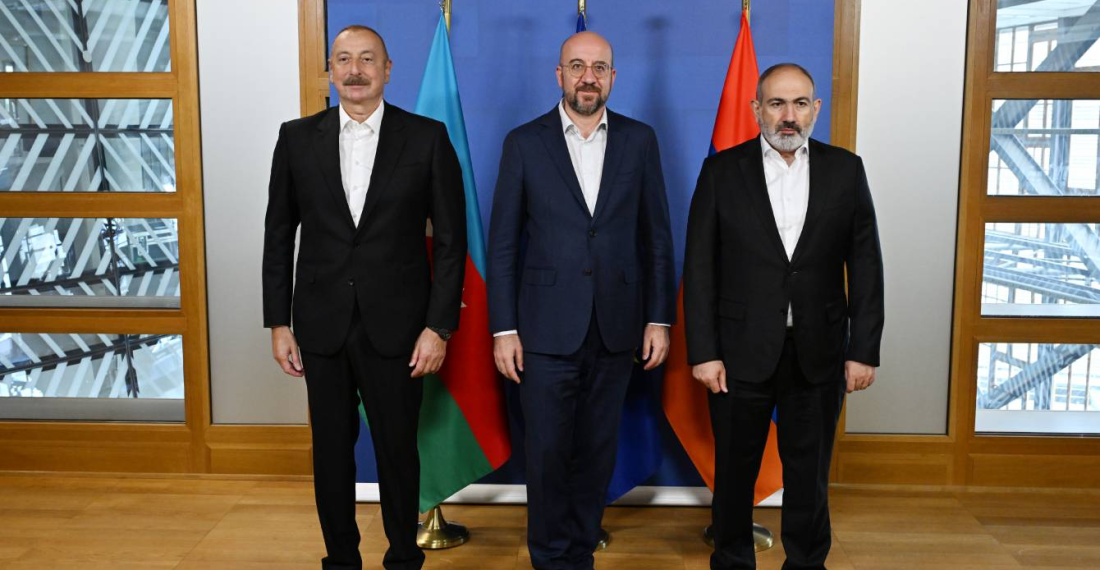
The latest Brussels summit of the Armenian and Azerbaijani leaders on 15 July was seemingly their least productive meeting mediated by the European Council President Charles Michel in the capital of the European Union (EU). The post-summit press statement released by Michel did not announce any progress or breakthrough. Two major novelties that emerged from this meeting - namely the possible EU funding for the construction of the railway connection and the suggestion to use the Agdam district along with the Lachin road for humanitarian supplies to Karabakh - are important but not fundamental for the future of the talks.
The negotiations seem to have stalled due to the major issues that the sides continuously fail to reach an agreement on and the geopolitical dimensions of this process. The basis for the delimitation of borders (either a specific map as Armenians propose or legal documents as Azerbaijanis want), the modalities for the reintegration of the Karabakh region with Azerbaijan, and the framework for guarantors of the peace agreement remain as the top issues be agreed upon. Neither the summit of the leaders in Brussels nor the preceding meeting of the delimitation commission reported any advance in the talks on these matters. Meanwhile, the Russia-supported separatist regime in Karabakh refuses to accept Azerbaijani sovereignty over the region. On the one hand, this creates a rather negative background for the peace talks mediated by the EU and the United States, and on the other hand serves as an effective tool in the hands of Russia to pursue its regional interests.
Russia and Iran - two big neighbors of the South Caucasus - are highly displeased with Western-mediated peace talks
In parallel to these complexities, the geopolitical context of the negotiations is becoming increasingly more confrontational with an inevitable impact on the attitudes of the negotiating sides to the overall process. Two big neighbors of the South Caucasus - Russia in the North and Iran in the South - do not mince their words when they express their displeasure with the Western-mediated peace talks and the recent actions of Armenia and Azerbaijan in this context. The 12 July article of Ali Akbar Velayati, a senior adviser to the Iranian Supreme Leader, warned against instability and conflicts in the South Caucasus if the West attempts to redress the balance in the region. Velayati protested against “NATO plots” in Iran’s northern neighborhood, the Zangazur corridor project, the deployment of foreign forces in the region (with an apparent reference to the European Union’s monitoring mission in Armenia), and the overall pro-Western course of developments in the South Caucasus.
In a similar tone, the strongly worded statement shared by Russia’s Foreign Ministry on 15 July while the leaders of Armenia and Azerbaijan were in Brussels clearly demonstrated Moscow’s frustration, resentment and expectations. Moscow believes that the West seeks to push for a peace treaty between Baku and Yerevan with the goal of minimizing Russian influence in the region by kicking out its peacekeeping mission and eventually the Russian military base in Armenia as well. Clearly, the Kremlin wants to restore its leading mediating role between Baku and Yerevan and get the two sides to sign a peace treaty in line with Russian interests; or, if it is not possible, to indefinitely freeze the conflict. The presence of Russia’s troops in Karabakh and its influence over the separatist regime provides Moscow with strong leverage to assert its influence.
Local and geopolitical challenges are both complex and will likely not be resolved anytime soon
Thus, it is clear that the ongoing peace process between Baku and Yerevan is threatened by both local and geopolitical challenges. They are both complex and will likely not be resolved anytime soon. Against this backdrop, the Brussels summit of 15 July demonstrated a threat of deadlock looming over the peace negotiations. Armenian Prime Minister Nikol Pashinyan was quite right in his recent assessment, arguing that the two countries might end up with another war if the negotiations do not deliver a peace treaty. He is thus well aware of the threats posed by the current situation between Baku and Yerevan.
However, the policies of his government do not help the resolution of these disputes, but, on the contrary, are marred by serious paradoxes with damaging implications for the peace talks. The Armenian leadership holds two mutually exclusive approaches vis-à-vis Azerbaijan’s territorial integrity. On the one hand, they declare their recognition of the Karabakh region as part of Azerbaijan. This might seem like a great breakthrough and be interpreted by many observers as the settlement of the crux of the conflict. But, on the other hand, they problematize Azerbaijan’s sovereignty over Karabakh by demanding an international mechanism for the provision of security and rights of the Armenian population living there. Denying Azerbaijan’s right to install a checkpoint on its border is another inconsistency in their position.
Meanwhile, the related provisions of international law are clear and have been expressed again in the latest rulings of two international courts. As recently as 6 July, the International Court of Justice (ICJ) unanimously rejected Armenia’s request to order an additional provisional measure requiring Azerbaijan to “withdraw any and all personnel deployed on or along the Lachin Corridor since 23 April 2023”. A similar decision was made by the European Court of Human Rights (ECHR) that rejected Armenia’s request to introduce a temporary interim measure against Azerbaijan in connection with the installation of the Lachin checkpoint.
Thus, rejecting these realities on the ground, the Armenian government complicates the already strained situation in the region. The prolongation of these disputes and the failure of the sides to reach an agreement give useful instruments for the big, threatening neighbors to pursue “divide and rule” tactics as in the past and undermine efforts for the establishment of a peaceful and prosperous South Caucasus



