


The road across the South Caucasus could become not only a transport route but also a system of mutual commitments that makes another war prohibitively costly for all involved
In Nakhchivan, separated from the rest of Azerbaijan by Armenian territory, the old railway served for decades as a reminder of the disintegration of a once-unified South Caucasus. The rails remained, but regional links were severed by war, blockade and mutual distrust.
Now it is here that one of the most consequential infrastructure experiments in the post-Soviet space may begin.
During a visit to Nakhchivan on August 11, President Ilham Aliyev said an international consortium could be created to reconstruct the Nakhchivan railway. The controlling stake, he stressed, should belong to the Azerbaijani state, but foreign companies and organisations could be among the investors. According to the president, the European Union and several countries have already shown interest in the project.
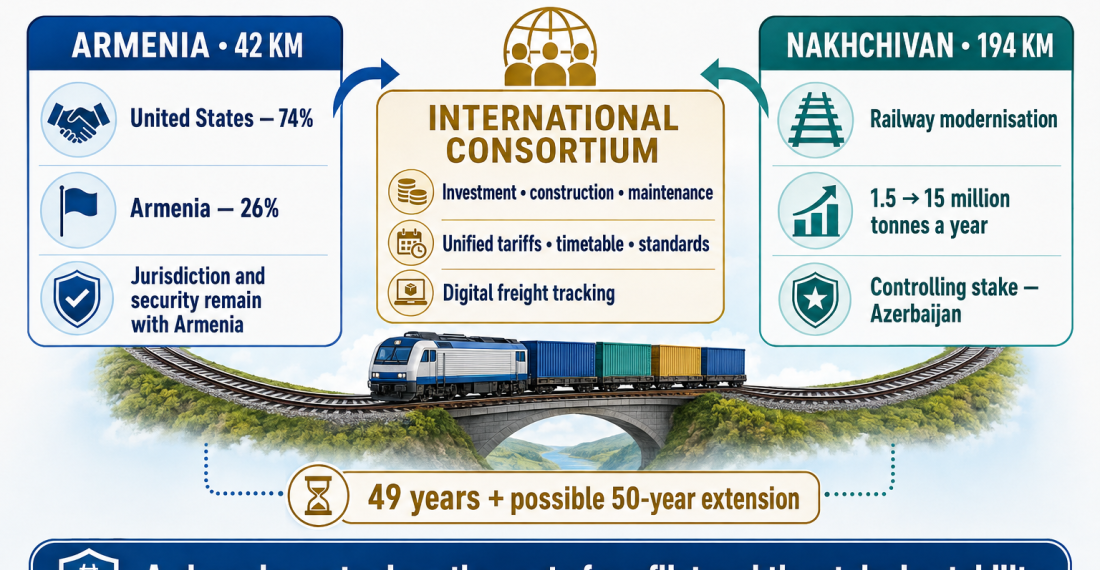
The plan concerns 194 kilometres of railway in Nakhchivan. It is expected to be modernised so that annual freight capacity can rise from the current 1.5 million tonnes to 15 million tonnes. The Armenian section of the future route is considerably shorter, at 42 kilometres. Aliyev said its construction should begin in 2026. In the interview, President Aliyev shows that the consortium proposal relates primarily to the Nakhchivan railway, not to placing the Azerbaijani part of TRIPP under foreign control.
That distinction matters. In official documents, TRIPP — the “Trump Route for International Peace and Prosperity” — refers to communications passing through Armenian territory. Aliyev’s proposal, however, effectively broadens the idea of international participation itself: different but interconnected models of infrastructure governance are taking shape on either side of the border.
In Armenia, the leading role is assigned to an Armenian–American company. In Azerbaijan, a consortium may emerge in which the state retains control. Together, these arrangements could transform the road from the subject of a territorial dispute into an international economic asset.
A dispute over one word
After the 2020 Karabakh war, the phrase “Zangezur corridor” became one of the most contentious formulations in regional politics.
For Azerbaijan, it meant an unhindered link to Nakhchivan and onward to Turkey. In Armenia, the word “corridor” was perceived as a threat to sovereignty — almost a demand for an extraterritorial strip on Armenian land beyond Yerevan’s control.
Armenia’s political and expert community insisted that all freight, vehicles and passengers must pass through Armenian border and customs controls. Baku, for its part, demanded guaranteed and unobstructed movement.
For several years, the dispute seemed insoluble because the parties discussed the road less as infrastructure than as a symbol of victory, defeat and state sovereignty.
A compromise was found in Washington.
In a joint declaration signed on 8 August 2026, Azerbaijan and Armenia agreed to open communications on the basis of respect for the sovereignty, territorial integrity and jurisdiction of states. At the same time, the document established the need for unobstructed connectivity between mainland Azerbaijan and Nakhchivan, with reciprocal benefits for Armenia itself.
President Donald Trump witnessed the declaration, and the route was named after him. But the American role proved to be more than symbolic.
Under the TRIPP framework, the United States is to receive 74 per cent of the development company and Armenia 26 per cent. The initial term of infrastructure development rights is set at 49 years. If it is extended for another 50 years, Armenia’s share is to rise to 49 per cent.
Private operators will be able to collect documents and payments and serve users in the so-called front office. Final decisions on customs, security, migration and law enforcement, however, will remain with Armenian state bodies. In other words, international management is separated from state sovereignty but does not replace it.
Prime Minister Nikol Pashinyan has described TRIPP as a United States-led investment programme. He presented long-term American involvement not as a loss of sovereignty but as a guarantee that Armenia would remain an independent and resilient state for decades to come. In his words, the presence of the world’s leading power creates a security horizon for the country lasting up to 99 years.
Thus, an idea that until recently was regarded in Armenia as a threat is gradually turning into a mechanism for insuring the state’s future.
The lesson of the “Contract of the Century”
At expert hearings held in Georgia in 2021 under the auspices of LINKS Europe, with representatives of Azerbaijan, Armenia and Georgia taking part, I argued that Yerevan’s rejection of international status for the road had been a mistake.
My argument drew on the experience of Azerbaijan’s oil and gas projects.
During the Karabakh war, public concern arose that the oil and gas pipelines linking Azerbaijan with Turkey and Europe might become military targets. In October 2020, Baku accused the Armenian side of attempting to attack energy infrastructure; Yerevan denied it. Yet the risks to the pipelines carrying Azerbaijani oil and gas to international markets were taken seriously. Reuters noted at the time that an expansion of the fighting could disrupt regional energy supplies.
At the hearings, I told my Armenian colleagues: you threatened these communications but did not strike them because you understood that the pipelines were backed not only by Azerbaijan but also by transnational companies, foreign governments and consumers in several countries.
The “Contract of the Century”, which Azerbaijan signed with an international oil consortium in 1994, did not create formal military protection for the fields and pipelines. It did something else: it made their security a shared interest of many states at once.
This is not an absolute shield. International ownership cannot by itself stop a war. But it sharply raises the political, diplomatic and economic cost of an attack. A strike on an asset belonging to one country remains a bilateral conflict. A strike on infrastructure involving the companies and capital of several powers immediately widens the circle of affected parties and potential responses.
That is why I proposed applying the oil model to the Zangezur route. Armenia, I argued, should be no less interested than Azerbaijan in an international consortium. The presence of American, European, regional and other investors could turn the disputed section of road into an asset whose security matters far beyond the South Caucasus.
Several years later, that idea ceased to be theoretical.
Two models for one route
The emerging system is not a single international consortium in the strict legal sense.
On Armenian territory, TRIPP will operate with a controlling United States stake while Armenian jurisdiction is fully preserved. In Nakhchivan, Aliyev proposes a different formula: international investors may take part in modernising the railway, but the controlling stake will remain with Azerbaijan.
On the surface, the models differ. In substance, they address the same problem: reconciling national sovereignty with international interest.
For Armenia, the American presence offers a guarantee that the route will not become an extraterritorial corridor imposed by a more powerful neighbour. For Azerbaijan, it increases the likelihood of unhindered connectivity with Nakhchivan. For the United States, the route means a long-term presence at the crossroads of the Caspian Sea, Turkey, Iran and Russia.
Turkey gains a shorter link to Azerbaijan and Central Asia. The European Union gains another element of the Middle Corridor, which allows freight to move between Asia and Europe while bypassing Russia. Armenia gains a chance to escape regional isolation and connect to new railway, road, energy and digital networks.
Economic success, however, is not guaranteed simply by opening a 42-kilometre section.
Claims that freight delivery between Asia and Europe could be cut to about 14 days refer to the Middle Corridor as a whole, not to TRIPP alone. Achieving such times requires harmonised tariffs, rapid customs procedures, sufficient shipping capacity on the Caspian Sea, upgraded ports and railways, and predictable timetables.
A road can be built quickly. The trust needed for it to operate efficiently takes much longer to construct.
From two sections to a single international project
For now, the Nakhchivan and Zangezur sections exist under different political and legal arrangements. The Armenian part of TRIPP is to be handled by an Armenian–American company, while in Nakhchivan Aliyev has raised the possibility of an international consortium in which Azerbaijan retains the controlling stake.
The logic of the project’s development, however, suggests that this separation is likely to be temporary.
The 42 kilometres in Armenia and the 194-kilometre Nakhchivan railway are not two independent routes. Each acquires economic meaning only as part of a single transport chain connecting mainland Azerbaijan with Nakhchivan and Turkey and, on a broader scale, Central Asia and the Caspian region with European markets.
For an international shipper, the administrative boundary between the two sections matters less than unified tariffs, a coordinated timetable, compatible technical standards, digital freight tracking and a clear accountability mechanism. If different parts of the route are managed separately, delays, contradictions and extra costs may arise at every border. Economic logic will therefore push the parties towards a single management system.
I believe that, in time, the Nakhchivan and Zangezur sections could be folded into one international project managed by a common consortium or a coordinating company that brings together national operators. In such a structure, Azerbaijan and Armenia should not be objects of external administration but co-operators, co-owners or, no less importantly, key players.
The participation of both countries in strategic decision-making is precisely what could make the project viable. Azerbaijan should receive a guaranteed link to Nakhchivan, while Armenia should retain sovereignty, jurisdiction and control over security on its territory. An international consortium could be responsible for attracting investment, building and maintaining infrastructure, coordinating tariffs, logistics, technical standards and the digital management of freight.
The most realistic model would not transfer the entire railway to a single foreign company but create a supranational management structure with national subsidiary operators. The Armenian and Azerbaijani sections would retain their own legal status, while the common consortium would coordinate the route as a single transport system.
It could include companies and financial institutions from the United States, the European Union, Turkey, Russia, Iran, Central Asian countries and other states interested in developing the Middle Corridor. Their participation would provide not only capital but also a political stake in the railway’s stable operation.
Such a model would resemble the architecture of Azerbaijan’s international oil and gas projects: the fields and infrastructure remain under national jurisdiction, while international participation broadens the circle of states interested in their security and uninterrupted operation.
A single consortium could also become a mechanism for practical equality between the parties. Azerbaijan and Armenia would be able to jointly resolve issues that had previously become sources of conflict: operating rules, tariffs, technical standards, infrastructure security and emergency response.
The railway would therefore cease to be perceived as one side’s victory and the other’s concession. It would become a shared asset whose disruption would harm both countries and every international participant.
This is where TRIPP’s greatest potential lies. The project could evolve from two national sections with different management models into a single international transport organism. If Azerbaijan and Armenia take their places as co-operators and key players, the corridor could become not only a road between East and West but also the first major joint system created by the two states after decades of conflict.
source: Mehman Aliyev is Head of Turan Analytical Service, and a member of the LINKS Europe Strategic Platform on Armenia-Azerbaijan relations



