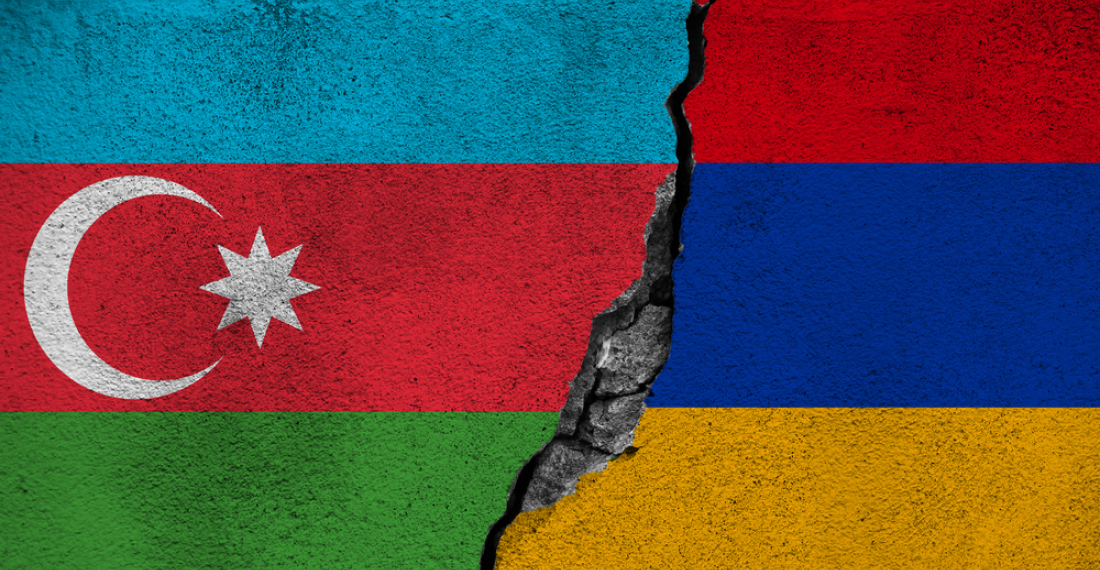
The conflict between Armenia and Azerbaijan, two republics in the South Caucasus, has never been solely about their bilateral relations. Regional and distant powers have long sought to influence the conflict, pursuing their own strategic interests. This dynamic persisted even after the Second Karabakh War (27 September – 10 November 2020), which ended the core dispute between Armenia and Azerbaijan by bringing an end to the occupation of Azerbaijan’s Karabakh region. As the fourth anniversary of the war’s onset – also known as the 44-Day War – approaches, Baku and Yerevan continue to struggle with the peace process. Meanwhile, the most significant post-war initiative, the reopening of regional transportation and communication links, is facing increasing complications. Today, the often destructive involvement of external powers has become a major obstacle to the normalisation of Armenia-Azerbaijan relations and the implementation of regional transport projects.
One of the key factors prolonging the peace treaty negotiations is the presence of powerful revanchist factions in Armenia, who aspire to reclaim lost territories with the military backing of countries such as France, India, and Iran. This revanchist sentiment, fueled by political opposition, religious groups, and experts, is further emboldened by growing arms supplies from these external actors. These factions in Armenia openly express their intentions, focusing on the possibility of a more favourable geopolitical environment to reignite war against Azerbaijan in the future. They often reference the First Karabakh War (1992-1994), during which Russia's military and political support enabled Armenia to wage war against Azerbaijan, despite the latter’s population being three times larger. With relations between Yerevan and Moscow deteriorating, Armenia now primarily relies on France and India for military support. Both powers have their own issues with Armenia’s conventional ally Russia or Azerbaijan’s allies Türkiye and Pakistan seeking to instrumentalise Armenia for their own agenda. The victim of these geopolitical games has been the Armenia-Azerbaijan peace talks.
The detrimental impact of external intervention is particularly evident in the efforts to reopen regional transportation links. At the heart of this issue is the Zangezur corridor, a proposed transport route following the Second Karabakh War, intended to connect Azerbaijan with its Nakhchivan exclave via Armenia’s southern territory. According to the trilateral agreement signed by Russia, Armenia, and Azerbaijan in November 2020, “control over transport” through this corridor “shall be exercised by the bodies of the Border Guard Service of the Federal Security Service (FSB) of Russia.”
This project could arguably not be more contentious in terms of great power competition. Numerous global powers have vested interests in the corridor and make no effort to conceal them. Russia, in particular, views the corridor as a means to mitigate the challenges posed by the disruption of its own transportation links due to the Western sanctions and to bolster its presence in the South Caucasus by deploying additional forces. Quite the contrary, the officials of the United States have publicly stated that they see this corridor as a means to reduce the dependency on Central Asian states on Russia and China to reach global markets – hence no Russian presence over the corridor is desired in Washington.
This picture has recently become more complex due to intensification of tensions between Moscow and Tehran over the corridor. Various official representatives and media outlets of Iran have been expressing strong displeasure with the latest statement of Russia’s Foreign Minister Sergei Lavrov who accused Armenia of sabotaging the Russia-Armenia-Azerbaijan trilateral agreements by refusing to open the Zangezur corridor. Iran perceives the project as a geopolitical maneuver aimed at severing its border with Armenia which would allegedly cut Iran’s ties with Europe via Armenia and Georgia. Tehran fears also by losing its transit leverage between Türkiye and Central Asia if the shorter route emerges via Armenia.
On 3 September, Russia’s ambassador to Tehran was summoned to Iran’s Ministry of Foreign Affairs, where officials reiterated Tehran’s opposition to any changes in internationally recognized borders or shifts in the region's geopolitical landscape. In a subsequent statement, on 6 September, Iran’s ambassador to Armenia declared that “All dreams and illusions regarding the Zangezur corridor will never materialize,” stressing that control over the corridor must remain under Armenian sovereignty. Ebrahim Azizi, head of Iran's Parliament's National Security and Foreign Policy Committee, issued a stern warning to Russia and Azerbaijan, stating that “Those pursuing such illusions will face heavy and costly consequences”. Iranian experts do not rule out the possibility of a military response by Tehran if the Zangezur corridor opens.
Tehran remains unconvinced by Moscow and Baku’s assurances that the corridor will not pose a threat to Iran. Even Iran’s deepening ties with Russia, strengthened amidst the Ukraine war and Western sanctions, have failed to ease these concerns. Additionally, the proposed alternative route, the Aras corridor, set to run through Iranian territory parallel to the Zangezur corridor, has not alleviated Tehran’s fears. Iranian experts argue that the Aras corridor’s strategic advantages could diminish if Armenia and Azerbaijan reach a peace agreement and Armenia normalises diplomatic relations with Türkiye. As a result, Tehran remains firmly opposed to the establishment of a corridor through Armenian territory, significantly complicating the project’s future.
This situation threatens the entire peace process, as Baku remains committed to its plans to open the Zangezur corridor, which would connect Azerbaijan to Nakhchivan and Türkiye. Earlier this year, President Ilham Aliyev of Azerbaijan stated unequivocally that Azerbaijan would not open its borders with Armenia elsewhere if Armenia refuses to open the Zangezur corridor. Baku expects Yerevan to fulfil its obligations under the trilateral statement to advance other aspects of interstate normalisation. Although Armenia does not fundamentally oppose the corridor, Yerevan rejects the deployment of Russian border guards to the passage. Instead, it has proposed deploying international private security companies on both Armenian and Azerbaijani territories to ensure security – a clear contradiction with the provisions outlined in the trilateral statement.
Thus, the peace negotiations between Armenia and Azerbaijan remain as complex as ever. The involvement of external powers continues to destabilise the already fragile process, with the Zangezur corridor, originally envisioned to enhance regional connectivity, now serving as a focal point for geopolitical rivalries. Competing interests from Russia, Iran, the United States, and others have transformed what could have been a step toward normalisation into a stage for power struggles, leaving little room for meaningful bilateral dialogue. Only by overcoming these external pressures and focusing on mutual reconciliation can Armenia and Azerbaijan hope to achieve a sustainable and lasting peace.