Nearly half a million Russians have died in fighting in Ukraine, as Vladimir Putin continues to push his country to the brink. His aim of completely controlling the Donbass region, which he annexed after invading Ukraine in 2022, seems more distant than ever. . However, Putin can still bomb civilian targets in Kyiv. The Ukrainian Air Force says a "serious shortage" of interceptor missiles meant none of the 23 ballistic missiles fired by Russia at Kyiv on Sunday night were shot down. At least 15 people were killed in the second large-scale Russian attack on the Ukrainian capital in a week, officials said. Seven more were killed in the wider Kyiv region. Ukrainian President Volodymyr Zelensky has appealed for allies to take "strong decisions" at this week's Nato summit to provide Kyiv with air defences. After the strikes, he said the Ukrainian military had been successful in intercepting cruise missiles and drones – but not ballistic missiles. Sunday's "massive Russian attack" consisted of 68 missiles and 351 strike drones, he said in a post on X. The air force shot down or suppressed 37 missiles and 326 drones, it said. Zelensky warned that Moscow would continue to hit residential buildings as long as defensive Patriot missiles "remain in our allies' stockpiles".
After a bleak winter which saw months of fierce Russian bombing of Ukrainian energy infrastructure, the future is beginning to look more positive for Kyiv
Russia’s frontline advances have slowed almost to a halt, as Ukrainian counter-attacks and defensive tactics become more effective.
Successes in local counterattacks have become more frequent, as Ukrainian forces scale up their use of ground robots and sshort-range drone warfare
Also, Kyiv has succeeded in bringing home the war to Russia, inflicting costly damage to its fuel infrastructure which has caused major shortages. This has fomented public discontent in Russia, increasing the pressure on Putin to end the conflict.
Moscow;'s gains on Ukrainian territory have dropped significantly since last year, to just a fraction of the territory they seized in May 2025, according to data from the Institute for the Study of War (ISW).
Between December 2025 and May 2025, Russians gained control of or infiltrated 40.64 square km - compared to 515.84 square km in the same period from last year.
“Russian forces thus seized or infiltrated into only 7.87 percent as much territory in 2026 as they advanced into in 2025,” the ISW said in its analysis.
For the first time in years, Moscow’s footprint in Ukraine stopped growing in spring 2026.
A combination of Ukraine’s expanded medium-range drone strike campaign, improved defensive tactics including frequent local counterattacks, and a drone dominated battlefield, have all contributed to slowing Russian advances.
The Centre for Strategic and International Studies (CSIS) says that Russia has advanced at historically slow rates, a product of the defensive advantage that has shaped the war since 2023.
The dense minefields, multi-layered fortifications, heavy shelling and drone-saturated areas have created a danger zone more than 20 kilometres wide, slowing both Russian and Ukrainian advances.
In the most prominent Russian and Ukrainian offensives in the first half of 2026, troops advanced at an average of between 50 and 90 metres per day.
This is a world away from the opening phase of the war in 2022, where Russian forces gained from roughly 3,000 to more than 7,000 meters per day.
“Russian forces currently control about 118,000 square kilometers of Ukraine, including Crimea and the parts of Donbas held before 2022,” CSIS says. “Within that area, roughly 75,000 square km (about 12 percent of Ukraine) has been taken since the February 2022 invasion.”
The Centre for Strategic and International Studies (CSIS) paints a bleak picture of Russian casualties.
Between February 2022 and June 2026, there have been as many as 450,000 Russian battlefield deaths and 1.4 million casualties, it says.
The UK’s biggest spy agency, GCHQ, has produced a similar figure. In May, GCHQ director Anne Keast-Butler said in her inaugural public speech that nearly 500,000 Russian soldiers had been killed.
The massive death toll is a product of several factors, including an attritional warfare strategy in which Moscow sends thousands of troops towards fortified Ukrainian defences, attempting to grind Kyiv’s forces down with sheer manpower.
Estimates by Russian military bloggers suggested that Russian troops in some areas of the Ukrainian frontline can expect to live for just 20 to 35 minutes due to rising drone attacks, as cited by Oxford historian Peter Frankopan in a report for Foreign Policy.
Meanwhile, Ukrainian president Volodymyr Zelensky said in February that Ukraine had lost 55,000 soldiers since 2022
But CSIS puts the figure higher than this, stating that between there have been 125,000 and 150,000 Ukrainian deaths out of between 525,000 and 625,000 total casualties.
Combined casualties in the war have now exceeded two million, CSIS said in its report.
source: commonspace.eu with The Independent (London) and agencies
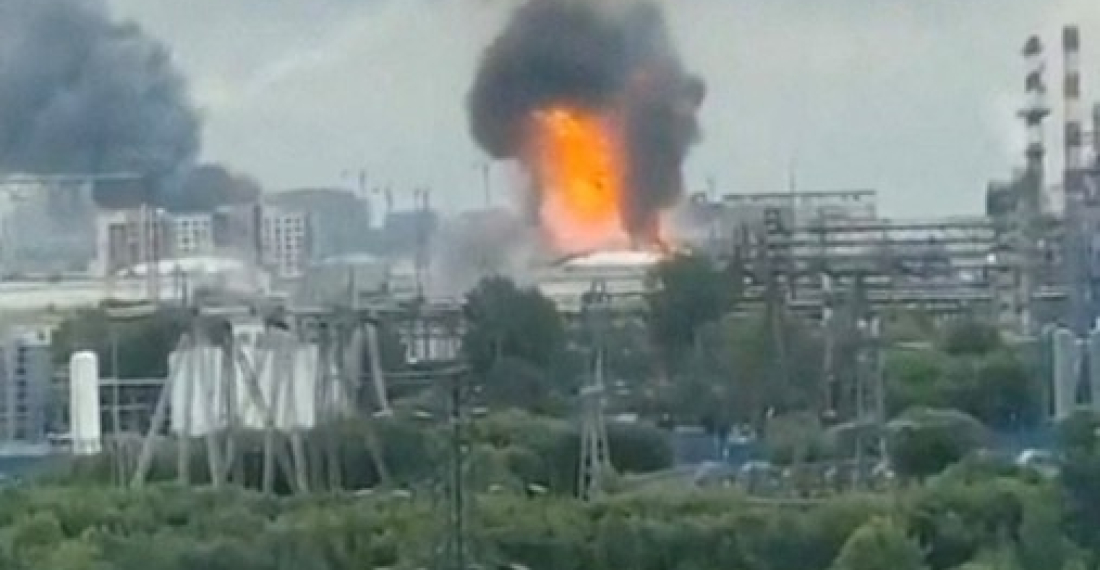
photo: The ceiling of a Moscow oil refinery was blown clean off by Ukrainian drone attack (picture from social media)