


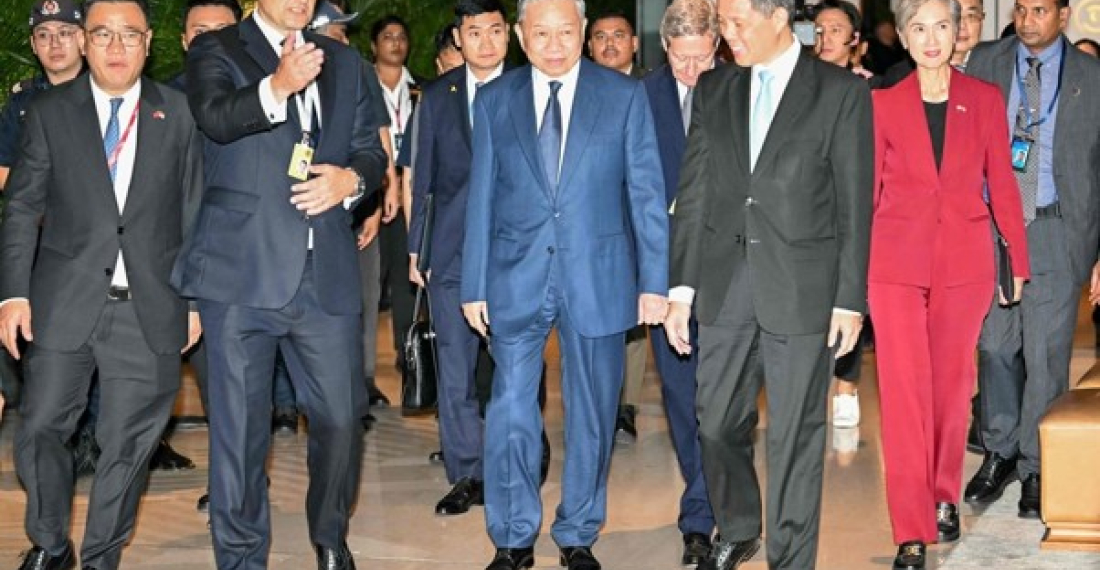
At the Shangri-La Dialogue Forum in Singapore, Vietnam’s To Lam warns of 3 crises converging in Asia-Pacific security

Vietnam’s President and Communist Party leader, To Lam, on Friday  (29 May) struck a sombre tone at a summit when he warned of three foundational crises converging to cause global instabilities – those of international order, development models and strategic trust.

He was delivering the keynote address at the Shangri-La  dialogue forum in Singapore, Asia’s premier defence forum, in his first speech on Vietnam’s foreign policy to an international audience since being elected president in April. The forum is organised by Lindon, International Institute for Strategic Studies (IISS), and will run from 29-31 May 2026.

Speaking to defence ministers, military chiefs, diplomats and analysts at the 23rd edition of the dialogue, Lam said the three crises – a changing world order where might was right, the erosion of globalisation and the loss of trust among countries – reinforced each other and converged most clearly in the Asia-Pacific region.

“This is the world’s most dynamic centre of growth, but also a theatre of intense strategic competition, a region defined by vital maritime routes, yet fraught with risk at sea; a region that benefited profoundly from globalisation, yet now faces mounting pressure from supply chain fragmentation, climate change, technological transition and emerging geoeconomic competition,” said Lam, the president and general secretary of Vietnam’s Communist Party.

On the crisis of strategic trust, Lam called this “a silent yet dangerous crisis” that caused states to interpret actions through mistrust and anxiety, a situation made more complex by rapid developments in emerging technologies.

“Big data, artificial intelligence, cyberspace, quantum technologies, autonomous systems, and digital infrastructure are expanding development capabilities, yet they also have the potential to amplify suspicion, enable information manipulation, compress decision-making timelines, and increase the risk of miscalculation,” Lam said.

He noted that strategic stability would become more fragile when technological advances outpaced the evolution of rules and human oversight.

To overcome this crisis, Lam called for a strategic framework for trust building that would include rapid communication channels in times of incident, dialogue to reduce misperception, clear codes of conduct to prevent collision and robust technological norms to ensure humans remained ultimately responsible for decisions carrying grave security consequences.

“Strategic trust does not require elimination of differences or denying competition, its essence lies in managing differences within a rules-based framework, ensuring that competition remains bounded, responsible and predictable. A durable regional order cannot be built upon perpetual fear and mutual distrust,” Lam said.

Precisely because it is where these challenges converge, the Asia-Pacific must also become where solutions emerge.

Asked if he agreed that AI also created new opportunities and gave countries the chance to deliver needed combat power for deterrence at a new speed, Lam said Vietnam believed the need for human decision remained important, especially in defence and security.

He called for transparency, information sharing, and building trust and consensus based on principles and technical standards when using these advanced technologies in military activities.

Lam was also asked by a senior colonel from China if he viewed Beijing and Hanoi’s “3+3” strategic dialogue on diplomacy, defence and public security as a new way of promoting regional security cooperation.

The concept refers to adding the public security element to the typical “2+2” bilateral mechanism involving foreign and defence ministers.

Lam said there were many mechanisms to bolster cooperation, and noted the implementation of this mechanism reflected Vietnam’s position of self-reliance and resilience.

“In its relations with China, Vietnam views the ‘3+3’ strategic dialogue as an important mechanism among core agencies in maintaining regional peace and security,” he said.

“These agencies all bring forth very practical values in bolstering Vietnam’s relations with China and ensuring and contributing to peace, stability and cooperation in the region.”

source: commonspace.eu with South China Morning Post  (Hong Kong) and agencies

 photo: The leader of Vietnam, To Lam, arrivinf to speak at the Shangri La Forum in Singapore

 

Related articles

Editor's choice
News
The leaders of the states of the Eurasian Economic Union issued a tough statement warning fellow-member state Armenia of the consequences of its desire to join the European Union.

The leaders of the states of the Eurasian Economic Union issued a tough statement warning fellow-member state Armenia of the consequences of its desire to join the European Union.

The leaders of the states of the Eurasian Economic Union (EEAS) issued a tough statement warning fellow-member state Armenia of the consequences of its desire to join the European Union. The stark, sharply worded,  warning, comes days before crucial parliamentary elections in Armenia, scheduled for 7 June. The full statement said, “We, the Presidents of the Republic of Belarus, the Republic of Kazakhstan, the Kyrgyz Republic and the Russian Federation, Taking into account the actions of the Republic of Armenia aimed at joining the European Union, including the approval in 2025 by the National Assembly of the Republic of Armenia and the signing by the President of the Republic of Armenia of the Law of the Republic of Armenia "On the Start of the Process of Accession of the Republic of Armenia to the European Union", as well as the confirmation by the European Union of the European aspirations of the Government of the Republic of Armenia, expressed in the joint declaration following the first Armenia-European Union summit, adopted on 5 May 2026, Taking into account the significant risks to the economic security of the member states of the Eurasian Economic Union (hereinafter referred to as the Union) arising in connection with the preparation of the Republic of Armenia for accession to the European Union, as well as the need to prevent the associated damage to the member states of the Union: decided that the members of the Eurasian Intergovernmental Council from the Republic of Belarus, the Republic of Kazakhstan, the Kyrgyz Republic and the Russian Federation will report at the next meeting of the Supreme Eurasian Economic Council in December 2026 on the possible consequences of the suspension of the Treaty on the Eurasian Economic Union with respect to the Republic of Armenia. We share the position on the need to hold a national referendum in the Republic of Armenia as soon as possible on joining the European Union or continuing to be part of the Eurasian Economic Union. Astana, May 29, 2026” A meeting of the Supreme Eurasian Economic Council was held in Astana, Kazakhstan, on May 29, 2026. The meeting of the Supreme Eurasian Economic Council in a restricted format was attended by Russian President Vladimir Putin, Belarusian President Alexander Lukashenko , Kazakh President Kassym-Jomart Tokayev , Kyrgyz President Sadyr Japarov , Armenian Deputy Prime Minister Mher Grigoryan, and Chairman of the Board of the Eurasian Economic Commission Bakytzhan Sagintayev. From the Russian side, the meeting was also attended by Deputy Prime Minister and member of the Council of the Eurasian Economic Commission Alexey Overchuk and Presidential Aide Yury Ushakov . The heads of delegations from EAEU observer states, including President of Uzbekistan Shavkat Mirziyoyev , Vice President of Cuba Salvador Valdés Mesa, Minister of Industry, Mines, and Trade of Iran Mohammad Atabak, and CIS Secretary General Sergei Lebedev, joined the expanded meeting . Following the meeting of the Supreme Eurasian Economic Council, a number of documents were signed .

Popular

Editor's choice
Interview
Thursday Interview: Murad Muradov

Thursday Interview: Murad Muradov

Today, commonspace.eu starts a new regular weekly series. THURSDAY INTERVIEW, conducted by Lauri Nikulainen, will host  persons who are thinkers, opinion shapers, and implementors in their countries and spheres. We start the series with an interview with Murad Muradov, a leading person in Azerbaijan's think tank community. He is also the first co-chair of the Action Committee for a new Armenian-Azerbaijani Dialogue. Last September he made history by being the first Azerbaijani civil society activist to visit Armenia after the 44 day war, and the start of the peace process. Speaking about this visit Murad Muradov said: "My experience was largely positive. My negative expectations luckily didn’t play out. The discussions were respectful, the panel format bringing together experts from Armenia, Azerbaijan, and Turkey was particularly valuable during the NATO Rose-Roth Seminar in Yerevan, and media coverage, while varied in tone, remained largely constructive. Some media outlets though attempted to represent me as more of a government mouthpiece than an independent expert, which was totally misleading.  Overall, I see these initiatives as important steps in rebuilding trust and normalising professional engagement. The fact that soon a larger Azerbaijani civil society visits to Armenia followed, reinforces the sense that this process is moving in the right direction." (click the image to read the interview in full)


